Effect of varying excitation of synchronous motor with constant load
In a synchronous motor, the change in field excitation affects neither the speed nor its output. But it affects the power factor and armature current for constant supply voltage and constant input power.
For proper operation of any electromagnetic device, the required magnetic flux must be produced. The synchronous motor is also an electromagnetic device that converts electrical energy into mechanical energy with the aid of a rotating magnetic field.
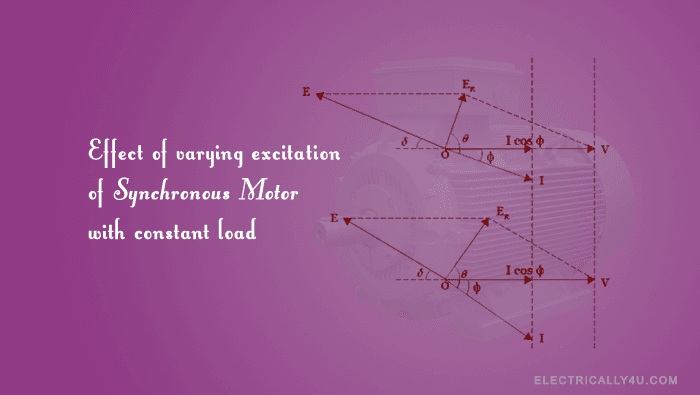
Consider a synchronous motor is operated at a constant supply voltage and loaded with a constant mechanical load. Also, normal excitation is given i.e., the induced emf is equal to the supply voltage. At this condition, the current drawn by the armature lags behind the applied voltage V by an angle ϕ, which is the power factor angle.
The armature current lags behind the resultant voltage ER by an angle θ, where θ is the internal angle. It is given by
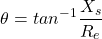
where Xs is the synchronous reactance per phase and Re is the effective armature resistance per phase. δ is the load angle or torque angle.
The power drawn per phase from 3-phase c supply is VI cos ϕ. Since the applied voltage and input power or load is constant, so the active component of the current drawn from the supply, I cos ϕ remains constant for a constant load.
As the speed of the motor remains constant, an increase in excitation causes an increase in excitation voltage E. Similarly, a decrease in excitation causes a reduction in excitation voltage E.
Now let us look at what happens when the excitation voltage is increased or decreased in a synchronous motor.
Under excitation
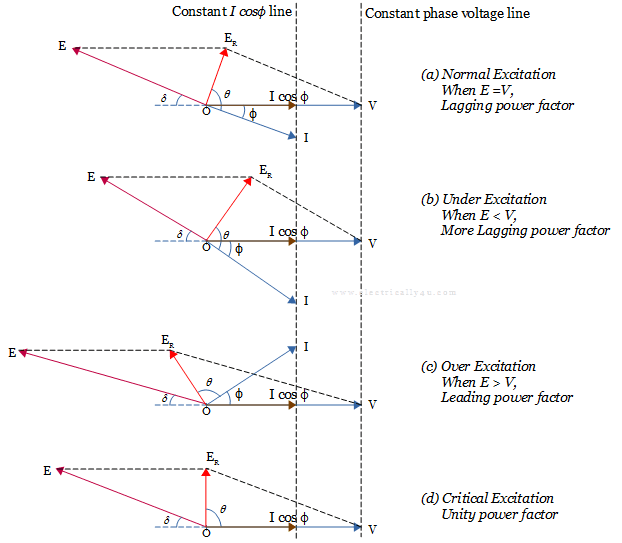
When the field excitation is reduced, the excitation voltage E decreases(E<V), as shown in the below figure(b). The decrease in excitation shifts the resulting voltage ER in a clockwise direction.
Since the phase angle between the resultant voltage and the armature current is equal to θ is fixed, the armature current phasor is shifted in the clockwise direction.
This shiting causes the power factor angle to increase, which means the power factor decreases. To maintain a constant I cos ϕ, the armature current increases.
Hence when the synchronous motor is operated in reduced excitation, it draws more current from the supply at the lower lagging power factor.
Over excitation
When the excitation is increased above the supply voltage(E>V), the excitation voltage E increases, as shown in the above figure(c). It will shift the resultant voltage ER in the anti-clockwise direction.
This shifting will cause a change in the position of the armature current phasor with respect to the terminal voltage V. Hence the motor operates at a leading power factor.
Critical excitation
The field excitation is increased, such that the phase angle between the voltage V and the current I is zero. Such excitation is called critical excitation. It means the current is in phase with voltage V, as shown in the above figure(d).
In this case, the current drawn will be minimum with the unity power factor. If the excitation is increased beyond that limit, then the synchronous motor draws the current with the leading power factor. It is depicted in figure(c).
Comparison of various excitations
The following table shows the comparison of the Effect of varying excitation of synchronous motor with constant load.
| Excitation type | Comparison of E and V | Nature of power factor | Armature current |
|---|---|---|---|
| Normal Excitation | E = V | Lagging | Increases |
| Under Excitation | E < V | More lagging | Increases |
| Over Excitation | E > V | Leading | Increases |
| Critical Excitation | E > V | Unity | Minimum |