New Articles

  • Open delta connection of Transformer with solved problem

    An open delta connection is a three-phase transformer connection that uses only two single-phase transformers instead of three. It is also known as a V-V connection because of the arrangement of the transformer windings. Even with only two transformers, it…

  • Three-Phase Transformer Connections

    A three phase transformer is a device that steps line voltage up or down in three phase AC power systems. Three-phase transformers distribute electrical power efficiently across transmission, distribution, and industrial plants, and have been a cornerstone of modern grids…

  • Parallel Operation of Single phase Transformer

    Parallel operation of transformers refers to the process of connecting two or more transformers such that their primary windings are connected to a common supply, while their secondary windings are connected to a common load bus. In the case of…

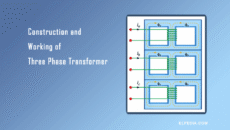
  • Three Phase Transformer – Construction and Working

    A three phase transformer is a single magnetic unit that transfers power between two three phase systems using electromagnetic induction, replacing three separate single phase transformers. It is built from a laminated steel magnetic core and copper or aluminium windings,…

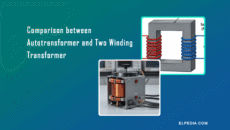
  • Comparison between Autotransformer and Two Winding Transformer

    An autotransformer and a two-winding transformer are both used to change AC voltage levels, but they differ in construction, working principle, and performance. A two-winding transformer has separate primary and secondary windings, providing electrical isolation between the input and output…

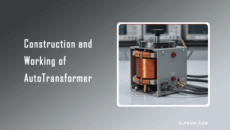
  • Construction, Working and Applications of Autotransformer

    An autotransformer is a type of electrical transformer that uses only a single continuous winding to perform voltage transformation between its input and output terminals. Unlike a conventional transformer – which has two separate windings that are electrically insulated from…
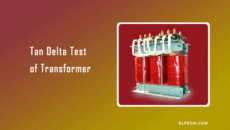
  • Tan Delta Test of Transformer

    Tan delta test of transformer is an important diagnostic test used to assess the condition and insulation quality of its windings and bushings. It measures the dielectric loss in the insulation by evaluating the dissipation factor (tan δ), which indicates…

  • Type Tests in Transformer

    A type tests in transformer refers to a set of design verification tests carried out on one transformer of a given rating and construction, usually witnessed by the purchaser or a third-party inspector. A single passed type test qualifies all…

  • Sumpner’s Test (Back to Back Test) of Transformer

    Sumpner’s test, also known as the back-to-back test, is an important method used to determine the losses and temperature rise of transformers under full-load conditions. Unlike conventional load testing, this method requires very little power from the supply because the…

  • Open circuit and short circuit test of transformer with solved problems

    Transformers are essential components of electrical power systems, and evaluating their performance is important for efficient and reliable operation. The open-circuit test and short-circuit test of a transformer are two standard tests used to determine its equivalent circuit parameters, losses,…

  • Testing of transformer

    A power transformer steps voltage up or down in electrical transmission and distribution networks, enabling efficient power transfer at different voltage levels. Since transformers operate under continuous electrical, thermal, and mechanical stresses, systematic testing is essential to ensure their safety,…

  • Efficiency of transformer

    A transformer is among the most efficient electrical devices in power systems, yet it never reaches 100% efficiency due to unavoidable power losses. Efficient energy transfer ensures steady primary-to-secondary voltage transformation, but a portion of input energy is always dissipated…

  • Losses in transformer

    Losses in transformer occur during the transfer of electrical energy from the primary winding to the secondary winding through electromagnetic induction. These losses convert part of the electrical energy into heat, reducing the efficiency of the transformer. Unlike an ideal…

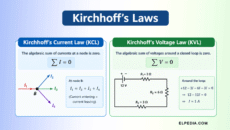
  • Kirchhoff’s Laws: KCL and KVL for Circuit Analysis

    When you have a simple circuit with one battery and one resistor, Ohm’s law is usually enough to determine the relationship between voltage, current, and resistance. But as a circuit becomes more complex—with multiple loops, voltage sources, and branches carrying…

  • Electricity and Electrical Engineering : From Power Systems to AI

    Electricity powers almost every layer of modern society. From medical equipment in hospital intensive care units to the data centers that support digital services, from high-voltage transmission networks spanning hundreds of kilometers to large solar farms supplying electricity to the…

  • Electric Charge: Definition, Types, and Everyday Effects

    Electric charge shapes nearly every interaction in the physical world, from the spark you feel touching a doorknob to the circuits powering the device you are reading this on. Yet many learners find the concept abstract until they see how…

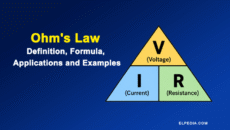
  • Ohm’s Law: Definition, Formula, Applications and Examples

    Ohm’s Law is one of the first equations you encounter in any electrical engineering or physics course, and for good reason. It captures the relationship between voltage, current, and resistance in a single, elegant formula that applies across countless real-world scenarios.

  • Basic Electrical Engineering Formulas with Examples

    Electrical engineering relies on fundamental formulas to analyze circuits, size components, and predict system behavior. Whether you’re studying dc circuits or designing three phase power systems, having the right equations at your fingertips saves time and prevents costly errors. This…

  • Electrical Quantities and Units with Tables and Conversions

    Introduction to Electrical Quantities Electrical quantities are measurable physical properties associated with electricity and magnetism. Common examples include electric charge, current, voltage, resistance, power, and energy. These quantities help engineers, technicians, and students understand and describe the behavior of electrical…

  • 150+ Basic Electrical Engineering Definitions

    Introduction to Basic Electrical Engineering Terms Mastering basic electrical engineering definitions is the first step for anyone working with electrical energy – whether you are a student, a technician, or an engineer preparing for a professional exam. Electric power supports…

  • Electrical Engineering Basics: Core Concepts, Circuits, and Practical Skills

    Electrical engineering is the study, design, and application of systems that generate, transmit, control, and convert electricity, electronics, and electromagnetic energy. An electrical engineer must understand fundamental electrical quantities and basic laws of circuit analysis to do useful work in any sub-discipline.

  • Testing of dc machine

    Testing of DC machine is an essential part of evaluating the performance, efficiency, reliability, and operating characteristics of DC generators and motors. Testing helps determine how effectively a DC machine converts energy, identify different types of losses, and verify whether the machine operates safely under different load conditions.

  • Efficiency of DC machine

    The efficiency of DC machine is an important parameter used to evaluate the performance of a direct-current electrical machine. In general, efficiency is defined as the ratio of output power to input power. It indicates how effectively a DC machine…

  • Power flow in dc machine

    Power flow in DC machine represents the sequence in which power is transferred, converted, and lost as it moves through the machine. In order to analyze the operation and performance of electrical machines, it is important to understand the sequence…

  • Losses in DC machine

    An electrical machine converts energy from one form to another. Losses in DC machine occur because it does not convert all the input energy into useful output energy. As you know, a DC generator converts mechanical energy into electrical energy,…

  • Two point starter – Construction and Working

    A two point starter is a starting device used to safely start a DC series motor by limiting the high starting current. Since a DC series motor draws a large current when it starts, connecting it directly to the supply…

  • Four point starter – Construction and Working

    Four point starter is also a protective starting device similar to three point starter, used in DC shunt and compound motors. It safely starts the motor by limiting the high starting current and provides protection against low voltage and overload…

  • Three point starter – Construction & Working

    A three point starter is a protective starting device used with DC shunt motors and compound motors to limit the high starting current and protect the motor from damage. Since the armature resistance of a DC motor is very low, connecting the motor directly to the power supply at the time of starting will draw a dangerously high current.

  • Need for Starter in DC Motor

    A starter is an essential device that is used to protect a DC motor during starting. The need for starter in DC motor arises because the motor draws a very large current when it is switched ON. This excessive starting…

  • Parallel Operation of DC Generators

    The parallel operation of DC generators is widely used in power stations because it provides a reliable, efficient, and flexible power supply. Instead of installing one large generator to meet the maximum load demand, power plants use several smaller DC…

  • Equalizer Rings in DC Machines

    Equalizer Rings in DC Machine are used in lap wound DC generators and DC motors to maintain equal current distribution among the parallel paths. They reduce brush sparking, improve commutation, and increase the efficiency of the machine. Since unequal pole…

  • Methods of Improving Commutation

    Methods of Improving Commutation are used in DC machines to ensure smooth current reversal in the armature coils without producing sparks. Poor commutation can lead to excessive sparking, overheating, and damage to the commutator and brushes. The two most common…

  • Commutation in DC Machine

    Commutation in DC machine is one of the most important processes in electrical machine. It ensures that current flowing in the armature conductors of a dc machine reverses smoothly as the rotor rotates. Without proper commutation, a DC motor or…

  • Direct Memory Access

    Direct Memory Access (DMA) is a data transfer technique used in computer systems to move data directly between memory and peripheral devices without continuous CPU involvement. In a traditional system, the CPU manages all data transfers between the peripheral devices…

  • Star Delta Transformation with solved problems

    Star delta transformation is a simple and useful technique used for solving complex networks. The three circuit elements, such as resistance, inductance, and capacitance, can be connected and represented in two different ways. In a star connection, the branches containing…

  • Kapp regulation diagram of transformer

    The Kapp regulation diagram is a graphical method of determining the voltage regulation in a transformer. It was proposed by late Dr. Kapp and hence the name Kapp regulation diagram or simply Kapp diagram. Using this diagram, it is possible…

  • Voltage regulation of transformer

    The voltage regulation of transformer is used to understand the characteristics of transformer under loaded conditions. When a transformer is loaded with constant primary voltage, the secondary voltage decreases because of load current, internal resistance, and leakage reactance. The change…

  • Equivalent circuit of transformer

    The equivalent circuit of transformer is a circuit representation of equations that describes the performance of the device. The equivalent circuit of transformer is used to predetermine the behavior of the transformer under various operating conditions. It can be drawn…

  • Equivalent resistance and reactance of transformer

    The transformer has two independent circuits primary and secondary winding. The two circuits can be resolved into an equivalent circuit to make the calculations simple. Consider a practical transformer as shown below, which has primary and secondary windings whose resistance…

  • Phasor diagram of practical transformer on Load

    A practical or actual transformer will have winding resistance and leakage reactances both on the primary and secondary sides. When the secondary of the transformer is connected to the load terminals, the transformer is said to be on load. The…

  • Energy Efficiency – Importance and benefits

    Energy efficiency is an effective way of using less energy to perform the same task. It refers to the extent to which a device, building, or system uses energy effectively. It is expressed as a ratio of the useful energy…

  • Transformer with winding resistance and leakage reactance

    Resistance of transformer An ideal transformer has no losses because it possesses no resistance. It is not possible to build an ideal transformer. But an actual transformer always has some resistance in the primary and secondary windings. Due to this…

  • Transformer on load condition

    A transformer is said to be on load when the primary is connected to the alternating voltage source and its secondary is connected to the load. When a transformer is operated at no load condition, the current from the secondary…

  • Operation of Transformer on No load condition

    A transformer is said to be at no load when the primary of a transformer is connected to the source of ac supply and the secondary is kept open. Similarly, a transformer at load condition indicates that the secondary is…

  • Save energy at home to create a sustainable future

    Have you started to save energy at your home? Saving energy in every living place is the need of the hour to create a sustainable future. Saving energy will also make your home more energy efficient. Two great things will…

  • AC resistance and impedance

    AC resistance and DC resistance are the opposition offered to the flow of AC and DC currents respectively through a conductor. However, in AC circuits, the resistance is called impedance. Impedance is the effective resistance offered to the current flow around…

  • Real power, Reactive power, and Apparent Power | Power Triangle

    In an AC circuit, the total power consumed is called the apparent power. The power triangle is the representation of a right-angle triangle showing the relation between active or real power, reactive power, and apparent power. Almost all electrical loads operate on alternating current(AC). Each…

  • Electrical Power in AC circuits

    Electrical power is the rate at which the work is done or the rate at which the energy is being consumed in a circuit. Generally, all the electrical and electronic components have a specific power handling capacity. For example, a…

  • RL Series circuit

    An RL series circuit consists of passive circuit elements such as an inductor and resistance connected together to a source. In an electrical circuit, an inductor opposes the rate of change of current through the coil, but a resistance opposes…

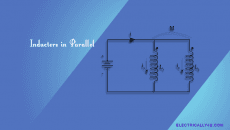
  • Inductors in Parallel

    When inductors are connected in parallel, the voltage drop across each inductor would be the same. In the case of inductors in series, the equivalent inductance is obtained by adding the inductances of all the individual inductors connected in series….

  • Inductors in Series

    Inductors in series have a total inductance value that includes the effect of both the self-inductance and mutual inductance. An inductor is nothing but a coil of wire wound around a central iron core. It is a passive component that…
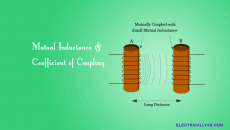
  • Mutual Inductance and coupling coefficient

    Mutual inductance is the basic operating principle of electrical machines such as transformers, motors, and generators. It is applied to any electrical component that needs interaction with another magnetic field. This principle is referred to as electromagnetic induction. Mutual inductance is…
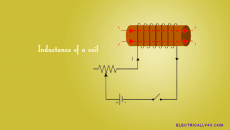
  • Inductance of a coil

    Inductance is the property of an inductor that opposes any change of current through the coil. An inductor has an important property: when the flux linking the coil changes, an emf is induced. It is also explained by Faraday’s law….

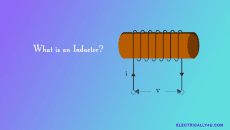
  • What is an Inductor?

    An inductor is a two-terminal passive electronic component that is capable of storing electrical energy in the form of a magnetic field when current flows through it. It is also called a coil, a choke, or a reactor. An inductor…

  • Types of torque in synchronous motor

    The torque required to operate the synchronous motor at every moment from its initial state to final shutdown is important in understanding its characteristics. Also to use the synchronous motor for different applications, the types of torques associated with the…

  • Voltage Unit Conversion tool

    The voltage unit conversion tool is an electric tool that is used to convert the voltage in one unit into the voltage in different other units such as nanovolt, microvolt, millivolt, Kilovolt, Megavolt, and Gigavolt. How to use the voltage…

  • Power unit conversion tool

    The power unit conversion tool is an electric tool that is used to convert the power into different units. The power conversion calculator converts the power in units such as kilowatts, megawatts, horsepower, and kilocalories per hour. How to use…

  • Temperature unit conversion tool

    The temperature unit conversion tool is a simple tool used to get the temperature in desired units. Using this tool, it is possible to convert into four different units as Fahrenheit, Celsius, Kelvin and Rankine. How to use the temperature…

  • Percentage Calculator

    The percentage calculator is a mathematical tool used to find the percentage change, percentage difference, and percentage error between the two values. Percentage Increase Using this option, it is possible to find the increase in percentage from an initial value…

  • Rectangular and Polar Conversion Tool

    The rectangular and Polar Conversion tool is used to convert the phasor quantity in the polar coordinates to the rectangular coordinates(or cartesian coordinates) and vice versa. They are the two forms of representing the phasor quantity. How to use the conversion…

  • Resistor color code calculator

    Are you struggling to find the values of different resistors? If so, this resistor color code calculator might help you to read the resistor values. Using this calculator, you can find the value of 4-band, 5-band, and 6-band resistors. So, how…

  • Series and Parallel resistance Calculator

    Series and Parallel resistance calculator is designed to calculate the equivalent resistance. In this calculator, you can determine the equivalent resistance for up to 5 resistors. Resistance is the property of a resistor, by which it opposes the flow of…

  • Voltage Divider Calculator

    A voltage divider calculator is an electric tool, which is used to find the voltage across the resistors in series circuits. In general, the voltage divider rule is applicable for series circuits. In the following figure, a circuit is shown…

  • Current Divider Calculator

    The Current Divider Rule is applicable to the parallel circuit. The current divider calculator is an electric tool is used to find the currents in parallel circuits by applying the rule. The current Divider Rule calculator is used to find…

  • Average Value and RMS value calculator

    RMS value calculator is an electric tool, used to calculate the Peak to Peak value, RMS and Average value, form factor, and peak factor using this calculator. Formulas used Amplitude of the waveform Amplitude of the waveform = Maximum value…

  • Ohm’s Law calculator

    Ohm’s Law calculator is an electric tool used to calculate the voltage, current, or resistance and power when any of the other two parameters are known. Formulas Ohm’s Law states that, at a constant temperature, the current through a conductor…

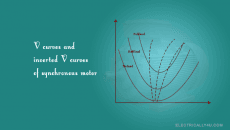
  • V curves and inverted v curves of synchronous motor

    The graphs obtained by plotting the armature current and field current of a synchronous motor are called the V curves. Similarly, the inverted V curves give the relation between the power factor and field current. In order to understand the…

  • Starting methods of synchronous motor

    A synchronous motor is an AC electric motor that always rotates at a synchronous speed. This speed is achieved with the help of the rotating magnetic field produced by the stator winding. It depends on the supply frequency and the…

  • Equivalent circuit and Phasor diagram of synchronous motor

    The phasor diagram of synchronous motor is used for understanding the behavior of the motor under different load conditions. We will discuss the easiest way of drawing the phasor diagrams of synchronous motor. Before looking at the phasor diagram, we…

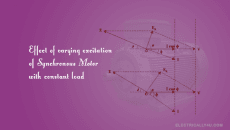
  • Effect of Load on Synchronous Motor

    The synchronous motor runs at a synchronous speed, which depends on the supply frequency. The operation of a synchronous motor is unique when compared to that of a DC motor and induction motor. In dc motor or induction motor, an…

  • Why is Renewable Energy Important to our Future?

    Environmental experts are predicting a very gloomy future. In little more than half a century, supplies of traditional fossil fuels, such as coal and oil, will be virtually exhausted. Their misuse will have contributed to the dire consequences of irreversible…

  • The Complete Guide to Different Types of Energy

    Energy is an important part of our lives. We use it daily to do the things that we enjoy like cooking, walking, working, and powering up our smartphones. There are different types of energy such as radiant, heat, sound, gravitational,…

  • What is Energy? Importance of energy and its impact

    Energy is a term used by all sorts of people, both casually and technically. It is because energy is all around us. Energy has its importance in every aspect of our life. It is not possible to sustain on the…

  • Design of Asynchronous / Ripple counter

    The asynchronous or ripple counter consists of series of flip-flops which are not synchronized by the same clock pulse. Design of asynchronous counter involves several steps from selecting the number of flip-flops to drawing the logic circuit diagram. Before entering…

  • Design of synchronous Counter

    The synchronous counters count the number of clock pulses received at its input. The synchronous counter uses the same clock signal from the same source and at exactly the same time. Generally, it is constructed using either JK flip flop…

  • Types and Selection of Memory for an embedded system

    Memory is one of the most important and essential parts of any processing system. Selecting from the available types of memory should be carefully done while developing an embedded system. So, what is memory? Memory is the physical storage element…

  • Electric Braking of DC motors

    Electric braking is a method of bringing the rotating motor to rest. When the load is removed from the DC motor or when the supply is disconnected, the motor should come to rest. But there will be a delay before…

  • Speed Control of DC motor – Types and applications

    Speed control of DC motor is the process of varying the rotational speed of a DC motor according to load requirements without affecting its performance. Because the speed of a DC motor can be controlled over a wide range, DC…

  • Characteristics of DC motor

    The performance and behavior of a DC motor is determined from its characteristics. It expresses the relation between two or more quantities. The important characteristics of DC motor are Characteristics of DC Series motor Torque – Armature current characteristics As…

  • Speed equation of DC motor

    The speed equation is very essential to analyze the speed of rotation of the DC motor. As the supply voltage given to the DC motor produces mechanical output. The output depends on several parameters like input voltage, field current, armature…

  • Torque equation of a DC Motor with solved problem

    The torque equation of dc motor is essential for analyzing the rotating force of a motor. A torque is nothing but the turning or twisting moment of a force about an axis. It is measured by the product of force…

  • Voltage Equation and Power Equation of a DC Motor

    In a dc motor, the applied input is electrical energy. The motor converts the electrical input into mechanical input. The applied voltage at the armature terminals of a DC motor has to overcome the back emf and has to supply…

  • Types of DC Motor and its equations

    DC motors are classified into several types, similar to DC generators. The DC motors are classified into three types based on the method in which the field windings are excited. You can also compare the types of a motor with…

  • Selection of processor for an embedded system

    The selection of a processor is not an easy task for an embedded system. It is not possible to simply select a processor from your favorite list. Several factors are to be considered while selecting a processor for an embedded…

  • Working principle of DC motor

    DC motor is an electrical machine that converts electrical energy into mechanical energy. The working principle of DC motor is given by, “When a current-carrying conductor is placed in a magnetic field, the conductor experiences a force which tends to…

  • Mathematical representation of phasor in Complex form

    The complex form of representing a phasor is used to solve complex sinusoidal equations. DC analysis requires simple mathematics to solve its equations. Since an AC waveform has magnitude and direction, it needs a complex number to solve AC sinusoidal…

  • Phasor Diagram and Phasor Addition

    Phasor Diagram is a graphical representation of the relation between two or more alternating quantities in terms of magnitude and direction. In other words, it depicts the phase relationship between two or more sinusoidal waveforms having the same frequency. Phasor is…

  • Structural units in Embedded Processor

    The processor in any embedded system contains various units for its successful and fast operation. Buses, memories, processing units, instructions, registers, control units are some of the structural units that an embedded processor should possess. For quick operation, the system…

  • Different types of Embedded Processor

    An embedded processor is a microprocessor designed especially for handling the needs of an embedded system. The processor is a heart of an embedded system. Processors get the user data as an input, process them and produce an output based on the…

  • Phase Difference in AC Circuits

    In the analysis of AC circuits, it is very difficult to deal with sinusoidal waveforms and their mathematical equations. It becomes a bit more difficult when dealing with two sinusoidal waveforms. Hence, phasor representation is an easier way to represent…

  • Peak value, Average value and RMS value of AC waveform

    As you know, the AC waveform is sinusoidal in nature. Its magnitude continuously varies with time, hence it is necessary to find the value at every instant and its peak value. Similar to the DC, which has a constant magnitude,…