Methods of Improving Commutation
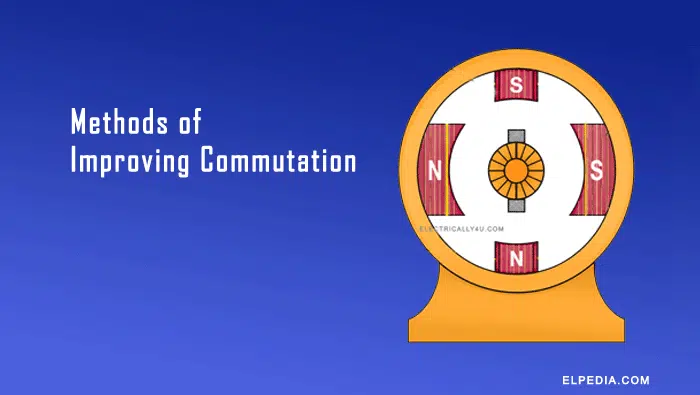
Methods of Improving Commutation are used in DC machines to ensure smooth current reversal in the armature coils without producing sparks. Poor commutation can lead to excessive sparking, overheating, and damage to the commutator and brushes. The two most common Methods of Improving Commutation are Resistance Commutation and EMF Commutation. Before reading this article, it is important to understand the concept of commutation process.
Resistance Commutation
Resistance Commutation is one of the widely used Methods of Improving Commutation. In this method, low resistance copper brushes are replaced with high resistance carbon brushes.
When current flows from one commutator segment to another, it can travel through two different paths. If copper brushes are used, the current mainly follows the shorter path because it has very low resistance. As a result, the current does not reverse properly, which can cause sparking.
Carbon brushes have higher resistance. During commutation, the resistance of the shorter path increases as the contact area with the brush becomes smaller, while the resistance of the longer path decreases as the contact area of the next segment becomes larger. This encourages the current to flow through the longer path, allowing the current in the coil to reverse more smoothly and reducing sparking.
Although carbon brushes improve commutation, they do not completely eliminate sparking because the main cause of sparking is the reactance voltage (self-induced EMF) in the armature coil.
Advantages of Carbon Brushes
- Help reduce sparking during commutation.
- Act as self-lubricating brushes, reducing wear on the commutator.
- Keep the commutator surface smooth and polished.
- Cause less damage to the commutator if sparking occurs compared to copper brushes.
Disadvantages of Carbon Brushes
- Their high contact resistance causes a voltage drop of about 2 V, reducing efficiency, especially in small machines.
- The extra heat produced requires a larger commutator for better heat dissipation.
- They carry lower current density (about 7–8 A/cm²) than copper brushes (25–30 A/cm²), so larger brush holders are needed.
EMF Commutation
Another important Methods of Improving Commutation is EMF Commutation. In this method, a reversing EMF is produced in the short-circuited armature coil. This reversing EMF opposes the reactance voltage. If both voltages are equal, they cancel each other, allowing the current to reverse quickly and smoothly without sparking.
The reversing EMF can be produced in two ways:
- By giving the brushes a forward lead, so the short-circuited coil comes under the magnetic field of the next pole.
- By using interpoles (commutating poles).
The brush-shifting method was used in older DC machines but is rarely used today because it creates several operating problems. Modern DC machines use interpoles for better performance.
Interpoles (Commutating Poles)
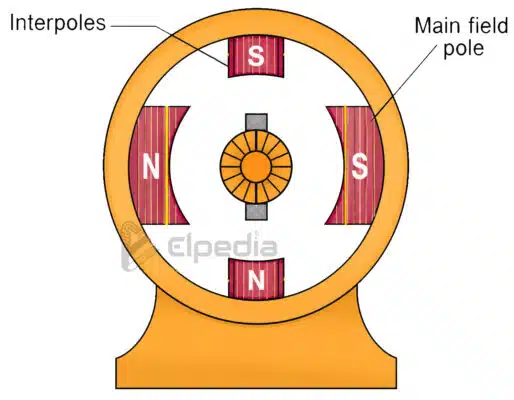
The use of interpoles is one of the most effective Methods of Improving Commutation in modern DC machines. Interpoles, also called commutating poles, are small poles placed between the main poles of a DC machine. They are wound with a few turns of thick copper wire and connected in series with the armature, so they carry the full armature current.
In a DC generator, each interpole has the same polarity as the next main pole in the direction of rotation.
Functions of Interpoles
Interpoles produce a commutating (reversing) EMF in the coil undergoing commutation. This EMF opposes and cancels the reactance voltage, allowing the current to reverse smoothly without sparking.
Because the interpoles carry the same current as the armature, the reversing EMF automatically increases or decreases with the armature current. This provides effective sparkless commutation even when the machine operates at 20–30% overload. As a result, DC machines with interpoles can be made smaller and more economical than machines without them.
Interpoles also neutralize the cross-magnetizing effect of armature reaction. Since both the armature reaction and interpole magnetic field depend on the armature current, the compensation is automatic at all load conditions. This allows the brushes to remain in their correct position without adjustment.
Difference Between Interpoles and Compensating Windings
Both interpoles and compensating windings are connected in series with the armature and help reduce the effects of armature reaction. However, their functions are different.
- Interpoles not only reduce armature reaction near the commutation zone but also produce the reversing EMF needed to cancel the reactance voltage and improve commutation.
- Compensating windings mainly cancel armature reaction over the pole faces and do not produce the reversing EMF required for commutation.
Therefore, interpoles play a dual role by improving commutation and reducing armature reaction, while compensating windings only reduce armature reaction.