Equalizer Rings in DC Machines
Equalizer Rings in DC Machine are used in lap wound DC generators and DC motors to maintain equal current distribution among the parallel paths. They reduce brush sparking, improve commutation, and increase the efficiency of the machine. Since unequal pole flux can create different induced voltages in each parallel path, equalizer rings provide an alternative path for circulating current and ensure smooth operation.
Need for equalizer rings in DC machine
In a lap wound DC machine, each parallel path contains conductors that lie under only one pair of poles. If every pole produces exactly the same magnetic flux, the induced EMF in every parallel path will also be identical. Consequently, each path carries the same current.
However, in practical machines, slight variations in air-gap length, manufacturing tolerances, and magnetic properties of the pole cores cause unequal magnetic flux. These differences produce unequal EMFs in the parallel paths.
The conductors under stronger poles generate higher EMF and carry more current, while those under weaker poles carry less current. As a result, the brushes do not share the current equally.
Some brushes become overloaded and produce excessive sparking, whereas others carry less current than expected. This uneven current distribution results in poor commutation in DC machines, increased brush wear, and reduced machine performance. So equalizer rings are used in DC machine to improve commutation.
What are equalizer rings?
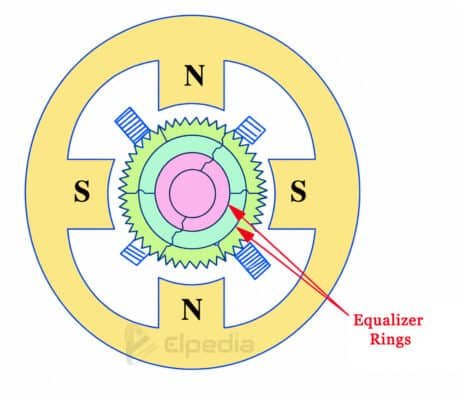
Equalizer Rings are heavy copper conductors installed at the back of the armature in lap wound DC machines. They connect armature points that should ideally be at the same electrical potential.
When unequal EMFs exist in different parallel paths, the resulting circulating current flows through the equalizer rings instead of passing through the brushes. This balances the current among the parallel paths and minimizes brush sparking.
Construction and working of equalizer rings
Equalizer rings are made of copper bars or copper rings mounted at the rear end of the armature. They connect armature conductors located one pole pair apart.
To connect these points correctly, the armature must have a whole number of slots per pole pair. This ensures that corresponding conductors under similar poles occupy identical positions.
For example, in a 6-pole DC machine, each equalizer ring is connected to three points in the armature winding, which is equal to the number of pole pairs.
The working principle of equalizer rings is simple. When one parallel path develops a slightly higher EMF than another, a circulating current is produced. Instead of flowing through the brushes, this current travels through the equalizer rings connecting the armature conductors.
Because of this arrangement brush currents become nearly equal, current imbalance is minimized, sparking at the brushes is reduced, commutation becomes smoother and machine efficiency improves. Thus, equalizer rings in DC machine provide an internal path for balancing the current.
The main functions of equalizer rings are:
- Equalize current in all parallel paths.
- Prevent brush overloading.
- Reduce brush sparking.
- Improve sparkless commutation.
- Increase machine efficiency.
- Reduce brush wear.
- Improve operational reliability.
- Increase the service life of the commutator.
Number of equalizer rings in DC machine
The maximum theoretical number of equalizer rings equals the number of conductors under one pair of poles. The number of rings is calculated as,
![\[ \text{No. of Equalizer Rings}= \frac{\text{No. of Conductors}}{\text{No. of pole pairs}} \]](https://elpedia.com/wp-content/ql-cache/quicklatex.com-fc93f16bd2aa1fc4621117f617309212_l3.png "Rendered by QuickLaTeX.com")
However, using too many rings increases manufacturing cost and complexity. Therefore, in practical, large DC machines generally use about 20 equalizer rings and smaller machines use fewer rings according to their design. Sometimes only a portion of the conductors are connected.
- 50% equalized winding – Half of the conductors are connected to equalizer rings.
- 100% equalized winding – Every conductor is connected to an equalizer ring.
Partial equalization usually provides satisfactory current balancing while keeping the design economical.
Why are equalizer rings used only in Lap winding?
Equalizer Rings are used only in lap winded DC Machine. In a wave winding, every parallel path contains conductors distributed under all poles instead of only one pair of poles.
Therefore, any variation in pole flux affects every parallel path almost equally. As a result, the induced EMFs remain nearly balanced, current distribution stays uniform, and equalizer rings become unnecessary.