Transformer

  • Construction of Transformer and its working Principle

    The transformer is a static device in its construction and the principle behind the working of transformer is Faraday’s law of Electromagnetic Induction. In this article, let us learn about the construction and working of transformers. What is a transformer? The…
  • EMF Equation of a transformer

    The emf equation of a transformer is derived by considering a single-phase transformer. When a single-phase AC supply is given to a transformer, the emf gets induced in the secondary winding by means of electromagnetic induction. Let, N1 be the…

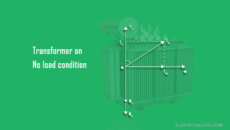
  • Operation of Transformer on No load condition

    A transformer is said to be at no load when the primary of a transformer is connected to the source of ac supply and the secondary is kept open. Similarly, a transformer at load condition indicates that the secondary is…

  • Transformer on load condition

    A transformer is said to be on load when the primary is connected to the alternating voltage source and its secondary is connected to the load. When a transformer is operated at no load condition, the current from the secondary…

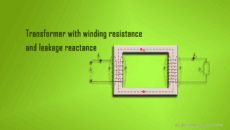
  • Transformer with winding resistance and leakage reactance

    Resistance of transformer An ideal transformer has no losses because it possesses no resistance. It is not possible to build an ideal transformer. But an actual transformer always has some resistance in the primary and secondary windings. Due to this…

  • Phasor diagram of practical transformer on Load

    A practical or actual transformer will have winding resistance and leakage reactances both on the primary and secondary sides. When the secondary of the transformer is connected to the load terminals, the transformer is said to be on load. The…

  • Equivalent resistance and reactance of transformer

    The transformer has two independent circuits primary and secondary winding. The two circuits can be resolved into an equivalent circuit to make the calculations simple. Consider a practical transformer as shown below, which has primary and secondary windings whose resistance…

  • Equivalent circuit of transformer

    The equivalent circuit of transformer is a circuit representation of equations that describes the performance of the device. The equivalent circuit of transformer is used to predetermine the behavior of the transformer under various operating conditions. It can be drawn…

  • Voltage regulation of transformer

    The voltage regulation of transformer is used to understand the characteristics of transformer under loaded conditions. When a transformer is loaded with constant primary voltage, the secondary voltage decreases because of load current, internal resistance, and leakage reactance. The change…

  • Kapp regulation diagram of transformer

    The Kapp regulation diagram is a graphical method of determining the voltage regulation in a transformer. It was proposed by late Dr. Kapp and hence the name Kapp regulation diagram or simply Kapp diagram. Using this diagram, it is possible…

  • Losses in transformer

    Losses in transformer occur during the transfer of electrical energy from the primary winding to the secondary winding through electromagnetic induction. These losses convert part of the electrical energy into heat, reducing the efficiency of the transformer. Unlike an ideal…

  • Testing of transformer

    A power transformer steps voltage up or down in electrical transmission and distribution networks, enabling efficient power transfer at different voltage levels. Since transformers operate under continuous electrical, thermal, and mechanical stresses, systematic testing is essential to ensure their safety,…

  • Open circuit and short circuit test of transformer with solved problems

    Transformers are essential components of electrical power systems, and evaluating their performance is important for efficient and reliable operation. The open-circuit test and short-circuit test of a transformer are two standard tests used to determine its equivalent circuit parameters, losses,…

  • Sumpner’s Test (Back to Back Test) of Transformer

    Sumpner’s test, also known as the back-to-back test, is an important method used to determine the losses and temperature rise of transformers under full-load conditions. Unlike conventional load testing, this method requires very little power from the supply because the…

  • Type Tests in Transformer

    A type tests in transformer refers to a set of design verification tests carried out on one transformer of a given rating and construction, usually witnessed by the purchaser or a third-party inspector. A single passed type test qualifies all…

  • Tan Delta Test of Transformer

    Tan delta test of transformer is an important diagnostic test used to assess the condition and insulation quality of its windings and bushings. It measures the dielectric loss in the insulation by evaluating the dissipation factor (tan δ), which indicates…

  • Efficiency of transformer

    A transformer is among the most efficient electrical devices in power systems, yet it never reaches 100% efficiency due to unavoidable power losses. Efficient energy transfer ensures steady primary-to-secondary voltage transformation, but a portion of input energy is always dissipated…

  • Parallel Operation of Single phase Transformer

    Parallel operation of transformers refers to the process of connecting two or more transformers such that their primary windings are connected to a common supply, while their secondary windings are connected to a common load bus. In the case of…

  • Three Phase Transformer – Construction and Working

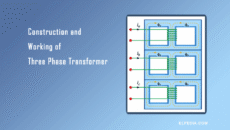
    A three phase transformer is a single magnetic unit that transfers power between two three phase systems using electromagnetic induction, replacing three separate single phase transformers. It is built from a laminated steel magnetic core and copper or aluminium windings,…

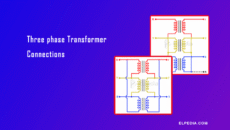
  • Three-Phase Transformer Connections

    A three phase transformer is a device that steps line voltage up or down in three phase AC power systems. Three-phase transformers distribute electrical power efficiently across transmission, distribution, and industrial plants, and have been a cornerstone of modern grids…

  • Open delta connection of Transformer with solved problem

    An open delta connection is a three-phase transformer connection that uses only two single-phase transformers instead of three. It is also known as a V-V connection because of the arrangement of the transformer windings. Even with only two transformers, it…

  • Different Types of Transformer

    There are different types of transformers based on the application, nature of use and number of phases. Based on the application, transformers are widely used in the electric power system to transmit the electric power between power plants, substations, industries…

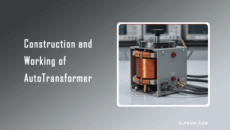
  • Construction, Working and Applications of Autotransformer

    An autotransformer is a type of electrical transformer that uses only a single continuous winding to perform voltage transformation between its input and output terminals. Unlike a conventional transformer – which has two separate windings that are electrically insulated from…

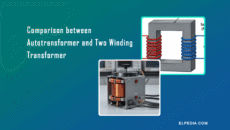
  • Comparison between Autotransformer and Two Winding Transformer

    An autotransformer and a two-winding transformer are both used to change AC voltage levels, but they differ in construction, working principle, and performance. A two-winding transformer has separate primary and secondary windings, providing electrical isolation between the input and output…