Open delta connection of Transformer with solved problem
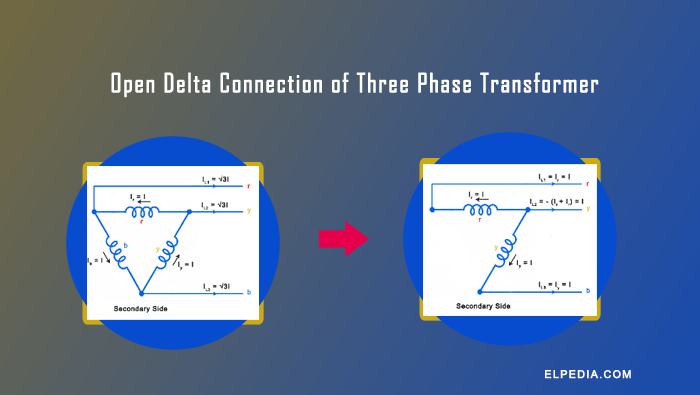
An open delta connection is a three-phase transformer connection that uses only two single-phase transformers instead of three.
It is also known as a V-V connection because of the arrangement of the transformer windings.
Even with only two transformers, it can continue supplying three-phase power to the connected load.
However, its power-handling capacity is reduced to approximately 57.7% of the corresponding closed-delta bank capacity.
In this article, we will discuss the circuit diagram, working principle, current relationships, advantages, disadvantages, capacity of the open-delta connection, and example problem.
Before reading this article, it is important to know about the three phase transformer connections.
How Open delta connection is formed?
In a closed-delta (Δ-Δ) connection, three single-phase transformers are connected to supply a three-phase load. If one transformer is disconnected, the remaining two transformers can continue supplying three-phase power.
This is possible because the voltage across the disconnected transformer is maintained by the other two transformers connected in series.
This arrangement is called an open-delta or V-V connection. It provides three-phase power using only two transformers.
An open delta connection is commonly used in the following situations:
- When the three-phase load is small and does not require three transformers.
- When one transformer in a closed-delta bank fails. The remaining two transformers can continue supplying power until the faulty transformer is repaired or replaced.
- When the load is expected to increase in the future. A third transformer can then be added to convert the open-delta connection into a closed-delta connection.
Consider three identical single-phase transformers connected in a closed-delta arrangement.
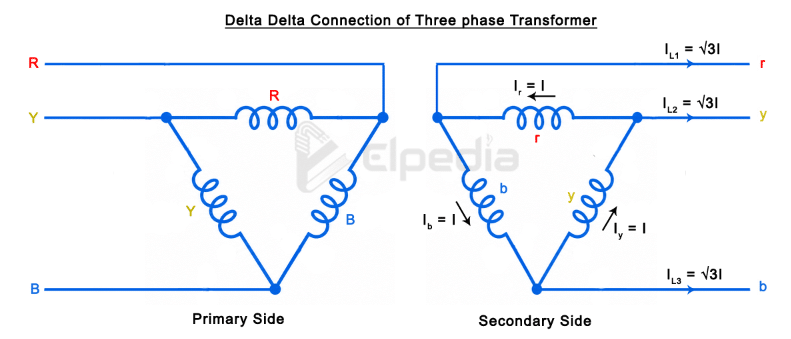
Let V be the secondary voltage of each transformer (V), I be the rated full-load current of each transformer (A) and S be the kVA rating of each transformer.
In a closed-delta connection, the line current is:

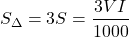
The kVA rating of each transformer is:

Therefore, the total kVA rating of the three-transformer bank is:
When one transformer is removed, the remaining two transformers continue supplying the three-phase load.
Each transformer can carry its rated current (I). In an open delta connection, the line current is equal to the transformer winding current.
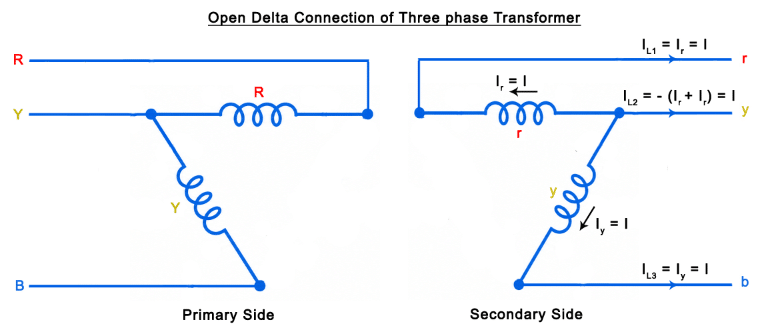
Therefore,

The total kVA rating of the open-delta bank is:
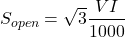
Since the closed-delta bank rating is (3S), the open-delta bank rating can also be expressed as:

Thus, the capacity of an open-delta bank is only 57.7% of the capacity of a closed-delta bank using the same three transformers.
For example, Consider three single-phase transformers, each rated at 10 kVA.
For a closed-delta connection:

When one transformer is removed, the open-delta bank rating becomes:


Therefore, the open-delta bank can supply only 17.32 kVA instead of 30 kVA.
The reduction in capacity is:

This represents a reduction of approximately 42.3% compared with the original closed-delta capacity.
Reason for the Reduced Capacity
When one transformer is removed from a closed-delta bank, the remaining two transformers must supply the entire three-phase load.
The currents carried by the two transformers are not in phase with their respective winding voltages. For a balanced load with unity power factor, each transformer operates at an effective power factor of:

This reduction in the effective power factor is one of the reasons for the lower capacity of the open-delta bank.
Power Factor of Transformers in an Open Delta Connection
In an open-delta (V-V) connection, the two transformers generally operate at different power factors when supplying a balanced three-phase load. Their individual power factors depend on the load power factor and the phase angle of the load.
If the load power factor is  , the power factors of the two transformers will be such that, first transformer will operate at a power factor of
 and the second one will operate at
 .
For example,
1. When the load power factor is unity ( ): Both transformers operate at a power factor of
 .
2. When the load power factor is 0.866 ( ): One transformer operates at unity power factor, while the other operates at 0.5 power factor.
3. When the load power factor is 0.5 ( ): One transformer operates at zero power factor, while the other operates at 0.866 power factor.
Thus, the two transformers in an open delta connection do not generally share the load equally in terms of real and reactive power, even though they carry the same rated apparent power under their respective rated operating conditions.
Disadvantages of Open Delta Connection
One of the main disadvantages of an open delta connection is the variation in secondary terminal voltages as the load increases. The voltage imbalance becomes more pronounced at higher loads, even when the three-phase load is balanced.
Another important consideration is transformer overloading when an open delta connection is formed by removing one transformer from a fully loaded closed-delta bank.
In a closed delta connection, the line current is  times the transformer phase current. However, in an open delta connection, the line current is equal to the current flowing through each transformer winding.
Therefore, if the original three-transformer bank was supplying its full rated load before one transformer was disconnected, the two remaining transformers would have to carry currents approximately 1.732 times their rated values to maintain the same load.
This represents an overload of approximately 73.2% on each remaining transformer. Such overloading can be permitted only for a limited period, depending on the transformer ratings and operating conditions.
Otherwise, the load must be reduced to prevent excessive heating and possible damage to the transformers.
Effect of Adding a Third Transformer
An open delta bank can be converted into a closed-delta bank by adding a third transformer.
For example, consider two 10 kVA transformers connected in an open delta arrangement. The total capacity of the bank is:


When a third 10 kVA transformer is added, the connection becomes closed-delta, and the total capacity increases to:
The percentage increase in capacity is:
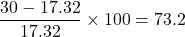
Thus, adding one transformer increases the bank capacity by approximately 73.2%, while the investment in transformer capacity increases by 50% compared with the original two-transformer installation.
This makes the open delta connection a useful and economical arrangement for supplying three-phase loads when the load requirement is relatively small or when temporary operation is necessary.
Example Problem
Two single-phase transformers are connected in an open-delta (V-V) configuration to supply a balanced three-phase load of 180 kW at 415 V with a lagging power factor of 0.8. Calculate: (a) The secondary line current, (b) The kVA rating of each transformer under the given load condition and (c) The real power supplied by each transformer.
Given: Total load , Secondary line voltage
 , Load power factor
 (lagging)
Solution :
(a) The three-phase power equation is given by,

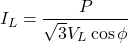
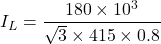
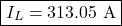
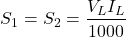
(b) In an open-delta connection, the current flowing through each transformer is equal to the secondary line current.
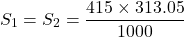
Therefore, the kVA load on each transformer is,
Upon substituting the values,

(c) First, let us calculate the load power-factor angle. From the problem,



The power supplied by one transformer,


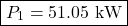
The power supplied by other transformer,