EMF Equation of a transformer
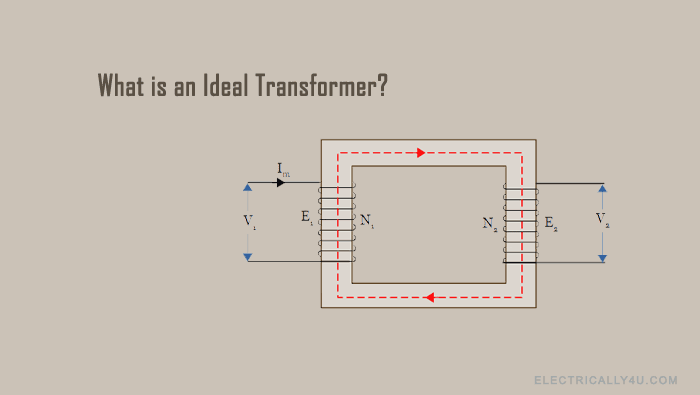
The emf equation of a transformer is derived by considering a single-phase transformer. When a single-phase AC supply is given to a transformer, the emf gets induced in the secondary winding by means of electromagnetic induction.
Let,
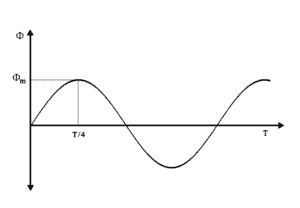
As shown in fig, flux ϕm increases from zero value to maximum value in one-quarter of the cycle, i.e., in 1/4f second.
![\[\text{Average Rate of change of flux} = \frac{\phi_m}{1/4f} = 4f\phi_m\]](https://elpedia.com/wp-content/ql-cache/quicklatex.com-43202540b5f131c45ffff70bf025e54b_l3.png "Rendered by QuickLaTeX.com")
By faraday’s law of electromagnetic induction, rate of change of flux is nothing but induced emf,
![\[\text{Average emf per turn} = 4f\phi_m \, \, \text{volt}\]](https://elpedia.com/wp-content/ql-cache/quicklatex.com-3e0c24cfcacfbf313a0557bf5ea03d12_l3.png "Rendered by QuickLaTeX.com")
If the flux varies sinusoidally, then the rms value of induced emf is obtained by multiplying the average value with form factor.
![\[\text{Form Factor} = \frac{\text{RMS Value}}{\text{Average Value}} = 1.11 \]](https://elpedia.com/wp-content/ql-cache/quicklatex.com-30d42bc90531c4ce468e0fcc9dc2505c_l3.png "Rendered by QuickLaTeX.com")
![\[\text{RMS Value of emf per turn} = 1.11 \times 4f\phi_m = 4.44f\phi_m \, \, \text{volt} \]](https://elpedia.com/wp-content/ql-cache/quicklatex.com-52bfcc767b71e09030ded07392394fb9_l3.png "Rendered by QuickLaTeX.com")
The rms value of induced emf in the primary winding is given by,
![\[ = \text{Induced emf per turn} \times \text{No. of Primary Winding} \]](https://elpedia.com/wp-content/ql-cache/quicklatex.com-214da6970cd376b9fd2f136c8075f4d1_l3.png "Rendered by QuickLaTeX.com")
(1) 
Similarly, rms value of induced emf in the secondary winding is given by,
(2) 
The above two equations are the emf equation of a transformer in the primary and secondary winding respectively.
From equations (1) and (2), we get the emf induced per turn in the primary and secondary winding of a transformer.
![\[\frac{E_1}{N_1} = \frac{E_2}{N_2} = 4.44f\phi_m \]](https://elpedia.com/wp-content/ql-cache/quicklatex.com-5f5ed1ee9fecffe39935c24db8c5826a_l3.png "Rendered by QuickLaTeX.com")
Dividing the equations (1) by (2), we get,
![\[\frac{E_1}{E_2} = \frac{N_1}{N_2} = K \]](https://elpedia.com/wp-content/ql-cache/quicklatex.com-8899212a8dda30716d6f2ad7fe624e96_l3.png "Rendered by QuickLaTeX.com")
where K is a constant, called transformation ratio.
For an ideal transformer, E1 = V1 & E2 = V2
where
V1 – AC Supply voltage of transformer in the primary side.
V2 – Terminal voltage of transformer in the secondary side.
Thus, the transformation ratio K of a transformer is
![\[\frac{E_1}{E_2} = \frac{N_1}{N_2} = \frac{V_1}{V_2}= K \]](https://elpedia.com/wp-content/ql-cache/quicklatex.com-aa23d1f94a64de083dba6d6b635de571_l3.png "Rendered by QuickLaTeX.com")
In the above equation,
If N2 > N1 & E2 > E1 then the transformer is a step up transformer.
If N1 > N2 & E1 > E2 then the transformer is a step down transformer.
Solved Problems
A 25 kVA transformer has 250 turns on the primary and 40 turns on the secondary winding. The primary is connected to 1500 V, 50 Hz supply. Find the secondary e.m.f., the full-load primary and secondary currents, and the maximum flux in the core. Neglect leakage drops and no-load primary current.
Given: Rated Capacity = 25 kVA, N1 = 250 turns, N2 = 40 turns, V1 = 1500 V, f = 50 Hz.
To find: V2, I1, I2, ϕm
Solution: Using the transformation ratio,
![\[\frac{V_2}{V_1} = \frac{N_2}{N_1} \]](https://elpedia.com/wp-content/ql-cache/quicklatex.com-1b3dc14a047735c9941525f7a4f5b825_l3.png "Rendered by QuickLaTeX.com")
![\[\frac{V_2}{1500} = \frac{40}{250} \]](https://elpedia.com/wp-content/ql-cache/quicklatex.com-6a1d2e55d1596eb30b6cb027d1f02ada_l3.png "Rendered by QuickLaTeX.com")
![\[\boxed{\text{Secondary emf, }V_2 = 240 \, V }\]](https://elpedia.com/wp-content/ql-cache/quicklatex.com-eb265094421a8dd0508d3ba70e695362_l3.png "Rendered by QuickLaTeX.com")
Primary and secondary currents are calculated using rated capacity (kVA), as shown below.
![\[I_1 = \frac{kVA}{V_1} = \frac{25000}{1500} \]](https://elpedia.com/wp-content/ql-cache/quicklatex.com-d1cce0873ff5bd8d262fd4aab62e6b30_l3.png "Rendered by QuickLaTeX.com")
![\[\boxed{I_1 = 16.67 \, A} \]](https://elpedia.com/wp-content/ql-cache/quicklatex.com-b0ff787c32eaaa209a7199d94224b46f_l3.png "Rendered by QuickLaTeX.com")
![\[I_2 = \frac{kVA}{V_2} = \frac{25000}{240} \]](https://elpedia.com/wp-content/ql-cache/quicklatex.com-6de3ef06327e9c9827840aa3e8a05aa1_l3.png "Rendered by QuickLaTeX.com")
![\[\boxed{I_2 = 104.2 \, A} \]](https://elpedia.com/wp-content/ql-cache/quicklatex.com-0002fb751f1e3bedbd747b0bbdad0c0a_l3.png "Rendered by QuickLaTeX.com")
We know, the emf equation of a transformer is given by,
![\[ E_1 = 4.44f\phi_m N_1 \]](https://elpedia.com/wp-content/ql-cache/quicklatex.com-054b7268abeb3182cfda5f1a7c296453_l3.png "Rendered by QuickLaTeX.com")
![\[ 1500 = 4.44 \times 50 \times \phi_m \times 250 \]](https://elpedia.com/wp-content/ql-cache/quicklatex.com-a988803ef20aecf373084e8d1740bca9_l3.png "Rendered by QuickLaTeX.com")
![\[\phi_m = \frac{1500}{4.44 \times 50 \times 250} \]](https://elpedia.com/wp-content/ql-cache/quicklatex.com-b0911917033ad9352c03ed44285291f5_l3.png "Rendered by QuickLaTeX.com")
![\[ \boxed{\phi_m = 0.027 \, Wb} \]](https://elpedia.com/wp-content/ql-cache/quicklatex.com-4dc5a805d4b872943018003a8f11d949_l3.png "Rendered by QuickLaTeX.com")
A single phase transformer has 400 primary and 1000 secondary turns. The net cross-sectional area of the core is 60 cm2. If the primary winding be connected to a 50 Hz supply at 520 V, calculate (i) the peak value of flux density in the core (ii) the voltage induced in the secondary winding.
Given: N1 = 400 turns, N2 = 1000 turns, A= 60 cm2, V1 = 520 V, f = 50 Hz.
To find: Bm, E2
Solution: We know, the emf equation of a transformer is given by,
![\[ E_1 = 4.44fB_m AN_1 \]](https://elpedia.com/wp-content/ql-cache/quicklatex.com-3e13173b8312ea81307a591b379a5b7a_l3.png "Rendered by QuickLaTeX.com")
![\[ 520 = 4.44\times 50 \times B_m \times 60 \times 10^{-4} \times 400 \]](https://elpedia.com/wp-content/ql-cache/quicklatex.com-27dca389135e5b80fbf3f783ca2b2c90_l3.png "Rendered by QuickLaTeX.com")
![\[ 520 = 532.8 \times B_m \]](https://elpedia.com/wp-content/ql-cache/quicklatex.com-01eef6b8fcf51e45ab7327220bf84f4f_l3.png "Rendered by QuickLaTeX.com")
![\[ \boxed{B_m = 0.976 \, Wb/m^2 }\]](https://elpedia.com/wp-content/ql-cache/quicklatex.com-cf825cc0a98519b017b19f06bc3e3034_l3.png "Rendered by QuickLaTeX.com")
We know, from the transformation ratio,
![\[\frac{E_2}{E_1} = \frac{N_2}{N_1} \]](https://elpedia.com/wp-content/ql-cache/quicklatex.com-29e9d6edd414e3821820b18e93cda456_l3.png "Rendered by QuickLaTeX.com")
![\[\frac{E_2}{520} = \frac{1000}{400} \]](https://elpedia.com/wp-content/ql-cache/quicklatex.com-376c8f9fe58d1edafc5be91e47956097_l3.png "Rendered by QuickLaTeX.com")
![\[\boxed{\text{Secondary emf, }E_2 = 1300\, V }\]](https://elpedia.com/wp-content/ql-cache/quicklatex.com-1ddb959b4d760f446d2d8ed576a55e91_l3.png "Rendered by QuickLaTeX.com")