Electricity and Electrical Engineering : From Power Systems to AI
Key Takeaways
- Electrical engineering is the discipline that studies and applies electricity, electronics, and electromagnetism to real-world systems ranging from electric power grids to smartphones and artificial intelligence.
- Electrical engineers work in diverse areas such as electric power generation and energy transmission, control engineering, signal processing, computer engineering, and renewable energy integration.
- Modern electricity infrastructure depends on robust power system design, protection, and control, including transformers, circuit breakers, and digital substations at LV/MV/HV levels.
- Advances in solid-state electronics, microelectronics, and nanoelectronics since 1947 have enabled compact devices, microprocessors, and intelligent systems that define our modern world.
- The future of electrical engineering is tightly linked with artificial intelligence, smart grids, and sustainable electric power, creating strong career opportunities for electrical engineers.
Electricity powers almost every layer of modern society.
From medical equipment in hospital intensive care units to the data centers that support digital services, from high-voltage transmission networks spanning hundreds of kilometers to large solar farms supplying electricity to the grid, electrical energy is fundamental to modern life.
Without reliable electricity, communication systems, transportation networks, industrial processes, healthcare facilities, and many everyday technologies would be severely disrupted.
Understanding the difference between electricity as a physical phenomenon and electrical engineering as the discipline that applies it is essential.
Electricity encompasses a range of physical phenomena associated with electric charge, electric fields, electric current, and electrical energy.
These phenomena are governed by the principles of electromagnetism and the behavior of matter at the atomic and subatomic levels.
Electrical engineering, on the other hand, is the branch of engineering concerned with the study, application, design, and development of electrical and electronic systems.
It transforms fundamental electrical principles into practical technologies such as power grids, electric machines, communication systems, electronic devices, control systems, and embedded systems.
Elpedia is an educational resource designed to connect fundamental electrical engineering concepts with practical applications.
Whether you are a student building foundational knowledge, a practicing engineer expanding your technical understanding, or a professional from another field seeking to understand electrical and electronic systems, this guide provides a structured introduction to the field.
This article covers the fundamentals of electricity, the development of electrical engineering, its major subfields and applications, and emerging areas such as renewable energy, smart grids, embedded systems, and artificial intelligence.
Think of it as a roadmap to electrical engineering—from fundamental electrical concepts and circuits to modern intelligent technologies.
Fundamentals of Electricity
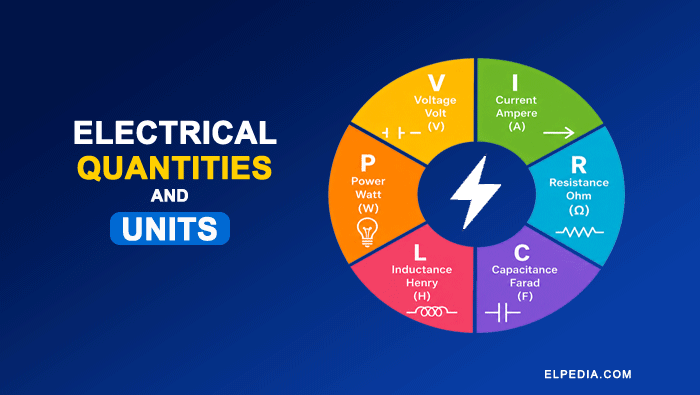
Every electrical system is based on a few fundamental concepts. Understanding electric charge, current, voltage, resistance, power, and energy provides the foundation for studying electrical circuits and electrical engineering.
Electric charge is a fundamental property of matter associated with electric and electromagnetic interactions. It is carried by particles such as electrons and protons and is measured in coulombs (C). An electron carries negative charge, while a proton carries an equal-magnitude positive charge.
Electrical engineering involves controlling how electric charges move and interact in conductors, electrical components, and semiconductor devices. Learn more about electric charge.
Electric current is the rate at which electric charge flows through a circuit. In metallic conductors, current is primarily associated with the movement of electrons. The SI unit of current is the ampere (A), where one ampere corresponds to one coulomb of charge passing a point in one second. A simple analogy is water flowing through a pipe: the rate of water flow can be compared with electric current.
Electrical engineers design circuits and power systems to maintain current within safe operating limits and prevent overheating or component failure. Learn more about electric current.
Voltage, or electric potential difference, is the difference in electric potential between two points. It represents the energy transferred per unit charge and is measured in volts (V). Voltage provides the potential difference that can drive current through a circuit. In the water analogy, voltage can be compared with a pressure difference that drives water through a pipe.
Electrical engineers must consider voltage ratings, insulation, clearances, and protection systems when designing electrical equipment. Learn more about voltage.
Resistance is the opposition offered by a material or component to the flow of electric current. It is measured in ohms (Ω). Resistance determines the relationship between voltage and current in a resistive element and depends on factors such as material, length, cross-sectional area, and temperature.
In the water analogy, resistance can be compared with restrictions in a pipe that oppose water flow. Electrical and electronic engineers use materials and semiconductor structures with controlled electrical properties to design components such as resistors, transistors, diodes, and solar cells. Learn more about electrical resistance and conductance.
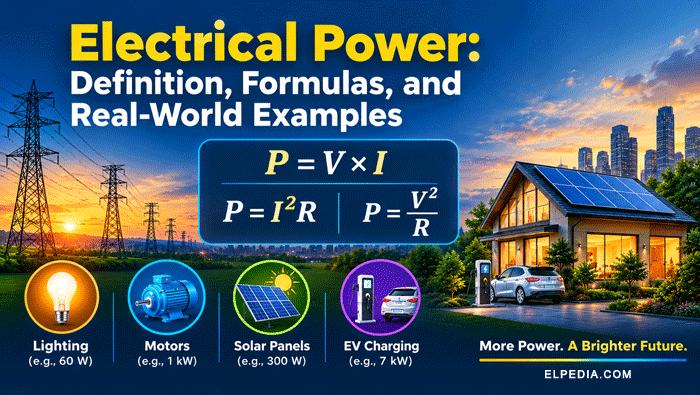
Electrical power is the rate at which electrical energy is transferred or converted. It is measured in watts (W). Electrical power is involved whenever electrical energy is supplied to, transferred through, or converted by a system.
Electrical power engineering deals with the generation, transmission, distribution, conversion, and utilization of electrical power, from small electronic devices to large power grids. Learn more about electric power.
The relationships among voltage, current, and resistance are described by Ohm’s law, while electrical power in a DC circuit can be calculated from the product of voltage and current. These fundamental relationships form the basis for analyzing many electrical circuits. Learn more about Ohm’s law.
Electrical energy is the capacity to do work and is commonly measured in joules (J). In practical electricity billing, energy consumption is usually expressed in kilowatt-hours (kWh). For example, a 1 kW heater operating continuously for one hour consumes 1 kWh of electrical energy. This is the quantity of energy typically recorded on an electricity meter and used to calculate electricity bills.
Beyond these basic quantities, Kirchhoff’s Current Law (KCL) and Kirchhoff’s Voltage Law (KVL) are fundamental laws used to analyze electrical circuits. Several circuit theorems, such as Thevenin’s theorem, Norton’s theorem, and the superposition theorem, further simplify the analysis of complex networks.
Together, these concepts, laws, and circuit theorems provide the foundation for analyzing electrical networks ranging from simple circuits to complex electrical and electronic systems. Learn more about basic electrical engineering concepts and definitions.
What is Electrical Engineering?
Electrical engineering is the study and application of electricity, electronics, electromagnetism, and related technologies to design, develop, operate, and maintain electrical and electronic systems.
These systems include power grids, electrical machines, electronic circuits, communication networks, control systems, and embedded devices.
Circuit analysis and design are fundamental parts of electrical engineering, but the discipline extends far beyond circuits into a wide range of specialized fields that support modern technology and infrastructure.
The practical development of electrical engineering as a distinct profession accelerated during the late 19th century.
Thomas Edison’s Pearl Street Station in New York, which began operation in 1882, was one of the first commercial central power stations and supplied 110 V direct current (DC) electricity to customers.
The subsequent “War of the Currents” involved competing DC and alternating current (AC) systems.
Edison’s company promoted DC, while George Westinghouse supported AC systems developed with contributions from Nikola Tesla.
AC eventually became dominant for large-scale power transmission and distribution because transformers made it possible to efficiently increase and decrease voltage levels.
These developments laid the foundation for the modern electrical power industry and the broader field of electrical engineering.
Electrical engineering includes many specialized areas, such as:
- Power and energy engineering
- Electrical machines
- Power electronics
- Control engineering
- Electronics and microelectronics
- Signal processing
- Telecommunications and wireless communication
- Computer and embedded systems
- Instrumentation and measurement
- Photonics and optical systems
- Renewable energy and smart grids
Electrical engineering is essential to many modern technologies, including electric power systems, smartphones, computers, medical imaging equipment, electric vehicles, industrial automation, renewable energy systems, and autonomous machines.
The field also overlaps significantly with other engineering and scientific disciplines. Electrical engineers work with computer scientists on computing, algorithms, and artificial intelligence; with mechanical engineers on mechatronics, robotics, and electromechanical systems; and with materials scientists on semiconductors, electronic materials, and advanced energy technologies.
This interdisciplinary nature gives electrical engineering a broad scope and allows electrical engineers to contribute to many industries, from energy and transportation to telecommunications, healthcare, manufacturing, computing, and aerospace.
Major Areas of Electrical Engineering
Electrical engineering has diversified into many subdisciplines that often overlap. Power engineers, electronics specialists, control engineers, and computer engineers frequently collaborate on projects that blend several areas.
Below is a concise tour of the major subfields.
Electrical Circuits
Circuit theory is the foundation of electrical engineering. Circuits consist of interconnected components forming paths for current, including resistors, capacitors, inductors, diodes, transistors, and integrated circuits connected by conductive paths.
Circuit nodes are junctions where circuit elements meet, and component connections in circuits can be arranged in series or parallel.
Electrical engineers use circuit analysis techniques like Kirchhoff’s Laws, which govern current and voltage in circuit analysis, along with simulation tools like SPICE software.
Common circuit types include analog circuits (amplifiers, filters, power regulators) and digital circuits (logic gates, flip-flops, microprocessor support circuits).
Impedance combines resistance and reactance in AC circuits, which is a key consideration in filter and amplifier design. Learn more about the electrical circuits.
Electrical Machines
Electrical machines convert electrical energy to mechanical energy and vice versa. Electric motors drive factory conveyors, drones, and electric vehicles, while generators in wind turbines and gas or steam turbines produce electrical power.
Changing magnetic fields induce currents according to Faraday’s Law, which is the principle behind every generator.
Electrical engineers design machine geometry, magnetic circuits, and control schemes to improve efficiency, torque, speed range, and reliability.
Modern electric vehicles and industrial robots rely on precisely controlled electrical machines integrated with power electronics and control systems.
For a closer look at machine fundamentals, look at the electrical machines.
Power Systems
Power systems engineering focuses on generation, transmission, and distribution of electric power.
Power generation and distribution moves electricity across national grids, from large plants and renewable sources to homes, businesses, and factories.
They work on power generation, transmission, and distribution systems at every level.
Key elements include power plants (coal, gas, nuclear, hydro, solar, wind), high-voltage transmission networks operating at 115–765 kV, substations with transformers and protection systems, and low-voltage distribution networks delivering 120/240 V or 230/400 V to consumers.
Modern power systems engineers increasingly integrate renewable energy, energy storage, and smart grid technologies.
Power Electronics
Power electronics uses semiconductor devices like IGBTs, MOSFETs, and thyristors to efficiently convert and control electric power.
Semiconductors control and switch currents essential in modern electronics, making this field critical for energy conversion.
Applications include solar inverters, EV chargers, variable-speed drives for industrial motors, and DC-DC converters.
Advances in wide-bandgap semiconductors like silicon carbide (SiC) and gallium nitride (GaN) are enabling more compact, efficient systems that produce less waste heat.
Control Systems
Control engineering designs systems to manage dynamic processes.
Control systems use feedback to adjust system behavior, keeping machines and processes at desired setpoints despite disturbances.
Control engineering employs algorithms for system optimization across diverse domains.
Applications include robotics, automotive systems, and industrial automation. It is essential for the operation of commercial airliners, where autopilots maintain altitude, heading, and speed.
Modern control systems use microcontrollers, PLCs, and real-time software implementing algorithms from basic PID control to advanced model-predictive control.
There is growing overlap with artificial intelligence, where machine learning methods enable adaptive, data-driven control in complex systems.
Instrumentation
Instrumentation engineering covers sensors, measurement systems, and data acquisition equipment that monitor physical quantities like voltage, current, temperature, pressure, and vibration.
Examples include power plant monitoring, medical instrumentation such as ECG and MRI systems, and industrial sensor networks.
Engineers ensure measurement accuracy, calibration, noise reduction, and safe isolation.
Supervisory Control and Data Acquisition (SCADA) systems combine instrumentation and control engineering to operate large infrastructures like water treatment plants and transmission grids.
Digital Electronics
Digital electronics uses discrete voltage levels, typically representing binary “0” and “1,” to process information.
Building blocks include logic gates, flip-flops, counters, arithmetic units, and microprocessors implemented as integrated circuits.
Microprocessors depend on electrical circuits and semiconductor technology, which is why this subfield sits at the intersection of electrical and computer engineering.
Applications span smartphones, laptops, automotive control units, consumer electronics, and communication infrastructure equipment like routers and base stations.
Digital electronics bridges electrical engineering and computer engineering, especially in areas like embedded systems and hardware design for artificial intelligence accelerators. To learn more, look at the articles on digital electronics.
Embedded Systems
Embedded systems are specialized computing systems built into products like washing machines, smart thermostats, drones, and medical devices to perform dedicated functions.
Electrical engineers working on embedded systems combine hardware design (microcontrollers, sensors, actuators, power supplies) with low-level software including firmware and real-time operating systems.
Modern examples include battery management systems in electric vehicles, control boards in solar inverters, and microcontroller-based IoT devices in smart homes and factories.
Embedded systems are central to the Internet of Things, enabling massive networks of connected devices that collect and exchange data.
Elpedia’s guide on embedded systems covers this topic in more depth.
How Electricity Reaches our Homes
In India, electricity is generated at power plants and renewable-energy projects and then transferred through a network of transmission and distribution systems befmagnetic circuitore reaching homes, businesses, and industries.
India had approximately 552 GW of installed power-generation capacity as of July 2026.
The basic journey of electricity is shown in the figure below and is explained.
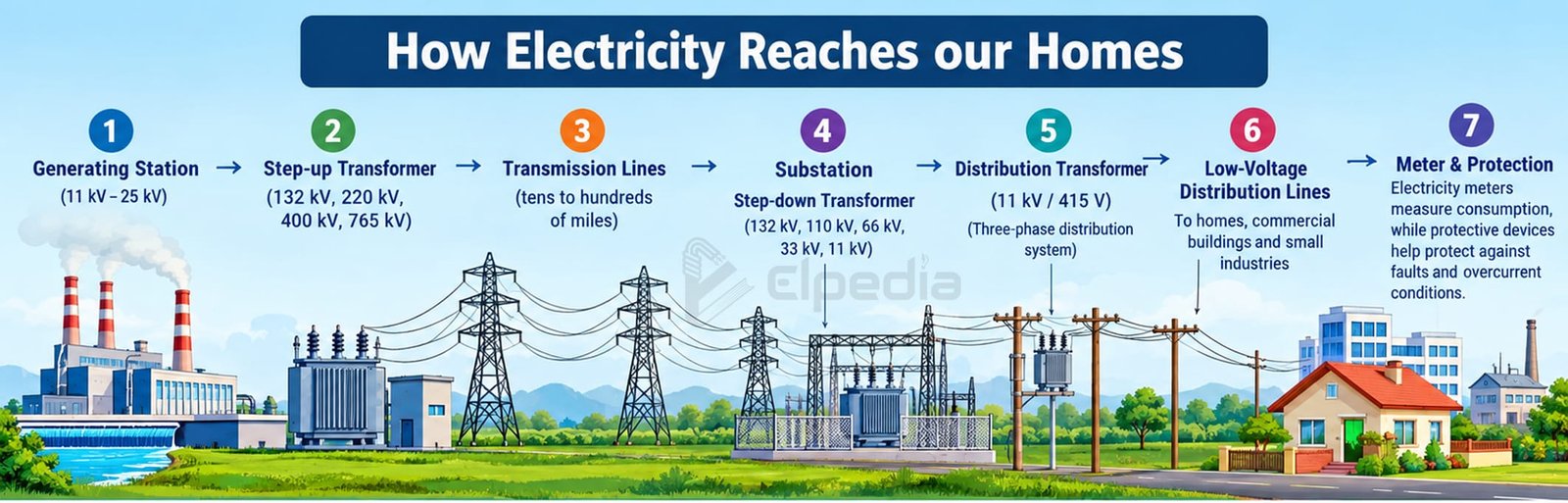
- Generating stations produce electricity at medium voltages, commonly around 11 kV to 25 kV, depending on the type and design of the generating unit. The generator output is connected to a switchyard and transformer for further transmission.
- Transformers at the generating station step voltage up to 132 kV, 220 kV, 400 kV, and 765 kV, reducing current and resistive losses over long distances.
- Transmission lines carry electricity tens to hundreds of miles. Circuit breakers, protective relays, and other protection equipment detect and isolate faults to protect the power system.
- At substations, transformers step down the voltage to medium levels such as 132 kV, 110 kV, 66 kV, 33 kV, and 11 kV, depending on the network and utility for distribution.
- Distribution transformers, commonly 11 kV/415 V in three-phase distribution systems, reduce the voltage to the low-voltage level used by consumers. In a typical Indian three-phase, four-wire system, the supply is approximately 415/230 V: about 415 V between phases and 230 V between a phase and neutral.
- From the distribution transformer, low-voltage distribution lines supply electricity to homes, commercial buildings, and small industries.
- Electricity meters measure the energy consumed by each consumer, while protective devices help protect electrical installations against faults and overcurrent conditions.
Electrical engineers design power plants and transmission lines to ensure projects meet reliability and safety standards.
Grid operators balance supply and demand in real time because electricity must be consumed as it is produced unless stored.
Distributed generation, such as rooftop solar feeding into local grids, and smart meters are changing how consumers interact with electric power.
Electrical Engineering Applications
Electrical engineers work across nearly every sector of the economy. Here are some of the most impactful domains:
- Energy and utilities: Power engineers design generation facilities, substations, and protection systems. They ensure compliance with grid codes and reliability standards.
- Transportation: Electric vehicles and automated transportation systems use electrical engineering for motor drives, battery management, charging infrastructure, and navigation systems. High-speed rail traction systems depend on power electronics and control engineering.
- Healthcare: Medical technologies use electrical systems developed through engineering, including MRI scanners, ECG monitors, ultrasound machines, and laser systems for surgery.
- Telecommunications: Telecommunications relies on manipulating electrical signals in semiconductors. Electrical engineers design telecommunications networks like cellular systems, 5G base stations, satellite links, and fiber optic networks. Wireless networks rely on electrical engineering principles involving signals and radio waves.
- Manufacturing: Automation uses electrical circuits and sensors in manufacturing and robotics. Engineers develop programmable logic controllers, robotic arms, and quality inspection systems using image processing.
- Consumer electronics: Engineers create products like smartphones, personal computers, gaming consoles, and related devices, handling everything from detailed calculations in circuit design to installation and test procedures.
Electrical engineers’ work directly affects safety, energy efficiency, cost, and user experience in everyday products and large infrastructures.
Renewable Energy
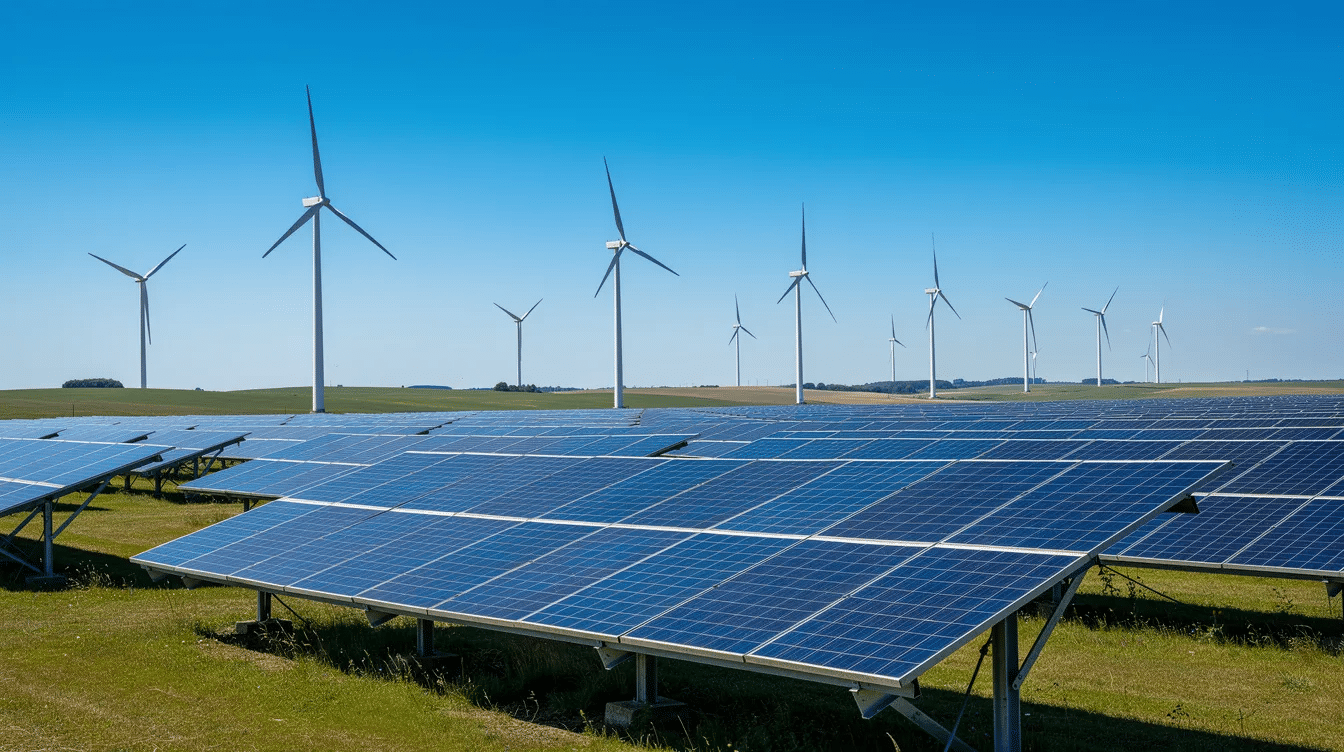
Renewable energy integration incorporates solar and wind into energy systems, driven by global decarbonization goals and policies like the EU Green Deal and the U.S. Inflation Reduction Act.
Renewable energy sources include solar and wind power, along with hydro and geothermal.
In 2023, renewables were the largest energy source in 57 countries.
By 2028, 68 countries will rely on renewable energy as their main source.
The IEA forecasts that renewables plus nuclear will provide around 50% of global electricity generation by 2030.
Electrical engineers are involved in renewable energy system design at every stage.
For solar, they design arrays, inverters converting DC to AC, and grid interconnections.
For wind, they engineer generators in turbines, power electronics for variable-speed operation, and grid code compliance.
Challenges include forecasting variable generation, deploying energy storage (batteries, pumped hydro), and upgrading protection systems to handle two-way power flows.
Automation and Smart Grids
Automation is the use of sensors, control systems, and communication networks to operate electrical equipment with minimal human intervention.
It spans manufacturing floors, commercial buildings, and power systems.
A smart grid is an electricity network that uses digital communication, advanced metering, and distributed control to improve reliability, efficiency, and integration of renewable energy and electric vehicles. Key technologies include:
- Advanced metering infrastructure (AMI) giving real-time usage feedback
- Automated fault detection and self-healing networks
- Demand response programs that shift loads to reduce peaks
- Distributed energy resource management systems (DERMS)
Electrical engineers design and implement automation solutions in substations, industrial plants, and smart buildings using PLCs, SCADA, and communication protocols like IEC 61850.
Cybersecurity is an increasingly important aspect, with engineers work alongside IT specialists to protect critical infrastructure from digital threats across the electrical grid.
Artificial Intelligence in Electrical Engineering
Artificial intelligence (AI) and machine learning (ML) have become increasingly important tools in electrical engineering.
Advances in computing power, data availability, and deep learning have enabled engineers to apply AI to increasingly complex electrical and electronic systems.
In power systems and smart grids, AI and ML are used for load forecasting, renewable energy forecasting, predictive maintenance of transformers and transmission equipment, fault detection and localization, power quality monitoring, energy management, and optimization of power-system operation.
AI can also support the integration of variable renewable energy sources such as solar and wind power into modern electrical grids.
In signal processing, machine learning algorithms can analyze large amounts of signal data and identify patterns that may be difficult to detect using conventional methods.
Applications include speech recognition, image processing, medical signal analysis, radar systems, wireless communications, condition monitoring, and industrial quality control.
In control engineering, AI-based and adaptive control techniques can improve the ability of systems to respond to changing operating conditions.
These techniques are being applied in areas such as autonomous robots, drones, industrial automation, electric vehicles, and other intelligent systems.
AI is also increasingly important in electronics and computer engineering. Electrical and computer engineers design and develop hardware accelerators, including GPUs, tensor processing units (TPUs), and application-specific integrated circuits (ASICs), to perform AI computations efficiently.
AI algorithms are also deployed in embedded and edge-computing systems, where data can be processed locally for real-time decision-making.
AI can further assist electrical engineers in design, simulation, optimization, and fault diagnosis.
For example, machine learning models can help optimize circuit designs, identify abnormal operating conditions, estimate system performance, and support predictive maintenance.
As electrical systems become more connected, automated, and data-driven, AI is expected to play an increasingly important role in areas such as smart grids, renewable energy, electric vehicles, industrial automation, robotics, power electronics, and intelligent electronic systems.
Evolution of Electrical Engineering
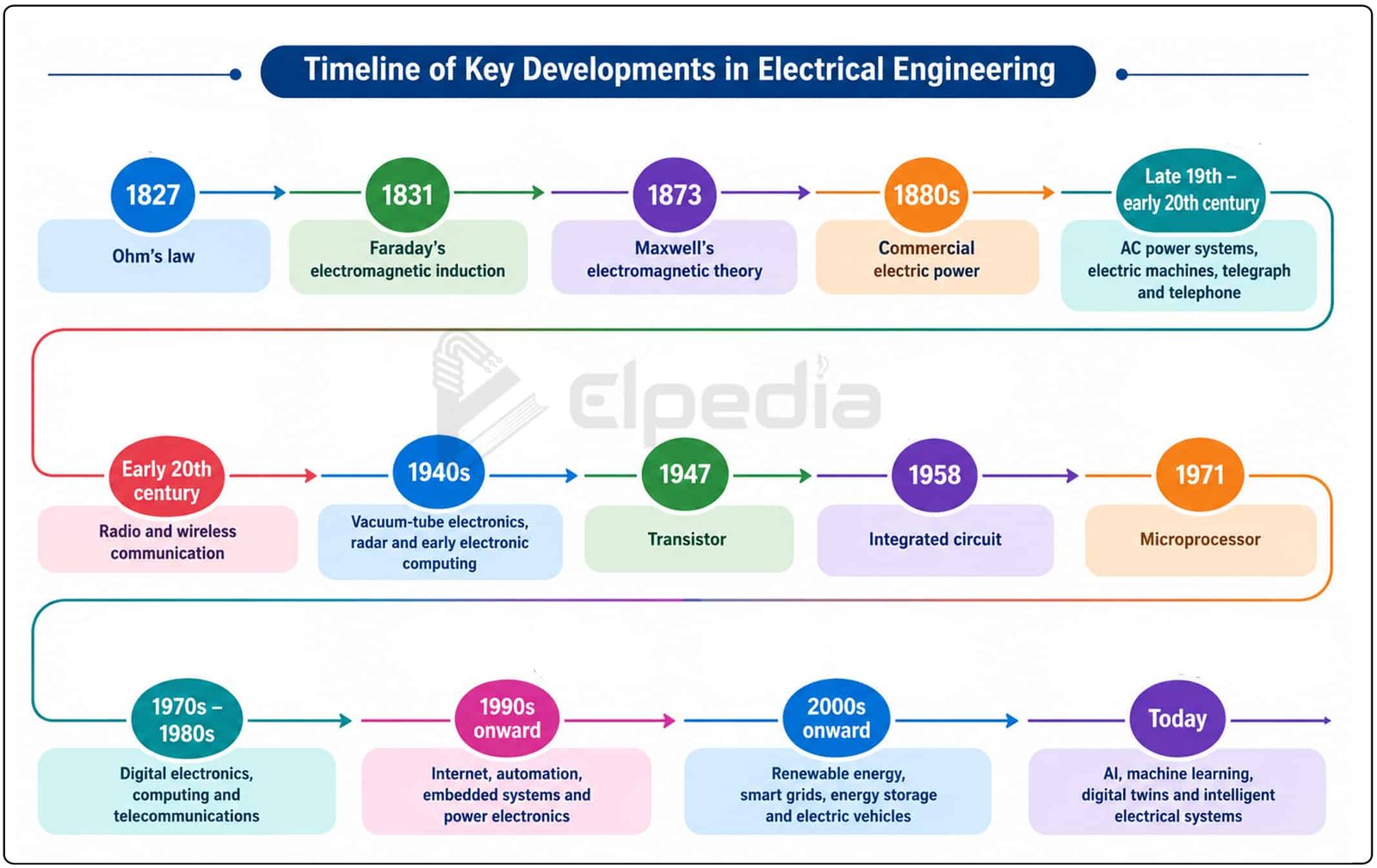
Electrical engineering has evolved from the study of electricity and electromagnetism into a broad field covering power systems, electronics, telecommunications, automation, renewable energy, and artificial intelligence.
The foundations were established during the 19th century. Georg Simon Ohm formulated Ohm’s law in 1827, Michael Faraday discovered electromagnetic induction in 1831, and James Clerk Maxwell developed a unified theory of electricity and magnetism in 1873.
These discoveries provided the scientific foundation for electrical generators, transformers, motors, and communication systems.
During the 1880s, commercial electric-power systems emerged, leading to the development of electrical generation, transmission, distribution, and utilization.
Telegraph and telephone networks expanded communication, followed by radio and wireless technologies in the early 20th century.
The development of electronics transformed the field during the 20th century. The transistor (1947), integrated circuit (1958), and microprocessor (1971) enabled increasingly smaller, faster, and more powerful electronic and computing systems.
From the late 20th century, electrical engineering expanded into digital electronics, telecommunications, computing, embedded systems, automation, and robotics.
Advances in power electronics also enabled applications such as variable-speed drives, electric vehicles, renewable-energy systems, and energy storage.
Since the 2000s, solar and wind energy, smart grids, microgrids, and battery storage have become increasingly important.
Today, electrical engineers also use software, data science, machine learning, and artificial intelligence for applications such as energy management, forecasting, fault diagnosis, and predictive maintenance.
Thus, electrical engineering continues to evolve from fundamental electrical principles toward intelligent, connected, and sustainable technologies.
Future of Electrical Engineering
The future of electrical engineering will be shaped by the growing demand for clean energy, electrification, intelligent systems, and reliable digital infrastructure. Several important trends are expected to influence the field in the coming decades:
- Renewable energy integration: Solar, wind, and other renewable-energy sources will continue to expand, creating new requirements for power conversion, grid integration, forecasting, and energy management.
- Smart grids and microgrids: Power systems will become more digital, flexible, and decentralized. Microgrids will provide localized energy systems that can operate independently or in coordination with the main grid.
- Electrification of transportation and heating: Electric vehicles, charging infrastructure, heat pumps, and other electric technologies will increase electricity demand and create new challenges for power-system planning and control.
- Energy storage and hydrogen: Battery storage and hydrogen technologies will support renewable-energy integration, energy storage, and flexible power-system operation.
- Advanced power electronics: Wide-bandgap semiconductor devices such as silicon carbide (SiC) and gallium nitride (GaN) will enable more efficient and compact power converters, motor drives, chargers, and renewable-energy systems.
- Internet of Things and intelligent infrastructure: Connected sensors and devices will generate large amounts of data that can be used for monitoring, automation, and optimization.
- Digital twins: Virtual representations of electrical equipment and power systems will increasingly support simulation, condition monitoring, predictive maintenance, and system optimization.
- Artificial intelligence: AI and machine learning will support applications such as load forecasting, renewable-energy forecasting, fault diagnosis, predictive maintenance, and intelligent energy management.
Emerging technologies such as quantum computing hardware, neuromorphic computing, advanced sensors, and new semiconductor materials will further expand the scope of electrical engineering.
As climate change, urbanization, increasing electricity demand, and aging infrastructure create new challenges, electrical engineers will play an important role in developing efficient, reliable, sustainable, and intelligent electrical systems.
Future engineers will increasingly combine knowledge of power systems, electronics, control engineering, communication, programming, data science, and artificial intelligence.
Career Opportunities in Electrical Engineering
Electrical engineers have career opportunities in a wide range of industries, including electric utilities, manufacturing, transportation, telecommunications, electronics, aerospace, healthcare technology, and computer hardware and software.
Electrical engineers also work with professionals from other engineering disciplines on multidisciplinary projects.
Depending on the organization and project, engineers with management experience may also take on project management and leadership responsibilities.
Common career roles include:
- Power systems engineer
- Electrical design engineer
- Control systems engineer
- Embedded systems engineer
- Electronics engineer
- Signal processing engineer
- Renewable energy engineer
- Instrumentation engineer
- Computer hardware engineer
- AI hardware engineer
The work of an electrical engineer may involve designing and analyzing circuits, developing electrical systems, performing simulations, writing and testing firmware, conducting field measurements, preparing technical specifications, and carrying out engineering calculations.
Electrical engineers must also consider reliability, efficiency, performance, and safety requirements when developing electrical systems and equipment.
A bachelor’s degree in electrical engineering or a closely related engineering field is typically required for entry-level electrical engineering positions. Electrical engineering programs generally lead to a four-year bachelor’s degree.
Engineers can pursue a master’s degree to develop specialized knowledge in areas such as power systems, control engineering, electronics, signal processing, renewable energy, embedded systems, or artificial intelligence.
Professional engineering licensure may be beneficial or required for certain engineering roles, particularly positions involving public safety, engineering services, or approval of engineering work.
Requirements vary by jurisdiction and may include education, examinations, and professional experience.
Employment opportunities are supported by developments in areas such as renewable energy, semiconductor and electronic systems, communications technologies, electrification, and modernization of electrical infrastructure.
The increasing use of advanced computing and AI technologies is also contributing to demand for electrical and computer hardware engineering skills.
Electrical engineering therefore offers career paths across traditional fields such as power and electrical machines as well as emerging areas such as renewable energy, electric transportation, embedded systems, semiconductor technology, and AI hardware.