Average Value and RMS value calculator
RMS value calculator is an electric tool, used to calculate the Peak to Peak value, RMS and Average value, form factor, and peak factor using this calculator.
Formulas used
Amplitude of the waveform
Amplitude of the waveform = Maximum value
For voltage,
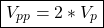
For current,

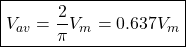
Average value of voltage is given by,
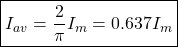
Average value of current is given by,
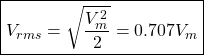
RMS value of voltage is given by,
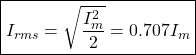
RMS value of current is given by,
Form Factor

Peak Factor

Where,
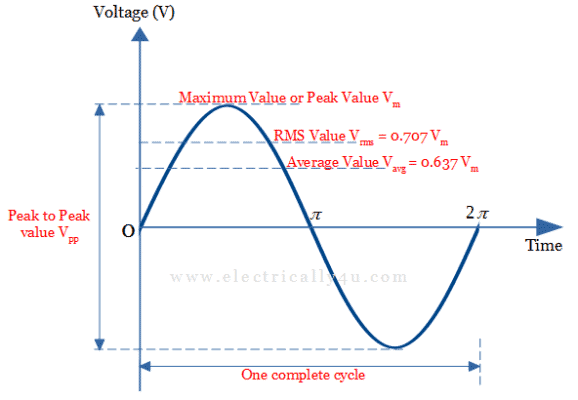
VP – Peak voltage is the maximum instantaneous value of a waveform measured from the zero-volt level. For the waveform shown below, the peak amplitude and maximum value are the same.
VPP – Peak to peak voltage is the voltage from the positive peak to the negative peak of the waveform. In other words, the sum of the magnitude of the positive and negative peaks.
Vrms – RMS voltage is the effective value or root mean square of a sine wave. It is the equivalent steady DC (constant) value that gives the same effect in AC.
Vavg – Average voltage is the average of all the instantaneous values of an alternating quantity over one complete cycle. That is, the area enclosed by the curve in the positive level is exactly equal to the area enclosed by the curve below this level.
Learn the related topics for clear understanding.
The Generalized AC waveform representing the peak value, average value and RMS value is shown below for your understanding.