New Articles

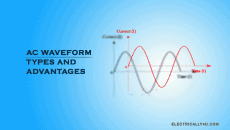
  • AC waveform | Types and Advantages

    There are two types of power supply: DC and AC. DC supply has constant magnitude with respect to time and hence called a Direct Current. In contrast, in AC supply the magnitude and direction change with time, hence called Alternating…
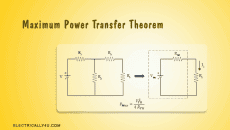
  • Maximum Power Transfer Theorem

    The maximum power transfer theorem is applicable to both AC and DC circuits. In any circuit, the maximum power drawn from the supply depends on the load. If the load is high, more power is drawn from the supply. Similarly,…

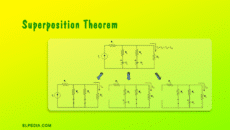
  • Superposition Theorem with solved problems

    Superposition theorem is used to solve the complex electric network, which consists of two or more sources and several resistances, by considering and analyzing all the sources individually. Superposition theorem states that, “In any linear, bilateral network having more than…

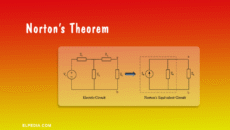
  • Norton’s Theorem with solved problem

    Norton’s theorem is used to solve complex circuits consisting of several sources and impedances by converting them into a simple equivalent circuit called Norton’s equivalent circuit. Now let’s look at the statement. Norton’s Theorem states that “Any linear bilateral circuit containing…
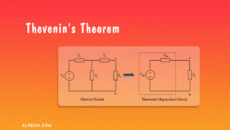
  • Thevenin’s Theorem with solved problem

    Thevenin’s theorem is used to solve the complex circuits consisting of several sources and impedances by converting them into a simple equivalent circuit called Thevenin’s equivalent circuit. Now let’s look at the statement. Thevenin’s Theorem states that “Any linear bilateral circuit…
  • Classification of Embedded System

    Embedded systems are classified based on different criteria like complexities, performance behavior, deterministic behavior, etc. Some of the major classifications are discussed below. Before looking into the classifications, learn about the embedded system and its characteristics. Based on Generation The…

  • Characteristics of an embedded System

    An embedded system is a computer system consisting of hardware and software components, which are embedded into a device to perform a specific function. An embedded system has its own unique characteristics, which make us identify and decide the system…

  • What is an Embedded system?

    An Embedded system is similar to a general-purpose computer. A general-purpose computer performs different applications like printing, scanning, playing games, reading and writing documents, hearing songs and videos, etc. But an embedded system is used to perform only specific applications….

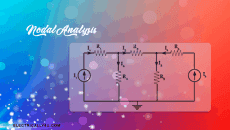
  • Nodal Analysis

    Introduction to Nodal Analysis Nodal analysis is one of the most widely taught and used techniques for analyzing electrical circuits. It is a fundamental topic in undergraduate circuit analysis courses and is also used in circuit simulation tools such as…

  • Mesh Analysis

    Mesh analysis is a systematic circuit analysis technique used to determine unknown currents and voltages in electrical circuits. It reduces the number of equations needed to analyze a circuit by assigning a current to each mesh and applying Kirchhoff’s Voltage…

  • Source Transformation in Electrical Circuits

    Source transformation is a method used for circuit simplification by replacing the voltage source with its equivalent current source or replacing the current source with its equivalent voltage source. For ideal electrical sources, losses will be zero. In the case…

  • Current Divider Rule

    The Current Divider Rule is applicable to parallel circuits, in which the current is divided into the number of parallel branches. The current in each branch may have a different value depending on the specification of branch component. In a…

  • Voltage Divider Rule

    The voltage divider rule explains, how the voltage gets divided in the circuit when two or more components are connected in series. The corresponding circuit is called a voltage divider or potential divider circuit. In this circuit, the voltage is…

  • Series and Parallel combination of Capacitor

    Capacitor is a passive element, in which the energy is stored in the form of electrostatic field. This property of capacitor is called as capacitance. The unit of capacitance is Farad(F), which was named after the British Scientist Michael Faraday….

  • Basic Terms in Electric Circuits | Types of Electric Networks

    Introduction to Electrical Networks An electrical network is any interconnection of electrical components like resistors, inductors, capacitors, voltage source elements, current source elements, switches, and more. An electric circuit is an electrical network that contains at least one closed path…

  • Programmable Array Logic(PAL)

    Programmable Array Logic (PAL) is a logic device, which has programmable AND array and fixed OR array. It is used to realize a logic function. In this PLD, only AND gates are programmable and hence it is easier to work…

  • Programmable Logic Array (PLA)

    Programmable Logic Array is a type of PLD, which has both programmable AND array and programmable OR array. In a combinational circuit, because of don’t care conditions, not all the minterms are used. In the case of PROM, where the…

  • Programmable Read-Only Memory(PROM)

    Programmable Read-only memory is one of the types of Programmable logic Devices (PLDs). PLDs are integrated circuits that perform a logic function based on user requirements. In general, a logic gate is an electronic component or integrated circuit that is…

  • Hazards in Digital Circuits | How to eliminate a hazard?

    Hazards are the unwanted switching transient that may appear at the output of the digital circuit. Such hazards may result in a malfunction in the output of the circuit. The propagation delay associated with the logic gates in the circuit…

  • Different types of Shift Register

    The shift register is a type of sequential circuit, where the data bits can be stored and can be transferred. Shift registers are constructed using flip-flops, so it is an application of flip-flops. Since flip-flop is a single-bit storage element,…

  • SR Flip flop – Circuit, truth table and operation

    SR flip flop, also known as SR latch is the basic and simplest type of flip flop. It is a single bit storage element. It has only two logic gates. The output of each gate is connected to the input…

  • What is a flip flop? How it differs from a Latch?

    Flip flops and latches are the two important elements of any digital circuit. They are used as a memory device in digital ICs. Both the flip flop and latch are used to store one-bit data at a time. But there…

  • Code converter | Types | Truth table and logic circuits

    The Code converter is used to convert one type of binary code to another. There are different types of binary codes like BCD code, gray code, excess-3 code, etc. Different codes are used for different types of digital applications. To…

  • What is a decoder? Operation, types and applications

    A decoder is a multiple-input, multiple-output combinational logic circuit. It converts the n bit data inputs into the coded 2n outputs. It decodes the information hidden by the encoder. While decoding, the decoder generally places logic 1 at one of…

  • What is a multiplexer? Operation, types and applications

    A multiplexer (MUX) is a combinational logic circuit, which selects and delivers a single input as output from multiple input lines. It performs the similar operation of a switch. Hence, we can call it a digital switch. In digital systems,…

  • CMOS logic family | NMOS and PMOS

    CMOS logic family is a group of logic circuits, built with complementary MOS devices. All the logic gates that are built with MOSFET devices will come under MOS logic family. MOS Logic family can be classified into three categories. They…

  • Emitter Coupled Logic (ECL)

    Emitter coupled logic is the fastest of all digital logic families. It was invented by Hannon S. Yourke in the year 1956 at IBM. It is also called as current mode logic. The design of ECL circuit consists of transistors and…

  • Transistor-Transistor Logic (TTL)

    Transistor-Transistor Logic belongs to the digital logic family. It consists of transistors at both input and output side, diodes and few resistors. Unlike Resistor-transistor logic and Diode transistor logic, both the logic function and amplifying function are performed by the…

  • Diode Transistor Logic (DTL)

    Diode transistor logic(DTL) belongs to the digital logic family. This logic circuit has diodes at the input side and transistor at the output side and so the name diode transistor logic. It has more advantages than resistor transistor logic(RTL). Logic…

  • Resistor Transistor Logic (RTL)

    Resistor Transistor Logic (RTL) is one of the early digital logic families developed for implementing basic logic functions using resistors and bipolar junction transistors (BJTs). It was the first monolithic integrated circuit originally introduced by Fairchild in the year 1961….

  • Classification and Characteristics of Digital Logic Family

    A digital logic family is a group of digital logic gates and integrated circuits designed using similar electronic technologies, such as resistors, diodes, transistors, MOSFETs, and other semiconductor devices. Logic gates belonging to the same family are designed to have…

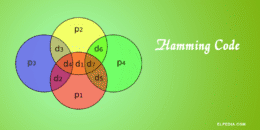
  • Hamming code with solved problems

    Hamming Code in computer network is one of the most widely used error detection and correction codes. It was originally invented by Richard W. Hamming in the year 1950. The Hamming code algorithm improves communication reliability while requiring only a small…

  • Error Detection and correction codes | Parity code

    An error is the common cause of any system, either it may be digital or analog. Error detection and correction codes allow the detection and correction of an error while transmitting the binary information. In digital electronics system or digital…

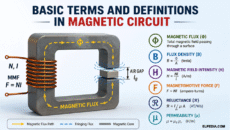
  • Basic Terms and Definitions in Magnetic circuit

    Introduction to Magnetic Circuits A magnetic circuit is a closed path in which magnetic flux Φ is established and guided, typically by a magnetizing coil carrying electric current or by a permanent magnet. Just as electrical circuits provide a route…

  • Characteristics of self-excited DC Generator

    For self-excited DC generator, the performance is analyzed with three different characteristics. They are no-load characteristics, internal and external characteristics. In this section, you will be learning about the characteristics of DC shunt generator, series generator and compound generator in…

  • Characteristics of separately excited DC Generator

    The performance of a separately excited DC generator is analyzed with the help of three different characteristics: Magnetic or no-load or open circuit characteristics, internal or total characteristics and external characteristics. Before getting into the topic, be strong with the…

  • Types of DC Generator and its equation

    DC generators convert mechanical energy into electrical energy. For this conversion to take place, dc generators require a magnetic field. The magnetic field is produced by the field coil or winding. DC generators are classified based on the way in…

  • EMF equation of a DC Generator

    An emf is induced in a DC generator, when a conductor is rotated in a magnetic field. The emf induced in a conductor depends on the speed of rotation of the conductor and the flux produced from a field winding….

  • Working Principle of DC Generator

    A DC generator converts the mechanical input into an electrical output. The mechanical energy input is given to the dc generator by means of a prime mover. The prime mover can be a dc motor, water turbine, steam turbines, hand…

  • Alternator on load

    Whenever the load on the alternator is varied, the terminal voltage will also vary. This variation in terminal voltage is mainly due to three reasons: Voltage drop due to armature resistance IRa, the voltage drop due to armature leakage reactance…

  • Armature reaction in Alternator or Synchronous Generator

    Armature reaction is an important aspect in DC generator and AC synchronous Generator or Alternator. Armature reaction in alternator is defined as the effect of armature flux on the main flux produced by the field poles. An electric machine normally…

  • EMF equation of alternator

    The emf induced by the alternator or synchronous generator is three-phase alternating in nature. Let us derive the mathematical equation of emf induced in the alternator. Let, Z = number of conductors in series per phase. Z = 2T, where…

  • Design of parallel subtractor

    The parallel subtractor is similar to the design of a parallel adder, both in its structure and operation. It is a combinational circuit, used to perform subtraction of multi-bit binary numbers. Why parallel subtractor? As you know, half subtractor is…

  • Design of Parallel Adder

    Parallel adder is a combinational circuit, used to add multi-bit binary numbers. With half adder and full adder in use, What is the need for going to parallel adder? What is parallel adder? How it works? In this topic, you…

  • Half Subtractor and Full Subtractor

    Half subtractor and full subtractor are the combinational logic circuits used in digital computer systems. Digital computers perform number of computations in their lifetime. In which, subtraction is one of the common and essential operation. To perform such operations, half…

  • Half Adder and Full adder

    A digital computer performs different operations with devices like half adder, full adder, half subtractor, full subtractor, parallel adder, BCD adder, multiplexer, demultiplexer, decoder, encoder, code converters, etc. Theses circuits are called as combinational circuits. In this post, you will…

  • Different Types of Transformer

    There are different types of transformers based on the application, nature of use and number of phases. Based on the application, transformers are widely used in the electric power system to transmit the electric power between power plants, substations, industries…

  • Universal Logic gates

    Universal logic gates are used to build all other logic functions. NAND gate and NOR gate are known as universal logic gates. With these two gates, other logic functions like AND, OR, NOT, NOR, EX-OR or Ex-NOR can be implemented….

  • Logic Gates

    Logic gates are the basic building blocks of any digital system. Generally, a digital circuit will consists of number of logic gates, which receive the binary inputs and perform a logical operations like AND, OR and NOT. There are two…

  • Minimization of Boolean function using k-map

    The Karnaugh map or K-map is used for minimization or simplification of Boolean function either in Sum of Product(SOP) form or in Product of Sum(POS) form. Before proceeding with the minimization procedures using K-map, you should be clear with the…

  • Plotting Karnaugh Map with examples

    Simplification of Boolean expression by using postulates and theorems of Boolean algebra can never be the simplest possible expression. So we use the Karnaugh map or K map to simplify the boolean expressions. What is Karnaugh map or K-map? Karnaugh…

  • Sum of Product and Product of Sum Form

    Sum of Product and Product of Sum Form are the two forms of boolean expressions. Generally, Boolean expressions are built with constants and variables. These expressions describe the Boolean function. For example, in an expression f = A + (B…

  • Postulates and Theorems of Boolean Algebra

    Boolean algebra is a system of mathematical logic, introduced by a mathematician George Boole in 1854. Boolean algebra differs from ordinary algebra and binary number system. It is a binary algebra defined to perform binary and logical operations. Take a…

  • BCD and Excess-3 codes

    BCD Code BCD code is an abbreviation for Binary coded Decimal codes. It is a numeric weighted code, in which each digit of a decimal number is represented by a separate group of 4-bits. There are several BCD codes like…

  • Binary Codes

    Binary codes are the group of symbols which are used to encode the numbers, alphabets or special characters by using a group of bits. This group of bits is known as binary codes. Classification of binary codes The following figure…

  • Arithmetic operation of binary numbers

    The arithmetic operation of binary numbers include the basic operations like binary addition, binary subtraction, binary multiplication and binary division. Let’s take a look at each of the operation. Before proceeding, take your time to know about the different number…

  • Number system conversion

    As we are dealing with the electronic system and digital system in our daily life, we should be aware of the different number system conversion. There are different ways to convert one number system to the other. Take a look…

  • Number systems

    The number system is a systematic way of representing numbers. It defines the set of values used to represent a quantity. The numbers are the mathematical value used to count, compute or measure the task or event that occurred. The…

  • Construction of DC Generator

    The construction of DC generator is same as that of the DC motor. It means, a DC machine can be used both as a generator and as a motor. When the machine is driven by a prime mover, it converts…

  • Armature winding in alternator

    For an alternator, the armature is kept stationary on the stator. The stationary armature has several advantages over rotating armature. The armature winding is placed on the slots of the stator. The armature winding of dc machine is of closed-circuit…

  • Parallel operation of Alternator

    Parallel operation of alternator is a method of adding an alternator in the existing live system with another alternator. When there is more demand for power to supply the load, there comes the need for an additional generator. So, additional…

  • EMF Equation of a transformer

    The emf equation of a transformer is derived by considering a single-phase transformer. When a single-phase AC supply is given to a transformer, the emf gets induced in the secondary winding by means of electromagnetic induction. Let, N1 be the…

  • Construction of Transformer and its working Principle

    The transformer is a static device in its construction and the principle behind the working of transformer is Faraday’s law of Electromagnetic Induction. In this article, let us learn about the construction and working of transformers. What is a transformer? The…

  • Voltage regulation of Alternator by MMF method

    Voltage regulation of alternator by MMF method requires mmf (which is a product of field current(I) and number of turns(N) of field winding) for two separate purposes. The field mmf (If1) required to induce the rated terminal voltage is obtained…

  • Voltage regulation of Alternator by EMF method

    The voltage regulation of alternator by EMF method involves the EMF quantities of all the armature parameters (armature resistance, Armature leakage reactance, armature reaction). The drop due to armature reaction is not considered, because it does not occur due to…

  • Voltage Regulation of Alternator

    The voltage regulation of alternator is defined as “the rise in voltage at the terminals, when the load is reduced from full load rated value to zero, speed and field current remaining constant”. With the change in load, there is a…

  • Construction and working of alternator

    The construction of alternator or synchronous generator is very much similar to the DC machines. In the DC generator, the armature winding is placed in the rotor and the field winding is placed in the stator. This type of construction…

  • Basic Laws of Electrical Engineering

    Introduction to Basic Electrical Engineering Laws The fundamental laws of electrical engineering are called “fundamental” because they express conservation of charge, energy, and flux in any electric circuit or electromagnetic field. Without them, analyzing even basic electrical circuits would be…