Efficiency of DC machine
The efficiency of DC machine is an important parameter used to evaluate the performance of a direct-current electrical machine. In general, efficiency is defined as the ratio of output power to input power.
It indicates how effectively a DC machine converts input power into useful output power while accounting for the different losses occurring during operation.
Depending on whether the machine operates as a generator or a motor, the direction of energy conversion changes, but the fundamental concept of efficiency remains the same.
A DC generator converts mechanical energy supplied by a prime mover into electrical energy, whereas a DC motor converts electrical energy into mechanical energy.
In both cases, a portion of the input power is inevitably lost in the armature winding, field winding, magnetic circuit, brushes, bearings, and other mechanical components. These losses reduce the useful output power and consequently affect the overall efficiency of the machine.
In this article, the efficiency of DC machine is explained in detail, including the efficiency of DC generator, efficiency of DC motor and the condition for maximum efficiency. Before proceeding, read the previous articles on losses and power flow in dc machine for clear understanding.
Efficiency of DC generator
The efficiency of DC generator can be evaluated using mechanical efficiency, electrical efficiency, and commercial or overall efficiency.
Mechanical efficiency represents the ratio of electrical power developed in the armature to the mechanical power supplied by the prime mover. It is given by,
![\[ \eta_m = \frac{\text{Electrical Power developed by the armature}}{\text{Total Mechanical Power Input}} \]](https://elpedia.com/wp-content/ql-cache/quicklatex.com-3852249795cf98427113ceee967309e3_l3.png "Rendered by QuickLaTeX.com")
![\[ \eta_m = \frac{E_g I_a}{\text{Brake HorsePower of Prime mover x 735.5}} \]](https://elpedia.com/wp-content/ql-cache/quicklatex.com-357c90cb828f8169e24c4763d3b15017_l3.png "Rendered by QuickLaTeX.com")
Electrical efficiency represents the ratio of useful electrical output to the electrical power developed by the armature. It is given by,
![\[ \eta_e = \frac{\text{Useful Electrical Power Output}}{\text{Electrical Power developed}} \]](https://elpedia.com/wp-content/ql-cache/quicklatex.com-b586acba73f2d4d080d52e8edcc67b57_l3.png "Rendered by QuickLaTeX.com")
![\[ \eta_e = \frac{VI_L}{E_g I_a} \]](https://elpedia.com/wp-content/ql-cache/quicklatex.com-cf56d97610b93e59beca417c575d0191_l3.png "Rendered by QuickLaTeX.com")
The product of these efficiencies gives the overall efficiency of the DC generator. Commercial efficiency or overall efficiency is given by,
![\[ \eta_G = \eta_m . \eta_e = \frac{\text{Useful Electrical Power Output}}{\text{Total Mechanical Power Input}} \]](https://elpedia.com/wp-content/ql-cache/quicklatex.com-6ad17b78d10582bf0ea5342f8164a304_l3.png "Rendered by QuickLaTeX.com")
![\[ \eta_G = \frac{VI_L}{\text{Brake HorsePower of Prime mover x 735.5}} \]](https://elpedia.com/wp-content/ql-cache/quicklatex.com-fe59518c463ca50755e66fd07af20b13_l3.png "Rendered by QuickLaTeX.com")
In order to express the above equation in electrical terms, the input power can also be expressed as the sum of output power and losses. So in the above expression,
Total Mechanical Power Input = Electrical Power Input + Total Losses.
Therefore, the efficiency of dc generator is now expressed as,
![\[ \eta_G = \frac{\text{Useful Electrical Power output}}{\text{Electrical Power Input + Total Losses}} \]](https://elpedia.com/wp-content/ql-cache/quicklatex.com-b39ec4b80c1c69532b79165d21e65c20_l3.png "Rendered by QuickLaTeX.com")
![\[ \eta_G = \frac{VI_L}{VI_L + \text{Total Losses}} \]](https://elpedia.com/wp-content/ql-cache/quicklatex.com-bbc0857197bfec80271d60b8e6684b12_l3.png "Rendered by QuickLaTeX.com")
Efficiency of DC Motor
Similarly, the efficiency of a DC motor can be determined from its electrical, mechanical, and overall efficiencies by considering the electrical input and useful mechanical output.
Electrical Efficiency is given by,
![\[ \eta_e = \frac{\text{Mechanical Power developed}}{\text{Total Electrical Power Input}} \]](https://elpedia.com/wp-content/ql-cache/quicklatex.com-e4b9b22ceb5ced4dcf8d96b238062215_l3.png "Rendered by QuickLaTeX.com")
![\[ \eta_e = \frac{E_b I_a}{VI_L} \]](https://elpedia.com/wp-content/ql-cache/quicklatex.com-734a5e105ccd493a999cf1b345bdb286_l3.png "Rendered by QuickLaTeX.com")
Mechanical efficiency is given by,
![\[ \eta_m = \frac{\text{Useful Mechanical Power Output}}{\text{Mechanical Power developed}} \]](https://elpedia.com/wp-content/ql-cache/quicklatex.com-81876db28e739410d819629d654154c7_l3.png "Rendered by QuickLaTeX.com")
![\[ \eta_m = \frac{\text{Brake HorsePower of motor x 735.5}}{E_b I_a} \]](https://elpedia.com/wp-content/ql-cache/quicklatex.com-47ee8601cd6b9968610aa43934f9f186_l3.png "Rendered by QuickLaTeX.com")
Commercial or overall efficiency of DC motor is given by,
![\[ \eta_M = \eta_m . \eta_e = \frac{\text{Useful Mechanical Power Output}}{\text{Total Electrical Power Input}} \]](https://elpedia.com/wp-content/ql-cache/quicklatex.com-ec9d5bda084b4b48d6a644bbbb206eaf_l3.png "Rendered by QuickLaTeX.com")
![\[ \eta_M = \frac{\text{Brake HorsePower of motor x 735.5}}{VI_L} \]](https://elpedia.com/wp-content/ql-cache/quicklatex.com-e133056e875461594b0ac0ca9577b01a_l3.png "Rendered by QuickLaTeX.com")
The output power can also be obtained by subtracting the total losses from the input power. So in the above expression,
Total Mechanical Power Output= Electrical Power Input – Total Losses.
Therefore, the efficiency of dc motor is now expressed as,
![\[ \eta_M = \frac{\text{Total Electrical Power Input - Total Losses}}{\text{Total Electrical Power Input}} \]](https://elpedia.com/wp-content/ql-cache/quicklatex.com-da27c91f14a1f51c6095fd553c6e3750_l3.png "Rendered by QuickLaTeX.com")
![\[ \eta_M = \frac{VI_L - \text{Total Losses}}{VI_L} \]](https://elpedia.com/wp-content/ql-cache/quicklatex.com-28b8b77e07ce9c90cf6b8269f6499eff_l3.png "Rendered by QuickLaTeX.com")
An important aspect of the efficiency of DC machine is its variation with load. The machine does not operate at maximum efficiency under all loading conditions because some losses remain approximately constant, while others vary with the load current.
In particular, copper losses increase approximately with the square of the armature current, whereas core, mechanical, and certain field losses can be treated as constant under specified operating conditions.
Condition for Maximum Efficiency
The condition for maximum efficiency of DC machine is therefore an important concept in the design and operation of DC generators and motors. The condition for maximum efficiency is the same for DC generator and DC Motor. Let us consider the DC Generator.
![\[ \text{Generator Output} = VI_L \, \text{watts} \]](https://elpedia.com/wp-content/ql-cache/quicklatex.com-c965a586fd191b0393316f1fec3b70b0_l3.png "Rendered by QuickLaTeX.com")
![\[ \text{Generator Input} = \text{Output + Losses } \]](https://elpedia.com/wp-content/ql-cache/quicklatex.com-0d1e670b92aa1865711895daf98117de_l3.png "Rendered by QuickLaTeX.com")
![\[ \text{Generator Input} = VI_L + I_a^2 R_a + W_i\]](https://elpedia.com/wp-content/ql-cache/quicklatex.com-4e69e21eb1c5555e66394c40230c1554_l3.png "Rendered by QuickLaTeX.com")
where Wi represents the core loss or iron loss.
![\[ \text{Generator Input} = VI_L + (I_L+I_{sh})^2 R_a + W_i\]](https://elpedia.com/wp-content/ql-cache/quicklatex.com-c484cde669acbd3b5f370f6cbfcbd5d6_l3.png "Rendered by QuickLaTeX.com")
In the above equation, the shunt field current (Ish) can be neglected because it is very small compared to the load current (IL).
![\[ \text{Generator Input} = VI_L + I_L^2 R_a + W_i\]](https://elpedia.com/wp-content/ql-cache/quicklatex.com-2d10582b3c6df32ed4c89dd9bc53c7fc_l3.png "Rendered by QuickLaTeX.com")
Thus the generator efficiency is given by,
![\[ \eta = \frac{\text{Output}}{\text{Input}} = \frac{VI_L}{VI_L + I_L^2 R_a + W_i} \]](https://elpedia.com/wp-content/ql-cache/quicklatex.com-76bc65116be023f93b359d2ae2d5155f_l3.png "Rendered by QuickLaTeX.com")
Dividing the numerator and denominator by VIL, we get,
![\[ \eta = \frac{1}{1 + \frac{I_L R_a}{V} + \frac{W_i}{VI_L}} \]](https://elpedia.com/wp-content/ql-cache/quicklatex.com-e759998ec1eba922c459e37108a3043c_l3.png "Rendered by QuickLaTeX.com")
The efficiency will be maximum when denominator is minimum. So the denominator is differentiated with respect to the variable IL and equate to zero.
![\[ \frac{d}{dI_L}\left(\frac{I_L R_a}{V} + \frac{W_i}{VI_L} \right) = 0 \]](https://elpedia.com/wp-content/ql-cache/quicklatex.com-125694dd3f64316f17ddec6bcf6e4e9f_l3.png "Rendered by QuickLaTeX.com")
Differentiating the above equation,
![\[\frac{R_a}{V} - \frac{W_i}{VI_L^2} = 0 \]](https://elpedia.com/wp-content/ql-cache/quicklatex.com-3f4452afe5115a7f22be4ee67ba15ec8_l3.png "Rendered by QuickLaTeX.com")
![\[ I_L^2R_a = W_i \]](https://elpedia.com/wp-content/ql-cache/quicklatex.com-11094ae2ec9d5a2ab253c55579d00d87_l3.png "Rendered by QuickLaTeX.com")
It indicates that the efficiency of DC machine will be maximum when variable losses are equal to the constant losses. At this condition, the load current is given by,
![\[I_L = \sqrt{\frac{W_i}{R_a}} ---> (1) \]](https://elpedia.com/wp-content/ql-cache/quicklatex.com-e8e8b0a75400971b1328f5446c34e8f6_l3.png "Rendered by QuickLaTeX.com")
The efficiency of DC machine changes with the load, as shown in the following figure.
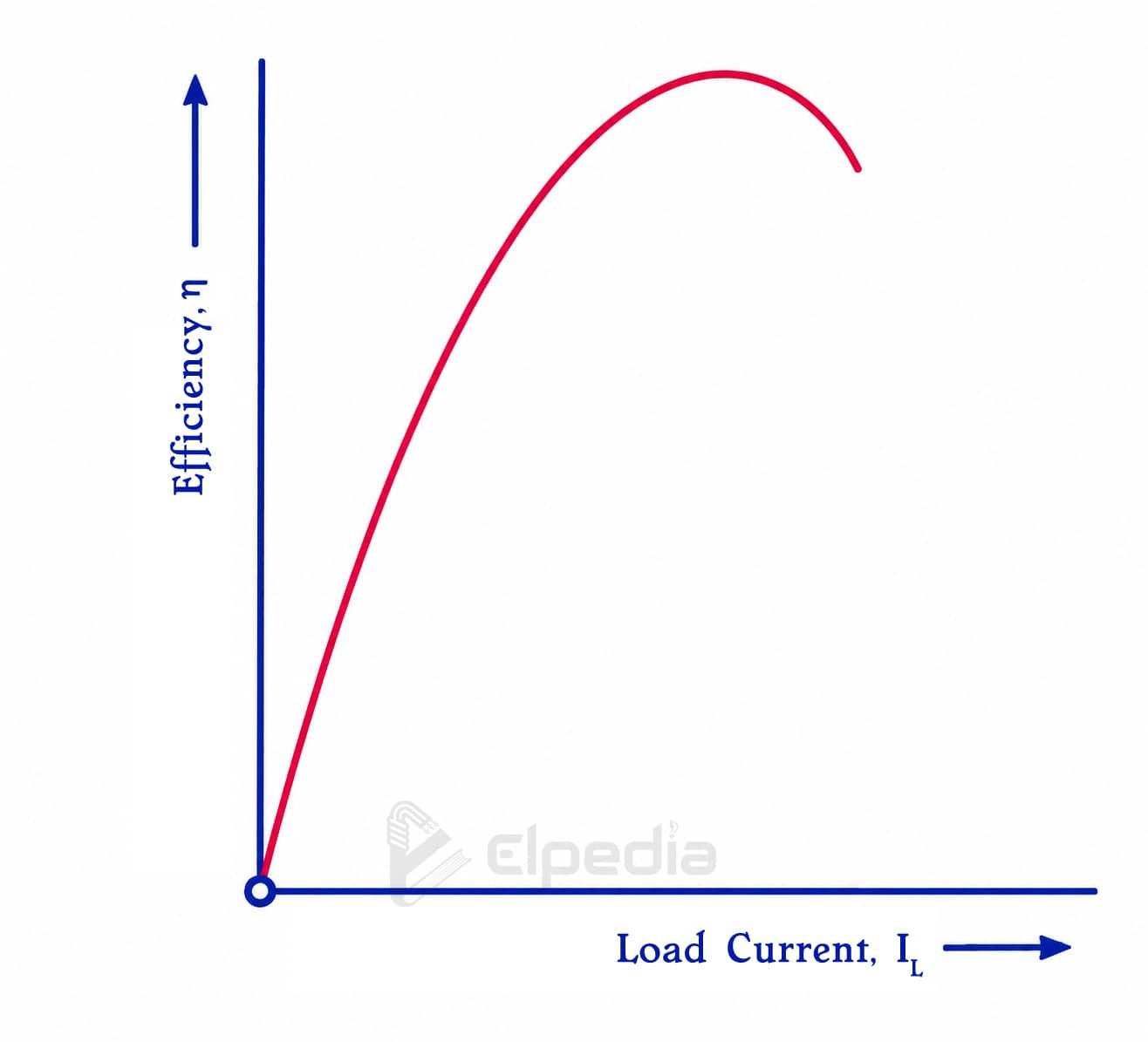
As the load current increases, the efficiency of machine also increases up to a certain point. The efficiency reaches its maximum value when the load current reaches the value given by Equation(1).
Beyond this point, further increase in load current causes the efficiency to decrease. Therefore, DC machines are generally designed to achieve maximum efficiency at or close to their rated load.
In the following section, solved problems on efficiency of DC machine have been discussed for better understanding of the theoretical concepts.
Solved Problem 1
A dc motor drives a 100 kW generator having an efficiency of 87%: (i) What should be the kW rating of the motor? (ii) If the overall efficiency of the motor generator set is 74%, what is the efficiency of the motor? (iii) Also calculate the losses in each machine.
Given:
- Generator Output = 100 kW
- Generator efficiency, ηg = 87 % = 0.87
To find:
- kW rating of the motor
- Efficiency of the motor
- Losses in each machine
Solution :
(1) kW rating of the motor
In general, KW rating of motor = Motor Output in kW. Also, since the motor is driving the dc generator, Motor Output in kW = Generator Input in kW.
We know,
![\[\eta_g = \frac{\text{Generator Output in kW}}{\text{Generator Input in kW}} \]](https://elpedia.com/wp-content/ql-cache/quicklatex.com-4ff2c3c7ec15d6a020638a7017b6a669_l3.png "Rendered by QuickLaTeX.com")
![\[\text{Generator Input in kW} = \frac{\text{Generator Output in kW}}{\eta_g} \]](https://elpedia.com/wp-content/ql-cache/quicklatex.com-fb553410494c65af61582d2e7864c750_l3.png "Rendered by QuickLaTeX.com")
![\[\text{Generator Input in kW} = \frac{100}{0.87} = 114.94 \, kW \]](https://elpedia.com/wp-content/ql-cache/quicklatex.com-9a798dc05d2a9d55d9d3a92aacc7b34c_l3.png "Rendered by QuickLaTeX.com")
![\[\boxed {\text{kW rating of motor} = 114.94 \, kW }\]](https://elpedia.com/wp-content/ql-cache/quicklatex.com-5cf23a56df161bfd6a95e70a943aa5cb_l3.png "Rendered by QuickLaTeX.com")
(2) Efficiency of the motor
![\[ \text{Overall efficiency of the motor generator set} = \eta_m . \eta_g = 0.74 \]](https://elpedia.com/wp-content/ql-cache/quicklatex.com-eea6555ce3887d74a9132e632e845264_l3.png "Rendered by QuickLaTeX.com")
![\[\text{Motor Efficiency}, \eta_m = \frac{\text{Overall efficiency}}{\eta_g} \]](https://elpedia.com/wp-content/ql-cache/quicklatex.com-952f38708675dae43af2b5a6c0bc52f3_l3.png "Rendered by QuickLaTeX.com")
![\[\text{Motor Efficiency}, \eta_m = \frac{0.74}{0.87} = 0.8506 \]](https://elpedia.com/wp-content/ql-cache/quicklatex.com-256a41251464cce7ad8b94e63811014c_l3.png "Rendered by QuickLaTeX.com")
![\[\boxed{\text{Motor Efficiency}, \eta_m = 85.06 \, \% } \]](https://elpedia.com/wp-content/ql-cache/quicklatex.com-d83c12fcea15cff80a3b2d28ec67a39e_l3.png "Rendered by QuickLaTeX.com")
(3) Losses in each machine
![\[ \text{Losses in generator} = \text{Generator input} - \text{Generator output} \]](https://elpedia.com/wp-content/ql-cache/quicklatex.com-eb6272594ae0da8ada34ca5bce5e7e69_l3.png "Rendered by QuickLaTeX.com")
![\[ \text{Losses in generator} = 114.94 - 100 \]](https://elpedia.com/wp-content/ql-cache/quicklatex.com-9a99e14d0534dd1b2c0ec89d9aa6a05b_l3.png "Rendered by QuickLaTeX.com")
![\[ \boxed{\text{Losses in generator} = 14.94 \, kW} \]](https://elpedia.com/wp-content/ql-cache/quicklatex.com-6924c43fc6700aa77399ec9233d8803b_l3.png "Rendered by QuickLaTeX.com")
![\[ \text{Losses in motor} = \text{motor input} - \text{motor output} \]](https://elpedia.com/wp-content/ql-cache/quicklatex.com-3d4382b022445adeb7b4e431e61fda7f_l3.png "Rendered by QuickLaTeX.com")
![\[ \text{Motor input} = \frac{\text{Motor output}}{\eta_m} = \frac{114.94}{0.8506} = 135 \, kW \]](https://elpedia.com/wp-content/ql-cache/quicklatex.com-92c8c27522d01682c46758b4e6a0a179_l3.png "Rendered by QuickLaTeX.com")
Therefore,
![\[ \text{Losses in motor} = 135 - 114.94 \]](https://elpedia.com/wp-content/ql-cache/quicklatex.com-cfb2b96d24fd8dcb1058932b5ac2a9e1_l3.png "Rendered by QuickLaTeX.com")
![\[ \boxed{\text{Losses in motor} = 20.06 \, kW }\]](https://elpedia.com/wp-content/ql-cache/quicklatex.com-16e2f89b7e11d87623d8f0e59c36c97e_l3.png "Rendered by QuickLaTeX.com")
Solved Problem 2
Calculate the overall efficiency of a 250 V, 100 kW dc shunt generator at full load if the resistance of the armature and shunt field are 0.006 Ω and 25 Ω respectively. The core, friction and windage losses together are 3.2 kW.
Given:
- Supply voltage, V = 250 V
- Output power, Pout = 100 kW
- Ra = 0.006 Ω, Rsh = 25 Ω
- Constant Losses = 3.2 kW
To find: Overall Efficiency of the dc generator
Solution:
![\[ \text{Load current}, I_L = \frac{P_{out}}{V} = \frac{100 x 1000}{250} \]](https://elpedia.com/wp-content/ql-cache/quicklatex.com-c4a833a1bc30f4ff09bc94e5785d3121_l3.png "Rendered by QuickLaTeX.com")
![\[ I_L = 400 \, A \]](https://elpedia.com/wp-content/ql-cache/quicklatex.com-180d7271630fed138a2ed8032a63e045_l3.png "Rendered by QuickLaTeX.com")
![\[\text{Shunt field current} = I_{sh} = \frac{V}{R_{sh}} = \frac{250}{25} \]](https://elpedia.com/wp-content/ql-cache/quicklatex.com-e2c70d5344b6b203336264f7bc443102_l3.png "Rendered by QuickLaTeX.com")
![\[\ I_{sh} = 10 \, A \]](https://elpedia.com/wp-content/ql-cache/quicklatex.com-8f8cd998c925cdb02345f7f7ab766bfb_l3.png "Rendered by QuickLaTeX.com")
![\[\text{Armature current}, I_a = I_L + I_{sh} = 400 + 10 = 410 \, A\]](https://elpedia.com/wp-content/ql-cache/quicklatex.com-b5edeb497bcbf5164f61af3a5f6a1562_l3.png "Rendered by QuickLaTeX.com")
![\[\text{Armature Copper loss} = I_a^2 R_a = 410^2 \times 0.006 = 1008.6 \,W \]](https://elpedia.com/wp-content/ql-cache/quicklatex.com-8675d427cdd34cfc0a5b7b40f88e2d28_l3.png "Rendered by QuickLaTeX.com")
![\[\text{Armature Copper loss} = 1.0086 \,kW \]](https://elpedia.com/wp-content/ql-cache/quicklatex.com-239c85c0f9a589334922c30568e459a5_l3.png "Rendered by QuickLaTeX.com")
![\[\text{Shunt Filed Copper loss} = VI_{sh} = 250 \times 10 = 2500 \, W \]](https://elpedia.com/wp-content/ql-cache/quicklatex.com-eaa5617d8e00aed21d938bef0cb01c4f_l3.png "Rendered by QuickLaTeX.com")
![\[\text{Shunt Filed Copper loss} = 2.5 \, kW \]](https://elpedia.com/wp-content/ql-cache/quicklatex.com-19c9974f4780f88a5db363cadfd69472_l3.png "Rendered by QuickLaTeX.com")
![\[\text{Total Losses} = \text{Armature Copper loss} +\text{Shunt Filed Copper loss} + Constant Loss\]](https://elpedia.com/wp-content/ql-cache/quicklatex.com-a8a191efc7800fda2bd98539ff26a556_l3.png "Rendered by QuickLaTeX.com")
![\[\text{Total Losses} = 1.0086 + 2.5 + 3.2 = 6.7086 \, kW \]](https://elpedia.com/wp-content/ql-cache/quicklatex.com-1c30fc07fcfb38851c9a7c93eac671da_l3.png "Rendered by QuickLaTeX.com")
![\[ \text{Input Power}, P_{in} = \text{Output Power} + \text{Total Losses} \]](https://elpedia.com/wp-content/ql-cache/quicklatex.com-cf2ff74dd3b15d027e2dd514598828a9_l3.png "Rendered by QuickLaTeX.com")
![\[ P_{in} = 100 + 6.7086 = 106.7086 \, kW \]](https://elpedia.com/wp-content/ql-cache/quicklatex.com-c84a58933cc2d6284a0e2a9a7c5a8a44_l3.png "Rendered by QuickLaTeX.com")
![\[ \text{Overall Efficiency of the generator}, \eta = \frac{P_{out}}{P_{in}} \, \text{x} \, 100 \]](https://elpedia.com/wp-content/ql-cache/quicklatex.com-3a51ccb35df0d278f23037dd0b8244f1_l3.png "Rendered by QuickLaTeX.com")
![\[ \eta = \frac{100}{106.7086}\, \text{x}\, 100 \]](https://elpedia.com/wp-content/ql-cache/quicklatex.com-3894941927c440a6ecc339eebcb635f9_l3.png "Rendered by QuickLaTeX.com")
![\[ \boxed{\eta = 93.71 \, \%} \]](https://elpedia.com/wp-content/ql-cache/quicklatex.com-afd64533f97bfa213c5243bf34c84f23_l3.png "Rendered by QuickLaTeX.com")