Electrical Quantities and Units with Tables and Conversions
Key Takeaways
Electrical quantities describe how electricity behaves in electrical and electronic circuits, and they are measured using the International System of Units (SI). Understanding these quantities is essential for anyone working in electronics, power systems, or physics.
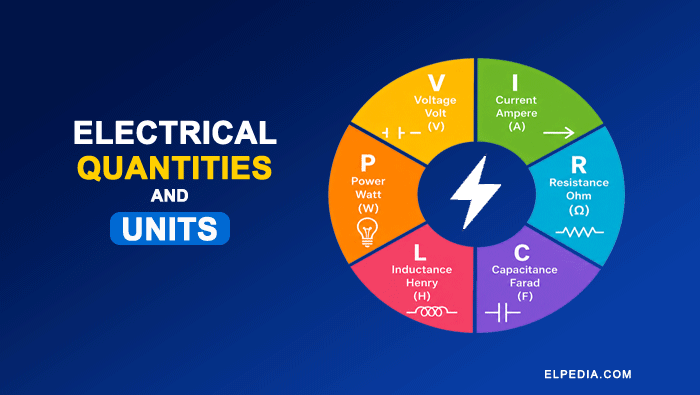
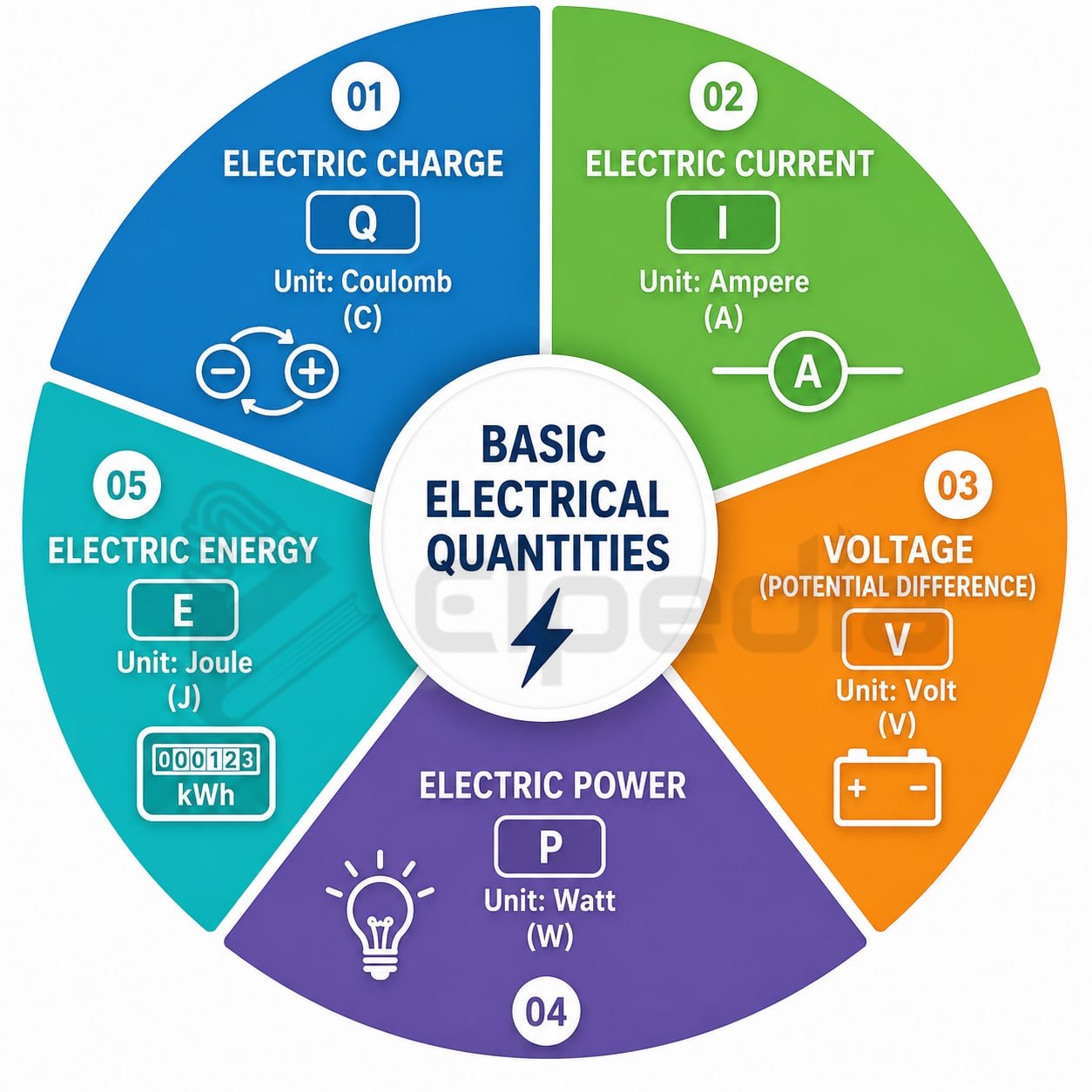
- Basic electrical quantities include electric charge, electric current, voltage (potential difference), electric power, and electrical energy.
- A comprehensive master table below lists over 40 electrical quantities – from charge, current, and resistance to capacitance, inductance, electric field strength, magnetic flux, and power factor – with their symbols, units, and concise descriptions.
- Ohm’s Law (V = I × R) links voltage, current, and resistance, all expressed in standard units: volt V, ampere, and ohm.
- A dedicated unit conversion table and FAQ at the end help with practical calculations and common confusions around prefixes, energy billing, and AC power types.
Introduction to Electrical Quantities
Electrical quantities are measurable physical properties associated with electricity and magnetism. Common examples include electric charge, current, voltage, resistance, power, and energy.
These quantities help engineers, technicians, and students understand and describe the behavior of electrical circuits—from a simple battery-powered light bulb to complex electronic systems used in smartphones and other modern devices.
The basic electrical quantities include electric charge, electric current, potential difference (voltage), electrical power, and electrical energy. These fundamental quantities form the foundation of electrical engineering.
Many other electrical quantities, such as impedance, inductance, capacitance, magnetic flux, and magnetic flux density, are derived from or related to these basic concepts.
Each electrical quantity has a specific unit of measurement and can generally be measured using an appropriate instrument. For example, an ammeter measures current, a voltmeter measures voltage, and a wattmeter measures electrical power.
This makes electrical quantities not only theoretical concepts but also practical tools for analyzing, designing, testing, and troubleshooting electrical systems.
In this article, we will explore the fundamental electrical quantities and provide a comprehensive table of 40+ electrical quantities, including their symbols, SI units, and definitions.
We will also discuss Ohm’s Law, unit conversions, electrical and magnetic field quantities, AC power quantities, and several worked examples to make these concepts easier to understand.
International System of Units (SI) for Electrical Quantities
The International System of Units (SI) is the globally accepted standard for measuring physical quantities, including electrical quantities. It is maintained and coordinated internationally through the General Conference on Weights and Measures (CGPM). The SI system is based on seven base units, from which other units are derived.
For electrical engineering, the ampere (A), the SI base unit of electric current, is particularly important. Other SI base units such as the second (s), meter (m), kilogram (kg), kelvin (K), mole (mol) and candela (cd) are also used in defining and expressing various electrical and physical quantities.
Since 20 May 2019, the ampere has been redefined by fixing the numerical value of the elementary charge at e = 1.602176634 × 10⁻¹⁹ C. This definition replaced the older definition, which was based on the electromagnetic force between two parallel conductors carrying electric current.
Some of the most commonly used SI units for electrical quantities are:
Electrical Quantity | SI Unit | Symbol |
|---|---|---|
Electric charge | Coulomb | C |
Electric current | Ampere | A |
Potential difference (Voltage) | Volt | V |
Resistance | Ohm | Ω |
Capacitance | Farad | F |
Inductance | Henry | H |
Electrical power | Watt | W |
Electrical energy | Joule | J |
Standard units in electrical engineering are based on SI units and their decimal multiples or submultiples, such as micro (µ), milli (m), kilo (k), and mega (M). Derived units such as the ohm (Ω), farad (F), and henry (H) can be expressed in terms of SI base units.
However, in practical electrical engineering, their standard symbols—such as V for volt, A for ampere, and Ω for ohm—are commonly used for simplicity and convenience.
Basic Electrical Quantities
This section introduces the five fundamental electrical quantities that are commonly taught first in electrical engineering. These quantities form the foundation for understanding electrical circuits and are used to define and describe many other electrical quantities.
Electric Charge
Electric charge is the fundamental quantity in electrical circuits. It is a property of matter carried by electrons and protons. The charge on a proton is approximately +1.6 × 10⁻¹⁹ C, while the charge on an electron is approximately −1.6 × 10⁻¹⁹ C.
Electric charge is measured in coulombs (C). According to the principle of conservation of charge, electric charge can neither be created nor destroyed; it can only be transferred from one body to another.
The total charge is always quantized, meaning that it occurs in integral multiples of the elementary charge: Q = n·e, where n is the number of elementary charges and e is the magnitude of the elementary charge.
Electric Current
Electric current is the flow of electric charge in a circuit. It is defined by I = Q/t, where Q is charge and t is time. Electric current is measured in amperes (A), and one ampere equals one coulomb per second.
In metals, current is carried by moving electrons, though conventional current flow assumes direction from the positive terminal to the negative terminal. Electric current can be direct current (DC) or alternating current (AC).
Voltage / Potential Difference
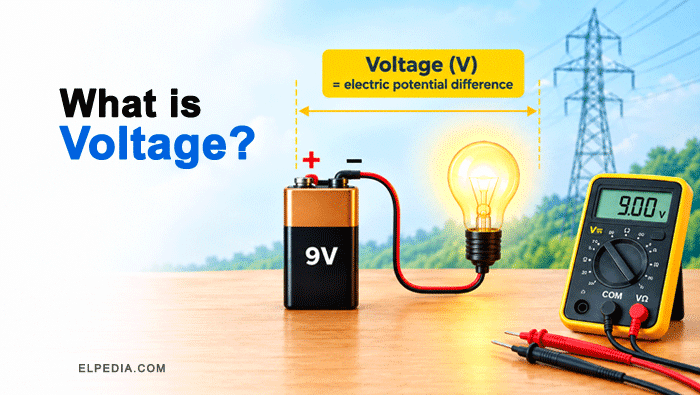
Voltage represents the potential difference between two points in a circuit. It equals the work done per unit charge to move that electrical charge between those two points in an electric field.
Voltage is measured in volts (V), with symbol V. The relationship V = W/Q tells you that one volt equals one joule per coulomb. Voltage is also known as potential difference.
For example, an AA battery provides approximately 1.5 volts of constant voltage, and a potential difference of one volt drives one coulomb through one ohm.
Electrical Power
Power is the rate at which energy is consumed or supplied. Electric power is measured in watts (W), and 1 watt equals 1 joule per second.
Electric power can be calculated as voltage times current: P = V × I. A power of 1000 W means 1000 joules of energy per second. Household devices are often rated in watts or kilowatts – a typical kettle draws about 1500 W, while a light bulb might use 60 W.
Electrical Energy
Electrical energy is the work done by electric current over time. The SI unit of electrical energy is the joule (J), but it is commonly measured in kilowatt-hours (kWh) for billing.
Electrical energy can be calculated as W = V × I × t. It is also measured in watt-hours (Wh), and 1 kWh equals 1,000 watt-hours.
For a concrete example: a 1500 W heater running for one hour consumes 1.5 kWh, which equals 5.4 × 10⁶ joules. This is the “unit” that appears on many electricity bills, representing electric power consumed over a certain period.
Comprehensive Table of Electrical Quantities and Units
The table below lists all major electrical quantities with their symbols, SI units, unit symbols, and a concise description. Use it as a quick-reference for any quantity you encounter in coursework or practice.
Quantity | Symbol | SI Unit | Unit Symbol | Brief Description |
|---|---|---|---|---|
Electric charge | Q, q | Coulomb | C | Total amount of charge; Q = It. Fundamental to all circuit analysis. |
Electric current | I, i | Ampere | A | Rate of charge flow through a conductor; I = Q/t. 1 A = 1 C/s. |
Voltage / Potential difference | V, v | Volt | V | Work per unit charge between two points; V = W/Q. Drives current through a circuit element. |
Electromotive force (EMF) | e, E | Volt | V | Voltage generated by a source (battery, generator) that drives charge flows around a circuit. |
Resistance | R | Ohm | Ω | Opposition to current flow; R = V/I. One ohm equals one volt per ampere of current. |
Conductance | G | Siemens | S | Ease of current flow; G = 1/R. Reciprocal of resistance. |
Resistivity | ρ | Ohm-metre | Ω·m | Intrinsic material property; R = ρ·ℓ/A. Copper ≈ 1.68 × 10⁻⁸ Ω·m. |
Conductivity | σ | Siemens per metre | S/m | Reciprocal of resistivity; σ = 1/ρ. Copper ≈ 5.96 × 10⁷ S/m. |
Electrical power | P | Watt | W | Rate of energy transfer; P = VI. A 60 W lamp converts 60 J every second. |
Electrical energy | W, E | Joule / kWh | J / kWh | Total work done over time; W = Pt. 1 kWh = 3.6 × 10⁶ J. |
Capacitance | C | Farad | F | Charge stored per volt; C = Q/V. Used in capacitors and filter circuits. |
Inductance | L | Henry | H | Voltage induced per rate of current change; EMF = −L·dI/dt. Found in coils and transformers. |
Impedance | Z | Ohm | Ω | Total AC opposition; Z = R + jX. Combines resistance and reactance. |
Reactance | X | Ohm | Ω | AC opposition from L or C; XL = ωL, XC = 1/(ωC). |
Susceptance | B | Siemens | S | Imaginary part of admittance; captures reactive behavior in admittance domain. |
Admittance | Y | Siemens | S | Reciprocal of impedance; Y = G + jB. |
Frequency | f | Hertz | Hz | Cycles per second of an AC signal; e.g., 50 Hz mains in Europe. |
Time period | T | Second | s | Duration of one cycle; T = 1/f. |
Angular frequency | ω | Radian per second | rad/s | ω = 2πf. Used in phasor and AC analysis. |
Phase angle | φ, θ | Radian / Degree | rad / ° | Angle between voltage and current phasors; determines power factor. |
Electric field strength | E | Volt per metre | V/m | Force per unit positive charge; E = V/d for uniform fields. |
Electric flux | ΦE | Volt-metre | V·m | Total electric field passing through a surface; used in Gauss’s law. |
Electric flux density | D | Coulomb per m² | C/m² | D = εE. Represents displacement field in dielectrics. |
Permittivity | ε | Farad per metre | F/m | Relates D and E; ε₀ ≈ 8.854 × 10⁻¹² F/m for vacuum. |
Relative permittivity | εr | Dimensionless | – | Ratio ε/ε₀; water ≈ 80, glass ≈ 4–10. Affects capacitance value. |
Magnetic flux | Φ | Weber | Wb | Total magnetic field through an area; Φ = B·A. |
Magnetic flux density | B | Tesla | T | Flux per unit area; B = Φ/A. 1 T = 1 Wb/m². |
Magnetic field strength | H | Ampere per metre | A/m | Field produced by currents; B = μH. |
Magnetomotive force | F, ℱ | Ampere-turn | A·turn | Driving force in a magnetic circuit; analogous to voltage in an electric circuit. |
Reluctance | ℛ | Ampere per weber | A/Wb | Opposition in a magnetic circuit; ℛ = MMF/Φ. Analogous to resistance. |
Permeability | μ | Henry per metre | H/m | Relates B and H; μ₀ ≈ 4π × 10⁻⁷ H/m. |
Relative permeability | μr | Dimensionless | – | Ratio μ/μ₀; iron can exceed 1000. |
Power factor | cos φ, PF | Dimensionless | – | Ratio of active to apparent power; PF = P/S. Indicates AC efficiency. |
Apparent power | S | Volt-ampere | VA | Product of RMS voltage and current; S = VI. Total power “seen” by the system. |
Reactive power | Q | Var | var | Oscillating power in reactive elements; Q = VI sin φ. Does no net work. |
Active power | P | Watt | W | Real work-performing power; P = VI cos φ. What you pay for on your bill. |
Energy | W, E | Joule | J | General energy; 1 J = 1 W·s. Expressed as kWh for billing. |
Charge density (volume) | ρ | Coulomb per m³ | C/m³ | Charge per unit volume; used in semiconductors and dielectrics. |
Surface charge density | σ | Coulomb per m² | C/m² | Charge per unit area; important on capacitor plates and conductive surfaces. |
Linear charge density | λ | Coulomb per metre | C/m | Charge per unit length; applies to wires and thin rods. |
Current density | J | Ampere per m² | A/m² | Current per unit cross-sectional area; J = I/A. Used in wire sizing. |
Mutual inductance | M | Henry | H | Inductance between two coupled coils; key in transformer design. |
Electric potential | V | Volt | V | Energy per unit charge at a point relative to a reference; defines voltage at a single point. |
Magnetic reluctivity | ν | Metre per henry | m/H | Reciprocal of permeability; ν = 1/μ. |
Standard Units, SI Base vs Derived, and Notation
Among electrical units, only the ampere is an SI base unit. Every other unit you see – volt, ohm, farad, henry, weber, tesla, watt – is a derived unit built from combinations of base units.
Here is how common derived units break down:
- 1 V = 1 J/C = 1 kgm2s-3A-1
- 1 Ω = 1 V/A = 1 kgm2s-3A-2
- 1 F = 1 C/V = 1 s4A2kg-1m-2
- 1 H = 1 Wb/A = 1 kgm2s-2A-2
- 1 W = 1 J/s = 1 kgm2s-3
Using electrical symbols and unit symbols correctly is important in technical writing, circuit diagrams, schematics, and datasheets. Unit symbols are case-sensitive.
For example, A represents ampere, V represents volt, and Ω represents ohm. Writing mA correctly indicates milliamperes, whereas ma is not the correct SI notation.
It is also important to distinguish between quantity symbols and unit symbols. In technical documents, quantity symbols are generally written in italic type, such as I for current, V for voltage, and R for resistance, while unit symbols are written in upright (roman) type, such as A, V, and Ω.
Some units that are not SI units are nevertheless widely used alongside SI electrical quantities.
For example, the decibel (dB) is commonly used to express ratios such as gain, attenuation, and signal levels, while the electronvolt (eV) is frequently used to express the energy of particles and electrons.
Ohm’s Law and the Relationship between Key Quantities
Ohm’s Law is one of the most fundamental and widely used relationships in electrical circuit analysis. It describes the relationship between voltage, current, and resistance in an electrical circuit.
It is expressed as, V = I × R, where V is potential difference in volts, I is current in amperes, and R is resistance in ohms.
Each quantity must be in its standard SI unit for the equation to hold directly. Resistance is measured in ohms (Ω).
Consider a 12 V battery connected to a 6 Ω resistor. Using Ohm’s Law, the current flowing through the resistor is: I = V/R = 12/6 = 2 A. Thus the current through the electric circuit is 2 amperes.
When combined with P = V × I, Ohm’s Law yields two useful power forms:
- P = I2R – useful for calculating the power dissipated as heat in a resistive circuit element
- P = V2/R – useful for finding the resistance of a device when power and voltages are known. For example, consider a 60 W, 230 V lamp. The resistance of the lamp can be calculated as: R = 2302/60 ≈ 882 Ω.
Metric Prefixes and Practical Electrical Unit Conversions
Electrical quantities span enormous ranges. A capacitor might be 47 µF while a power plant output is measured in GW. Metric prefixes keep the values encountered manageable.
Prefix | Symbol | Decimal Value | Base 10 |
|---|---|---|---|
Pico | p | 0.000 000 000 001 | 10-12 |
Nano | n | 0.000 000 001 | 10-9 |
Micro | µ | 0.000 001 | 10-6 |
Milli | m | 0.001 | 10-3 |
Kilo | k | 1,000 | 103 |
Mega | M | 1,000,000 | 106 |
Giga | G | 1,000,000,000 | 109 |
Tera | T | 1,000,000,000,000 | 1012 |
Quick conversion examples:
- 2300 mA → 2300 × 10-3 A = 2.3 A
- 0.1 MΩ → 0.1 × 10⁶ Ω = 100 kΩ
- 0.5 kWh → 0.5 × 3.6 × 106 = 1.8 × 10⁶ J
Always convert all quantities to consistent SI units before plugging them into formulas. Mixing V with mA and MΩ without converting leads to errors that are off by factors of thousands.
Electric and Magnetic Field Quantities in Circuits
In addition to basic circuit quantities such as voltage, current, and resistance, electrical engineering also involves quantities related to electric and magnetic fields. These quantities are especially important when studying devices and systems such as transformers, capacitors, inductors, motors, generators, transmission lines, and antennas.
All of these field-related quantities appear in the master table above with their SI-consistent units.
AC Quantities
Alternating current systems introduce several additional quantities that have no meaning in DC circuits.
For example, a 1 kVA transformer at 0.8 power factor delivers 800 W of active power and 600 var of reactive power.
Worked Examples Using Electrical Quantities and Units
Example 1 – Charge from current and time
Suppose an electrical device draws a current of 3 A for 15 seconds. The total amount of charge transferred can be calculated using:
![\[ Q = I t \]](https://elpedia.com/wp-content/ql-cache/quicklatex.com-b2ef56c0e5bed0a47ba067f1793df164_l3.png "Rendered by QuickLaTeX.com")
![\[Q = 3 \times 15 = 45 \,\text{C} \]](https://elpedia.com/wp-content/ql-cache/quicklatex.com-d85611461acc2a3457b3588987065db0_l3.png "Rendered by QuickLaTeX.com")
Therefore, 45 coulombs of electric charge are transferred through the device. The number of electrons corresponding to this charge can be found using:
![\[ n = \frac{Q}{e} \]](https://elpedia.com/wp-content/ql-cache/quicklatex.com-e2057001922d064abaab229eba59b3b5_l3.png "Rendered by QuickLaTeX.com")
![\[ n = \frac{45}{1.602 \times 10^{-19}} \approx 2.81 \times 10^{20} \]](https://elpedia.com/wp-content/ql-cache/quicklatex.com-9f9219b68444ecf2565bd869ce364741_l3.png "Rendered by QuickLaTeX.com")
Therefore, approximately 2.81 × 10²⁰ electrons pass through the device in 15 seconds. This example illustrates that even a relatively small current flowing for a short period involves an enormous number of electrons.
Example 2 – Energy from power and time
Consider a 1500 W heater that operates continuously for 2 hours. The electrical energy consumed can be calculated using:
![\[E = Pt \]](https://elpedia.com/wp-content/ql-cache/quicklatex.com-de2c1576f7183264c71f19556e6d5d07_l3.png "Rendered by QuickLaTeX.com")
Since the power is given in watts and the time in hours:
![\[ E = 1500 \times 2 = 3000 \text{ Wh} = 3\text{ kWh}\]](https://elpedia.com/wp-content/ql-cache/quicklatex.com-a14fc537358b8190cd0a3622f0e36fa5_l3.png "Rendered by QuickLaTeX.com")
Therefore, the heater consumes 3 kWh of electrical energy in 2 hours.
To express this energy in joules, use:
![\[1\text{ kWh} = 3.6 \times 10^6\text{ J} = 1.08 \times 10^7\text{ J}\]](https://elpedia.com/wp-content/ql-cache/quicklatex.com-4620b19e0fc79b731f9daa4944e80078_l3.png "Rendered by QuickLaTeX.com")
Thus, the heater consumes 1.08 × 10⁷ J of electrical energy.
For electricity billing, the energy consumed is normally measured in kilowatt-hours (kWh). Therefore, the cost of operating the heater for 2 hours depends on the electricity tariff per kWh (unit) applicable in the particular location.
Example 3 – AC power calculation
Consider a load connected to a 230 V RMS supply. The load draws a current of 10 A RMS and operates at a power factor of 0.8 lagging.
First, calculate the apparent power,
![\[S = VI = 230 \times 10 = 2300\text{ VA} \]](https://elpedia.com/wp-content/ql-cache/quicklatex.com-c422b465a17f467af89cdc2639cf5267_l3.png "Rendered by QuickLaTeX.com")
Next, calculate the active power,
![\[P = S \times \text{power factor} = 2300 \times 0.8 = 1840\text{ W} \]](https://elpedia.com/wp-content/ql-cache/quicklatex.com-8c43d477afd01e6572e9912cf06bd572_l3.png "Rendered by QuickLaTeX.com")
![\[P = 2300 \times 0.8 = 1840\text{ W} \]](https://elpedia.com/wp-content/ql-cache/quicklatex.com-42158f436ca5a9d4a6a32264735850c2_l3.png "Rendered by QuickLaTeX.com")
The reactive power can be calculated using the power triangle,
![\[Q = \sqrt{S^2-P^2} = \sqrt{2300^2-1840^2} \approx 1380\text{ var}\]](https://elpedia.com/wp-content/ql-cache/quicklatex.com-dba5d93cc8905299f00fef5d3de1102a_l3.png "Rendered by QuickLaTeX.com")
![\[Q = \sqrt{2300^2-1840^2} \approx 1380\text{ var}\]](https://elpedia.com/wp-content/ql-cache/quicklatex.com-edc7f6f5d70470a73cf5adb35d38f26d_l3.png "Rendered by QuickLaTeX.com")
All values are expressed in their correct units.
Example 4 – Unit prefix conversion
Convert 4.7 kΩ: 4.7 × 10³ = 4700 Ω = 0.0047 MΩ.
Convert 220 µF: 220 × 10⁻⁶ = 0.000220 F = 0.220 mF.
These conversions follow the SI metric prefix system. shown in the earlier table. Understanding the prefixes makes it easy to convert electrical quantities between different units.