Need for Starter in DC Motor
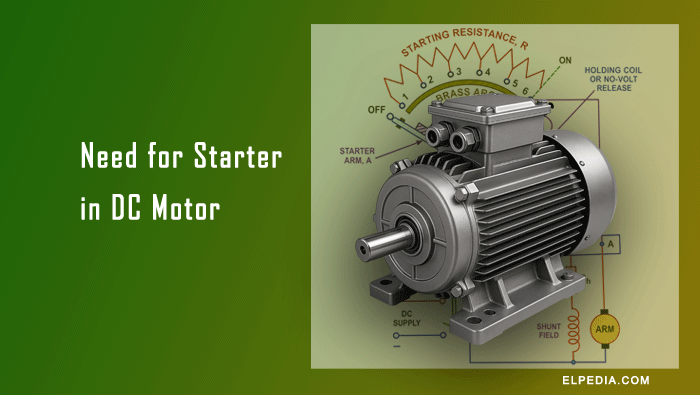
A starter is an essential device that is used to protect a DC motor during starting. The need for starter in DC motor arises because the motor draws a very large current when it is switched ON. This excessive starting current can damage the armature winding, commutator, and brushes, and may also cause a voltage drop in the electrical supply system. Therefore, a DC motor starter is used to limit the starting current and ensure smooth, safe, and reliable motor operation.
In this article, we will discuss the need for starter in DC motor, the reason behind the high starting current, the working principle of a DC motor starter, and the different starting methods of DC motor.
Need for starter
From the voltage equation of DC motor, the armature current is given by
![\[I_a = \frac{V-E_b}{R_a} \]](https://elpedia.com/wp-content/ql-cache/quicklatex.com-d8f9acae4743abac7252bab07e50c3ea_l3.png "Rendered by QuickLaTeX.com")
where V is the supply voltage, Eb is the back EMF and Ra is the armature resistance.
At the time of starting, no back emf is developed in the armature, so Eb becomes 0. Therefore the equation becomes,
![\[I_a = \frac{V}{R_a} \]](https://elpedia.com/wp-content/ql-cache/quicklatex.com-910162e1598d85d8015a999d60434d35_l3.png "Rendered by QuickLaTeX.com")
The armature winding of a DC motor has very low resistance. As a result, applying the full supply voltage directly across the armature causes a huge inrush current.
For example, consider a 220 V, 5 HP DC motor having an armature resistance of 0.25 Ω and full load current of 20 A. At starting, the armature current will be,
![\[I_a = \frac{220}{0.25} = 880 A\]](https://elpedia.com/wp-content/ql-cache/quicklatex.com-604e2ef7bf63946063565aa696070546_l3.png "Rendered by QuickLaTeX.com")
This current is 880/20 = 44 times greater than the rated full-load current. Such a large current can damage the motor components, including the commutator and brushes, and may also blow the protective fuses. This explains the need for starter in DC motor.
To prevent this problem, an external resistance have to be connected in series with the armature during starting. This resistance remains in the circuit only for a few seconds (typically 5–10 seconds) to limit the current to a safe value.
As the motor begins to rotate, it develops back EMF, which naturally reduces the armature current. At the same time, the starting resistance is gradually removed from the circuit. This is the primary need for starter in DC motor, ensuring smooth acceleration while protecting the motor components.
How to connect the starting resistance?
In a DC shunt motor, the starting resistance is connected only in series with the armature circuit and not with the entire motor. The field winding is connected directly across the supply lines, so the field current remains constant and is not affected by the starting resistance.
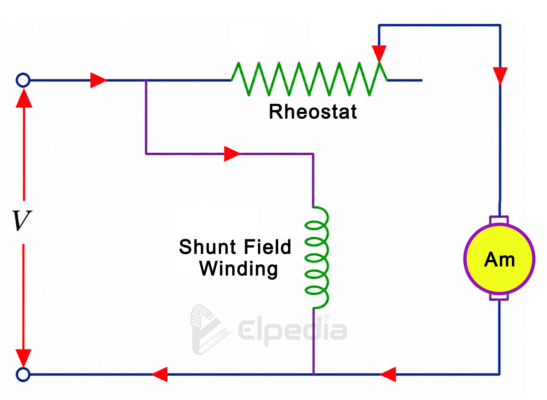
If the starting resistance were connected in series with the whole motor, the field current would decrease during starting. Since the starting torque of the motor depends on both the magnetic flux and armature current (Torque ∝ Φ Ia), a lower field current would reduce the starting torque, making it difficult for the motor to start properly.
Therefore, starters are used in the DC motors that inserts resistance only in the armature circuit during the starting period.
Starting of DC Motor
The main purpose of a starter is to connect an external resistance (Rex) in series with the armature. This increases the total resistance of the armature circuit to (Ra + Rex), thereby limiting the starting current to a safe value.
At the instant of starting, the armature current equation will become,
![\[I_a = \frac{V}{R_a + R_{ex}} \]](https://elpedia.com/wp-content/ql-cache/quicklatex.com-641326f850d21cce6f2b0169bc0af458_l3.png "Rendered by QuickLaTeX.com")
As the motor begins to rotate, back EMF is generated. This back EMF increases with speed and opposes the supply voltage. As a result, the effective voltage across the armature decreases, reducing the armature current.
The armature current during running becomes,
![\[I_a = \frac{V - E_b }{R_a + R_{ex}} \]](https://elpedia.com/wp-content/ql-cache/quicklatex.com-3e92d5727007f8357cb0768492082c7c_l3.png "Rendered by QuickLaTeX.com")
As the motor gains speed and the back EMF increases, the external resistance is gradually removed from the circuit. Eventually, when the motor reaches its normal operating speed, the back EMF becomes maximum, the external resistance is completely disconnected. This process keeps the armature current within its rated value throughout the starting period.
This gradual control of the armature current ensures safe and smooth starting of the DC motor while protecting both the motor and the power supply system.
Different types of starters are available for DC motors. The most commonly used starters are:
- Three-point starter – Used for DC shunt motors and DC compound motors.
- Four-point starter – Used for compound motors, providing better protection against field current variations.
- Series motor starter – Used for DC series motors and generally includes a no-load release coil to protect the motor during operation.
However, very small DC motors can often be connected directly to the supply without using a starter because:
- Small motors have comparatively higher armature resistance, so the starting current is lower.
- They have less inertia and therefore reach their operating speed quickly.
- The short duration starting current does not significantly affect the supply voltage.