Efficiency of transformer
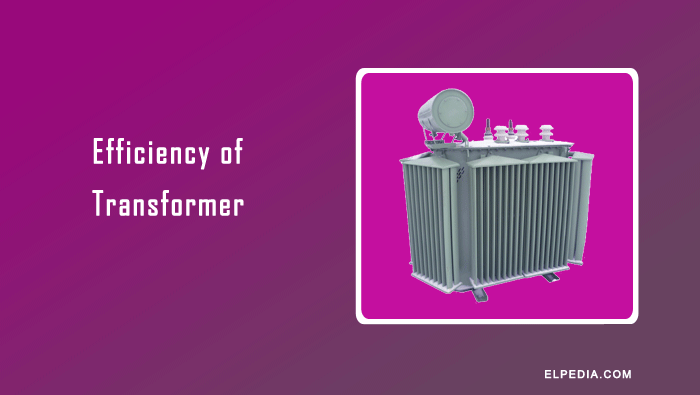
A transformer is among the most efficient electrical devices in power systems, yet it never reaches 100% efficiency due to unavoidable power losses.
Efficient energy transfer ensures steady primary-to-secondary voltage transformation, but a portion of input energy is always dissipated as heat.
Since direct measurement of input and output power with wattmeters can introduce 1–2% errors, engineers determine core losses and copper losses separately via open-circuit and short-circuit tests.
This article covers the efficiency of a single phase transformer with clear equations and worked examples. Learn the transformer losses before learning this article.
Transformer efficiency
Efficiency of transformer η is the ratio of output power to input power at a given load and power factor, typically expressed as a percentage:
![\[ \eta = \frac{\text{Output Power}}{\text{Input Power}} \times 100 \]](https://elpedia.com/wp-content/ql-cache/quicklatex.com-14a96fc3c7b5e7ea9b6ff6bddb906d7d_l3.png "Rendered by QuickLaTeX.com")
Since the input power equals the output power plus the total losses, and total transformer losses consist of core (iron) losses and load-dependent copper losses, the equation can be written as:
![\[ \eta = \frac{\text{Output Power}}{\text{Output Power}+\text{Losses}} \]](https://elpedia.com/wp-content/ql-cache/quicklatex.com-65ee36771c2e731e405e9f3ec667c114_l3.png "Rendered by QuickLaTeX.com")
![\[ \eta = \frac{\text{Output Power}}{\text{Output Power}+\text{Iron Loss}+\text{Copper Loss}} \]](https://elpedia.com/wp-content/ql-cache/quicklatex.com-8fd058360094107732d3d4580f8c33bc_l3.png "Rendered by QuickLaTeX.com")
Here the output power = V2 I2 cosϕ2, where V2 is the secondary voltage and I2 is the secondary or load current and cosϕ is the power factor of the load.
The efficiency of transformer can also be written as,
![\[ \eta = \frac{\text{Input Power - Losses}}{\text{Input Power}} \]](https://elpedia.com/wp-content/ql-cache/quicklatex.com-64a6a23907c3e52fb0db54da4a1b97c6_l3.png "Rendered by QuickLaTeX.com")
![\[ \eta = 1- \frac{\text{Losses}}{\text{Input Power}} \]](https://elpedia.com/wp-content/ql-cache/quicklatex.com-afee420959e773df2862b91f4a0b817e_l3.png "Rendered by QuickLaTeX.com")
Here the input power = V1 I1 cosϕ1, where V1 is the primary voltage and I1 is the primary current and cosϕ is the power factor of the load.
Iron loss , Pi = Hysteresis loss + Eddy current loss and Copper loss is given by Pcu = I12R1 + I22R2.
Method of determining the efficiency of transformer
Transformers generally have high efficiency, typically between 96% and 99%. Therefore, determining efficiency by directly measuring input and output power is difficult.
It is because the difference between them, which represents the losses, is very small. Even a small measurement error can cause a significant error in the calculated losses.
Direct loading also requires suitable load equipment with the correct voltage, current, and power factor ratings. This method consumes a large amount of electrical power and does not separately identify the iron and copper losses.
A more practical and accurate method is to determine transformer losses using the open-circuit test and short-circuit test. The efficiency can then be calculated without loading the transformer to its full rated capacity.
From the open circuit test, the power is measured using a wattmeter, which is the called the iron loss,
![\[P_i = W_{oc} \text{ or } P_{oc} \]](https://elpedia.com/wp-content/ql-cache/quicklatex.com-80eb894edb86e6c22b589e1e28be7a62_l3.png "Rendered by QuickLaTeX.com")
By conducting the short circuit test, the power is measured at full load, which gives the copper loss,
![\[P_{cu} = W_{sc} \text{ or } P_{sc} \]](https://elpedia.com/wp-content/ql-cache/quicklatex.com-1c6be626bbee3de7c836db38732b2691_l3.png "Rendered by QuickLaTeX.com")
If the transformer operates at x times its full-load current, the copper loss is given by,
![\[P_{cu} = x^2 P_{cu} \]](https://elpedia.com/wp-content/ql-cache/quicklatex.com-667822b7462083188cbe46367994b110_l3.png "Rendered by QuickLaTeX.com")
where x is the ratio of load current I₂ to full-load secondary current.
And efficiency of transformer is calculated as,
![\[ \eta = \frac{V_2 I_2 cos \phi}{V_2 I_2 cos \phi + P_i + x^2 P_{cu}} \times 100 \]](https://elpedia.com/wp-content/ql-cache/quicklatex.com-4b7f785e320218efd4cd473fd96b0627_l3.png "Rendered by QuickLaTeX.com")
In this method, measurement errors mainly affect the estimated losses, making the calculated efficiency more reliable than that obtained through direct loading.
Another advantage is that the transformer does not need to operate at full load during testing. The test equipment only needs to handle the power corresponding to the transformer losses, rather than its full rated output power.
Condition of Maximum efficiency
The equation of transformer efficiency is given by,
![\[ \eta = \frac{V_2 I_2 cos \phi}{V_2 I_2 cos \phi + P_i + x^2 P_{cu}} \]](https://elpedia.com/wp-content/ql-cache/quicklatex.com-8de2368be7ab63300d3e53c5071c99fc_l3.png "Rendered by QuickLaTeX.com")
![\[ \eta = \frac{xP}{xP + P_i + x^2 P_{cu}} ---> (1)\]](https://elpedia.com/wp-content/ql-cache/quicklatex.com-a71a06528e35e62c6e1a054286774d6e_l3.png "Rendered by QuickLaTeX.com")
where P indicates the full load power (kVA x cosϕ) and x is the fraction of full load kVA at which the efficiency is maximum.
Differentiating both sides of the equation (1), we get,
![\[\frac{d\eta}{dx} = \frac{(xP+P_i+x^2P_{cu})P-xP(P+2xP_{cu})}{(xP+P_i+x^2P_{cu})^2} \]](https://elpedia.com/wp-content/ql-cache/quicklatex.com-6726c5650a6f05e0eb39553107d6a6cd_l3.png "Rendered by QuickLaTeX.com")
![\[\frac{d\eta}{dx} =\frac{P(P_i-x^2P_{cu})}{(xP+P_i+x^2P_{cu})^2} \]](https://elpedia.com/wp-content/ql-cache/quicklatex.com-e758140d6197956648bb3ea5b166503c_l3.png "Rendered by QuickLaTeX.com")
The efficiency of transformer will be maximum when
![\[\frac{d\eta}{dx} = 0\]](https://elpedia.com/wp-content/ql-cache/quicklatex.com-38ab9b44c0cacffe8a4ecd505842b45d_l3.png "Rendered by QuickLaTeX.com")
![\[\frac{P(P_i-x^2P_{cu})}{(xP+P_i+x^2P_{cu})^2} =0 \]](https://elpedia.com/wp-content/ql-cache/quicklatex.com-d4600b345b3820cc9a6648457365fc07_l3.png "Rendered by QuickLaTeX.com")
![\[ P(P_i - x^2P_{cu}) = 0 \]](https://elpedia.com/wp-content/ql-cache/quicklatex.com-0c472dea973119fcb836d0b125f60837_l3.png "Rendered by QuickLaTeX.com")
![\[\[x^2P_{cu} = P_i \]](https://elpedia.com/wp-content/ql-cache/quicklatex.com-608414848e1a4f0f49359964bf653e00_l3.png "Rendered by QuickLaTeX.com")
It indicates that the efficiency will be maximum when the variable loss is equal to the core or iron loss.
From the above condition, the fraction of load, x is determined as,
![\[x=\sqrt{\frac{P_i}{P_{cu}}}\]](https://elpedia.com/wp-content/ql-cache/quicklatex.com-626b7ea0676541c8bee86e50d45ff48e_l3.png "Rendered by QuickLaTeX.com")
Output kVA corresponding to maximum efficiency = 
Copper loss at a given load at which efficiency is maximum is given by,
![\[P_{cu} = I_2^2R_{02} \]](https://elpedia.com/wp-content/ql-cache/quicklatex.com-3d7d4e1cdef4aa7550da904d1d641654_l3.png "Rendered by QuickLaTeX.com")
Under maximum efficiency condition, copper loss is equal to iron loss. Hence,
![\[I_2^2R_{02} = P_i\]](https://elpedia.com/wp-content/ql-cache/quicklatex.com-53c8cc3df27e04b1881d7c63386f2ccd_l3.png "Rendered by QuickLaTeX.com")
The output current I2 corresponding to maximum efficiency is determined as,
![\[I_2 = \sqrt{\frac{P_i}{R_{o2}}} \]](https://elpedia.com/wp-content/ql-cache/quicklatex.com-e6f425f9c744740634fa04a0751a00df_l3.png "Rendered by QuickLaTeX.com")
Power transformers used in bulk power transmission operate continuously at or near full load. Therefore, they are generally designed to achieve maximum efficiency at full load.
In contrast, distribution transformers supply consumers whose power demand varies throughout the day. Hence, they are usually designed to achieve maximum efficiency at a fraction of full load, often around 50% to 75%, depending on their expected load pattern.
Transformer losses depend on the operating conditions. Copper loss depends on the square of the winding current, while iron loss depends mainly on the applied voltage and frequency. Since these losses are largely independent of the load power factor, transformer capacity is rated in kilovolt-amperes (kVA) rather than kilowatts (kW).
Efficiency vs Load Curve
When a transformer operates at a constant supply voltage and frequency, its mutual flux remains nearly constant from no load to full load. Therefore, the iron loss is considered approximately constant, regardless of the load.
In contrast, copper loss increases with the square of the load current or load kVA. The variation of copper loss and transformer efficiency with load is shown in the figure.
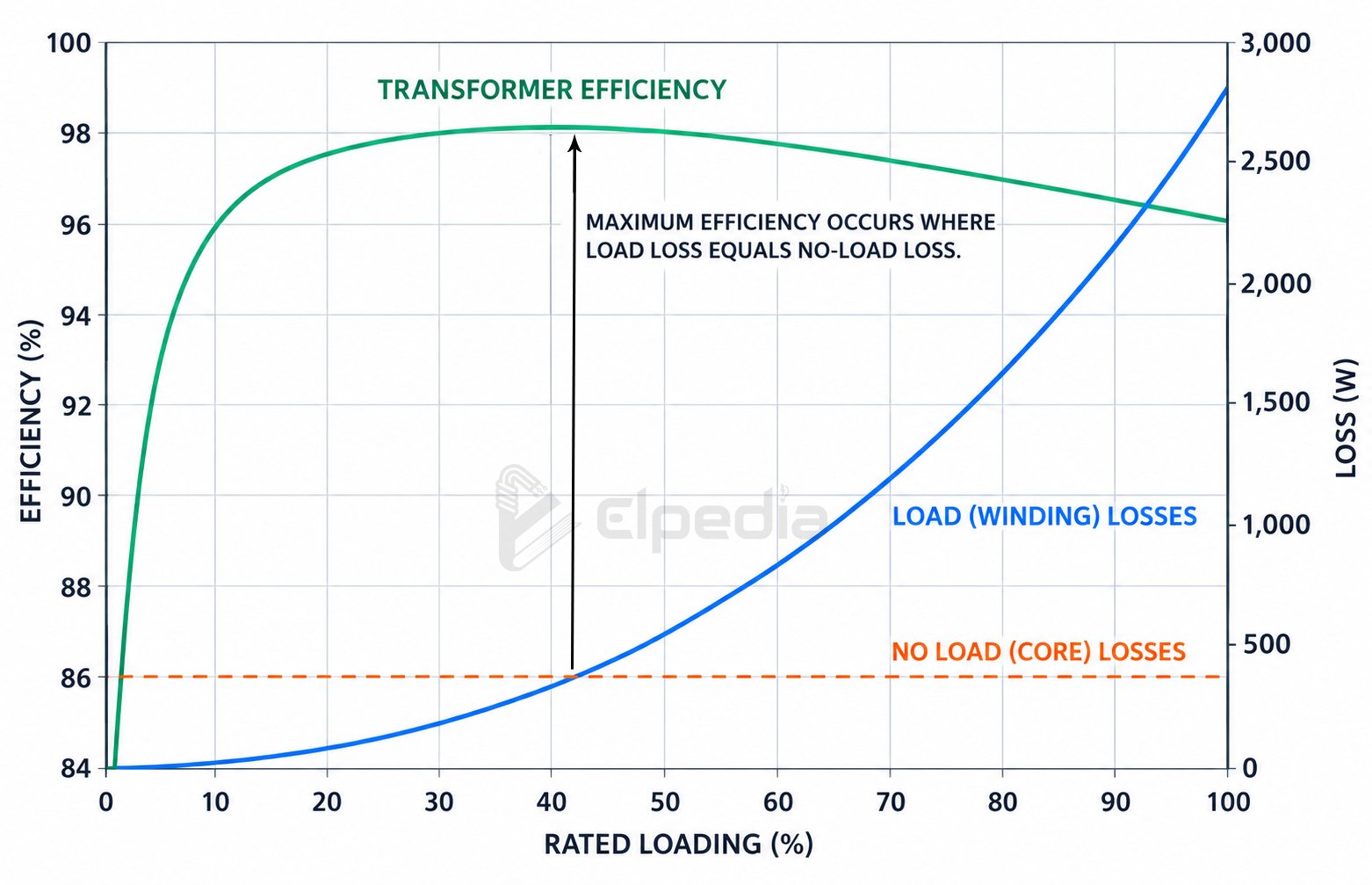
The efficiency–load curve indicates that a transformer maintains high efficiency even at light loads, such as 10% of its rated load. Its efficiency remains nearly constant over a wide range of loads.
However, efficiency is relatively low at very light loads because the constant iron loss forms a larger proportion of the output power.
At heavy loads, efficiency decreases when the increasing copper loss becomes significant. The condition for maximum efficiency is that the variable copper loss equals the constant iron loss.
All day efficiency of transformer
The efficiency discussed above is called the commercial efficiency. However, this efficiency is not sufficient to evaluate the performance of all types of transformers.
For example, distribution transformers remain energized throughout the day, but they often supply only a light load for several hours.
During this period, iron loss occurs continuously, whereas copper loss varies with the load current. Therefore, their performance is better evaluated using all-day efficiency, also known as energy efficiency or operational efficiency.
All-day efficiency is the ratio of the total electrical energy delivered by a transformer over 24 hours to the total electrical energy supplied to it during the same period.
![\[ \eta_{\text{all-day}}= \frac{\text{Energy output in kWh}} {\text{Energy input in kWh}}\times100 \]](https://elpedia.com/wp-content/ql-cache/quicklatex.com-b06308c61c4d47cfa258620ddfa28f25_l3.png "Rendered by QuickLaTeX.com")
Since the load on a distribution transformer varies throughout the day, its all-day efficiency depends on the daily load pattern and the duration for which different loads are supplied.
To calculate this efficiency, the energy output and the losses over the entire 24-hour period must be determined.
All-day efficiency is often lower than the rated-load commercial efficiency because iron loss continues throughout the day, even when the transformer supplies little or no load.
Distribution transformers are designed to achieve good efficiency under typical operating loads rather than only at full load.
Their maximum commercial efficiency is often designed to occur at approximately 50% to 75% of rated load, depending on the expected load pattern.
One design approach is to use a core with larger cross-sectional area, which allows the transformer to operate at a lower magnetic flux density. This helps to reduce iron loss.
By selecting suitable core dimensions and winding conductors, designers can achieve a balance between iron loss and copper loss, thereby improving the transformer’s all-day efficiency.
Solved problem 1
Calculate the efficiency at half-full load of a 100 kVA transformer for pf of 0.8. The copper loss is 1000 W at full load and iron loss is 1000 W.
Given : kVA rating of transformer = 100 kVA, cosϕ = 0.8, Pcu = 1000 W, Pi = 1000 W.
To find : Efficiency of transformer.
Solution : Output power of transformer at half full load and 0.8 pf,
![\[P_{out} = \frac{1}{2} \times kVA \times cos\phi = \frac{1}{2}\times100\times0.8 \]](https://elpedia.com/wp-content/ql-cache/quicklatex.com-01d6c17a0363b0cccaa05df0551affc6_l3.png "Rendered by QuickLaTeX.com")
![\[P_{out} = 50\, kW\]](https://elpedia.com/wp-content/ql-cache/quicklatex.com-4d7d257713d77af230e0c96d13bb2781_l3.png "Rendered by QuickLaTeX.com")
Copper loss at half full load,
![\[P_{cu} = \left(\frac{1}{2}\right)^2 \times P_{cu} = \left(\frac{1}{2}\right)^2 \times 1000 \]](https://elpedia.com/wp-content/ql-cache/quicklatex.com-e3b5f1d8113fad8e13a6ca3eec8ebc7d_l3.png "Rendered by QuickLaTeX.com")
![\[P_{cu} = 0.25 kW \]](https://elpedia.com/wp-content/ql-cache/quicklatex.com-7c4b638731ded814618189f0835383d0_l3.png "Rendered by QuickLaTeX.com")
Efficiency of transformer is calculated as,
![\[\eta = \frac{P_{out}}{P_{out} + P_{cu} +P_i} \times100 \]](https://elpedia.com/wp-content/ql-cache/quicklatex.com-035f8004f9fc51fc093b80274203f1ad_l3.png "Rendered by QuickLaTeX.com")
![\[\eta = \frac{50}{50+0.25+1} \times100 \]](https://elpedia.com/wp-content/ql-cache/quicklatex.com-21339103967f5c6c1a0b68d696da488c_l3.png "Rendered by QuickLaTeX.com")
![\[\eta = 97.56\,\% \]](https://elpedia.com/wp-content/ql-cache/quicklatex.com-d58f2839e0ccd0ecfb7022e1a4404f58_l3.png "Rendered by QuickLaTeX.com")
Solved Problem 2
A 11000/230 V, 150 KVA, single phase, 50 Hz transformer has core loss of 1.4 kW and full load copper loss of 1.6 kW. Determine (i) The kVA load for maximum efficiency and the value of maximum efficiency at unity p.f. (ii)The efficiency at half F.L 0.8 pf leading.
Given : kVA rating of transformer = 150 kVA, V1 = 11000 V, V2 = 230 V, f =50 Hz, Pi = 1.4 kW, Pcu = 1.6 kW
To find : kVA load for maximum efficiency, Max Efficiency at upf, efficiency at half Full load at 0.8 pf leading.
Solution :
kVA load corresponding to maximum efficiency is
![\[= \text{Full Load }\times \sqrt{\frac{P_i}{P_{cu}}} \]](https://elpedia.com/wp-content/ql-cache/quicklatex.com-b4d63e467649d17d9b538bd5019e3d9e_l3.png "Rendered by QuickLaTeX.com")
![\[=150000 \times \sqrt{\frac{1.4}{1.6}} \]](https://elpedia.com/wp-content/ql-cache/quicklatex.com-9a9cf2ad3397716559db753a540065e0_l3.png "Rendered by QuickLaTeX.com")
![\[=140.32 \,kVA \]](https://elpedia.com/wp-content/ql-cache/quicklatex.com-d3cf37a7b1c9d3062c6e0fd8d0c8968f_l3.png "Rendered by QuickLaTeX.com")
To determine the maximum efficiency at upf,
![\[\text{Output power in kW} = \text{Output power in kVA} \times \text{pf} \]](https://elpedia.com/wp-content/ql-cache/quicklatex.com-6386394d049ba39108d58e95b0772719_l3.png "Rendered by QuickLaTeX.com")
![\[\text{Output power in kW} = 140.31 \times 1 = 140.31 \, kW \]](https://elpedia.com/wp-content/ql-cache/quicklatex.com-60147e9454c62db1dfd3612796a10067_l3.png "Rendered by QuickLaTeX.com")
Under Maximum efficiency condition,
![\[P_{cu} = P_i = 1.4 \, kW\]](https://elpedia.com/wp-content/ql-cache/quicklatex.com-d9b45793c9ea732910bb8d174a37640d_l3.png "Rendered by QuickLaTeX.com")
![\[\text{Total Losses} = 1.4 + 1.4 = 2.8 \, kW \]](https://elpedia.com/wp-content/ql-cache/quicklatex.com-9763ff1032d47a0e9e4b7d4c43fd465a_l3.png "Rendered by QuickLaTeX.com")
![\[\eta_{max} = \frac{Output}{Output+losses} \]](https://elpedia.com/wp-content/ql-cache/quicklatex.com-5c37b07283fd525313ec2cfc38a5a729_l3.png "Rendered by QuickLaTeX.com")
![\[\eta_{max} = \frac{140.31}{140.31+2.8} \]](https://elpedia.com/wp-content/ql-cache/quicklatex.com-15c6813b5d4f20ccf1188caa44e22f76_l3.png "Rendered by QuickLaTeX.com")
![\[\eta_{max} = 97.1 \% \]](https://elpedia.com/wp-content/ql-cache/quicklatex.com-09cb69c1d271bdc2138e3d736b3ec2b8_l3.png "Rendered by QuickLaTeX.com")
To find the efficiency at half full load,
![\[\text{Cu loss at half full load} = \left(\frac{1}{2}\right)^2 \times 1.6 = 0.4 kW \]](https://elpedia.com/wp-content/ql-cache/quicklatex.com-c00f7597424878d61af1b854edbae181_l3.png "Rendered by QuickLaTeX.com")
![\[\text{Total Losses at half full load} = 1.4 + 0.4 = 1.8 \, kW \]](https://elpedia.com/wp-content/ql-cache/quicklatex.com-b2ab3b13f5bffe76328a15fc226fd101_l3.png "Rendered by QuickLaTeX.com")
![\[\text{Output at half full load in kVA} = 150 \times \frac{1}{2} = 75\,kVA\]](https://elpedia.com/wp-content/ql-cache/quicklatex.com-aaa8a35acca44007052d00915919adc5_l3.png "Rendered by QuickLaTeX.com")
![\[\text{Output at half full load in kW} = 75 \times 0.8 = 60 kW\]](https://elpedia.com/wp-content/ql-cache/quicklatex.com-9d258ba82e3e6f5e122fdecb17898b1a_l3.png "Rendered by QuickLaTeX.com")
![\[\eta_{max} = \frac{60}{60+1.8} \]](https://elpedia.com/wp-content/ql-cache/quicklatex.com-2fd512f237e88d845baa4c96e4bf27f9_l3.png "Rendered by QuickLaTeX.com")
![\[\eta_{max} = 97.09 \% \]](https://elpedia.com/wp-content/ql-cache/quicklatex.com-6ba7981216e193ec14a0ca80acab819f_l3.png "Rendered by QuickLaTeX.com")