
Tan Delta Test of Transformer

Tan delta test of transformer is an important diagnostic test used to assess the condition and insulation quality of its windings and bushings.
It measures the dielectric loss in the insulation by evaluating the dissipation factor (tan δ), which indicates how effectively the insulation behaves like an ideal dielectric material.
By analysing the measured values and comparing them with appropriate reference values and previous test results, maintenance engineers can evaluate insulation health and plan preventive maintenance.
Tan delta testing is commonly performed during transformer commissioning, periodic maintenance, and condition assessment to detect potential insulation problems at an early stage.
In this article, you will learn the principle of tan delta test, the method of conducting the test, interpreting the test results, applications and advantages of tan delta test of transformer.
Principle of the Tan Delta Test
An ideal insulating material behaves like a pure capacitor, in which the current leads the applied voltage by 90°.
However, practical transformer insulation exhibits dielectric losses due to factors such as ageing, moisture ingress, and contamination.
These losses introduce a resistive component of current, causing the phase difference between the voltage and total current to become slightly less than 90°.
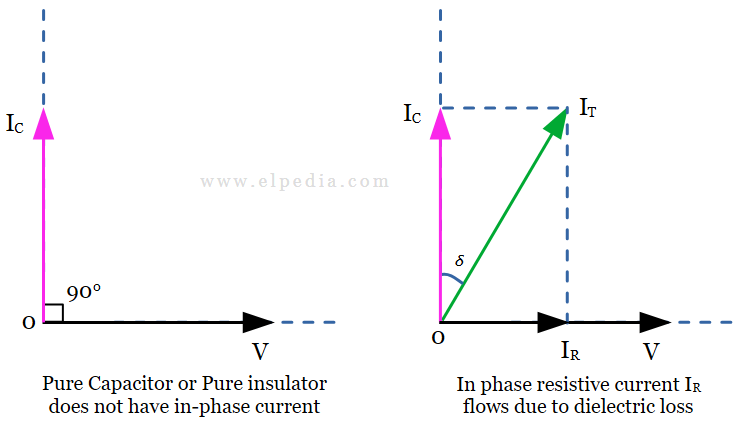
In the above phasor diagram, the applied voltage (V) is represented along the x-axis. For an ideal insulator, the capacitive current (IC) leads the voltage by 90° and is represented along the positive y-axis.
When insulation deteriorates, a resistive current component (IR) flows in phase with the applied voltage.
The total current (IT) is the phasor sum of the capacitive current (IC) and resistive current (IR). Consequently, the total current deviates from the y-axis by an angle δ.
The angle by which the phase difference between the voltage and total current falls short of 90° is called the dielectric loss angle, denoted by δ.
Using trigonometry, the tan δ, also known as the dissipation factor, is expressed as:

Where IR = resistive or loss component of current, IC = capacitive component of current and δ = dielectric loss angle.
A low tan delta value generally indicates good insulation condition, whereas an increase in the value may indicate moisture ingress, insulation ageing, contamination, or other forms of insulation deterioration.
Method of Tan delta testing
The tan delta test is generally performed using a specialized insulation diagnostic instrument that applies an AC test voltage and measures the dielectric loss factor and capacitance.
First, the transformer is isolated from the power supply, and the necessary electrical safety precautions are followed. The transformer is discharged, and the accessible insulation surfaces are cleaned. External connections are disconnected as required by the selected test arrangement and the manufacturer’s instructions.
Next, the tan delta test instrument is connected to the appropriate transformer terminals or bushings according to the prescribed test configuration.
The following figure illustrates the connection arrangement for measuring the tan delta of the insulation between the high-voltage (HV) and low-voltage (LV) windings of a power transformer.
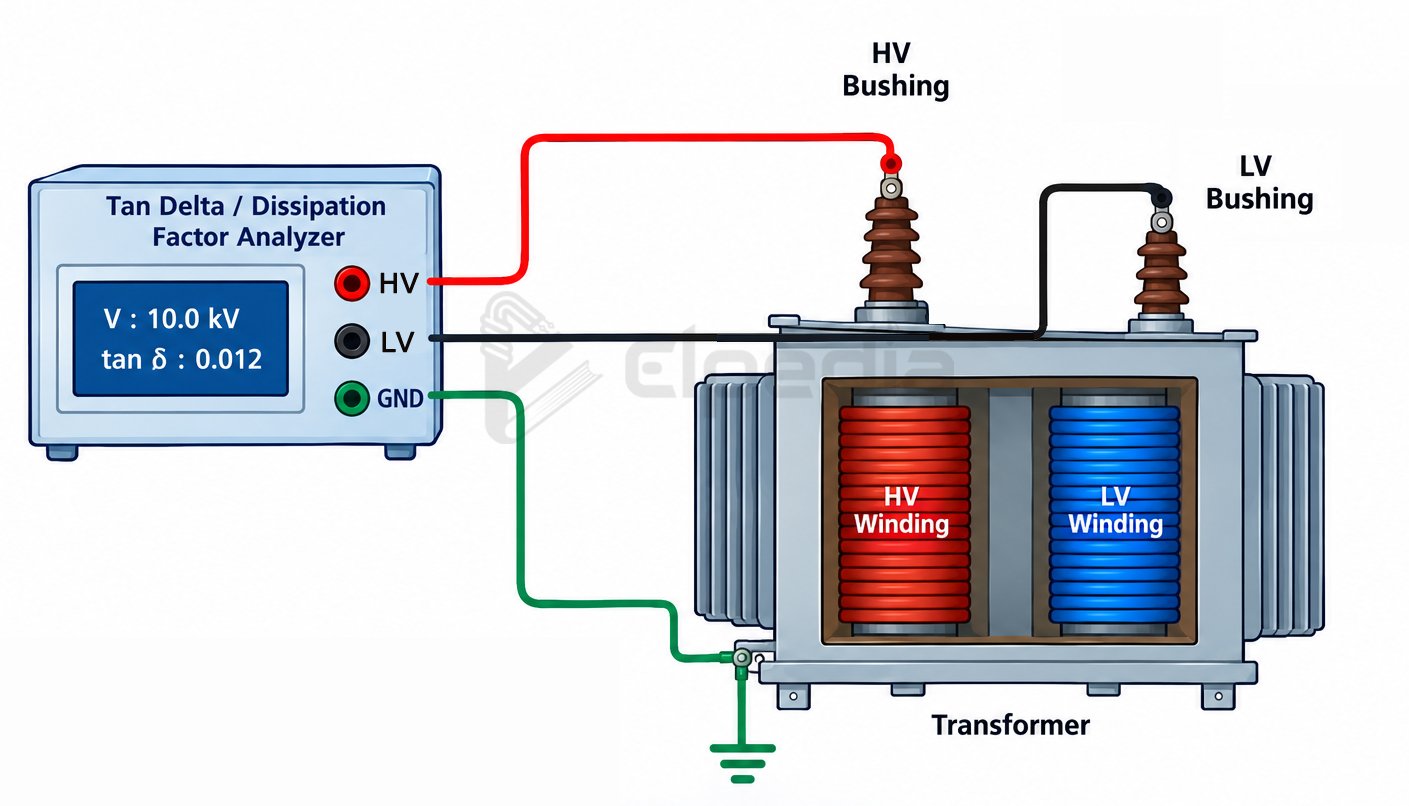
In the illustrated arrangement, the test leads are connected to the HV winding, LV winding, and transformer grounding point, as specified by the test instrument’s configuration. The transformer tank is connected to protective earth.
The exact connections depend on the analyzer, the insulation under test, and whether the measurement is performed in Grounded Specimen Test (GST) or Ungrounded Test Mode (UST) mode.
During the test, the analyzer applies a specified AC test voltage and measures the resulting current and phase relationship to determine the dielectric losses in the insulation system.
For an inter-winding insulation test, the connections are arranged to evaluate the insulation between the HV and LV windings while accounting for the effects of other insulation paths, as required by the selected test method.
The instrument measures and records the dissipation factor (tan δ) and insulation capacitance. Some instruments also display the insulation power factor.
Measurements are performed for the required insulation paths, including winding-to-ground insulation, inter-winding insulation, and transformer bushings, where applicable.
Finally, the measured results are evaluated by comparing them with the manufacturer’s reference values, previous test records, temperature-corrected results, and applicable standards.
An increase in the dissipation factor or a significant change in capacitance may indicate insulation deterioration, moisture ingress, contamination, or other abnormalities requiring further investigation.
Interpretation of Tan Delta Values
It depends on the type of insulation, transformer design, test voltage, and temperature during testing. A low and stable tan delta value generally indicates good insulation condition with low dielectric losses.
An increase in the tan delta value compared with previous measurements may indicate insulation ageing, moisture ingress, contamination, or other forms of deterioration.
An abnormally high value may suggest significant insulation degradation and the need for further investigation.
Therefore, the measured values should be compared with the manufacturer’s recommendations, applicable standards, and previous test results, taking temperature effects into account.
There is no single acceptable tan delta limit for all transformers, as the criteria vary depending on the insulation system and the component being tested.
Applications of the Tan Delta Test
The tan delta test of transformer is used for:
- Assessing the condition of transformer winding insulation.
- Detecting moisture and insulation deterioration.
- Evaluating transformer bushings and their insulation.
- Monitoring insulation ageing during periodic maintenance.
- Comparing insulation condition before and after major maintenance or repair.
- Supporting condition-based maintenance decisions.
Advantages of the Tan Delta Test
- It is a non-destructive insulation diagnostic test when performed within specified test limits.
- It can identify insulation deterioration that may not be apparent from a simple insulation resistance test.
- It provides quantitative measurements for condition assessment.
- It helps track insulation changes over time.
- It supports preventive maintenance and reduces the risk of unexpected insulation failure.
