Three Phase Transformer – Construction and Working
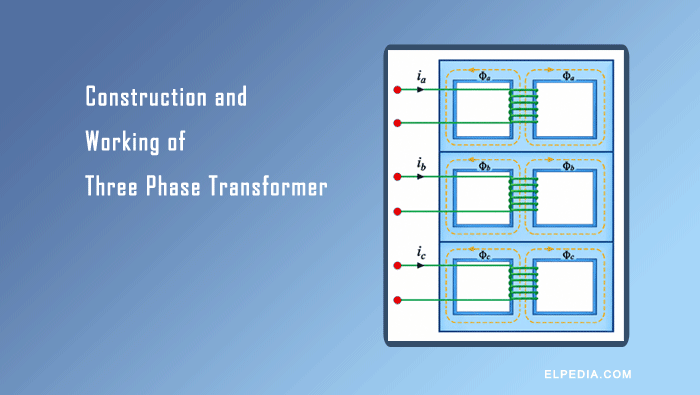
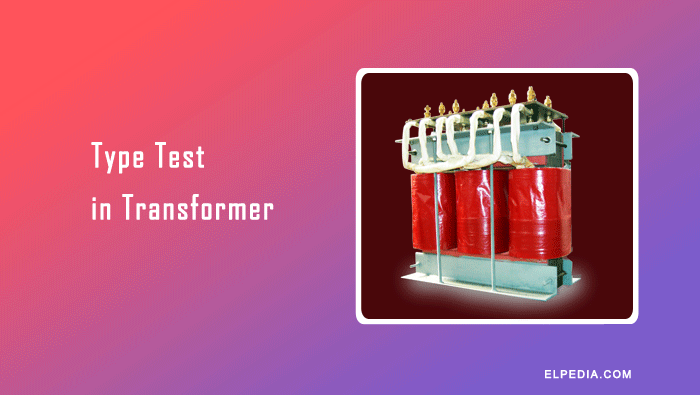
A three phase transformer is a single magnetic unit that transfers power between two three phase systems using electromagnetic induction, replacing three separate single phase transformers.
It is built from a laminated steel magnetic core and copper or aluminium windings, typically housed in an oil-filled tank with cooling arrangements for medium and high power ratings used by utilities and industries worldwide.
A 3 phase transformer is an assembly of several interconnected components working together to convert voltage and current levels across a three phase supply.
The main parts include the transformer core, primary winding, secondary windings, insulation system, steel tank, cooling apparatus, bushings, tap changer, and protective accessories.
This article covers the complete construction, working principle, and applications of the three phase transformer.
Construction of three phase transformer
The construction of a three-phase transformer is similar to that of a single-phase transformer.
However, instead of one primary and one secondary winding, a three-phase transformer has three sets of primary windings and three sets of secondary windings, corresponding to the three phases (R, Y and B).
Each set of primary and secondary windings is wound around a common magnetic core limb. The three primary windings are connected to form a three-phase primary circuit, while the three secondary windings are connected to form a three-phase secondary circuit.
Depending on the application, these windings can be connected in star (Y) or delta (Δ) configuration.
The detailed construction of the transformer core, windings, insulating oil, tank and other accessories has already been explained in the article Construction and Working Principle of Transformer. Therefore, readers can refer to that article for a detailed explanation of these components.
Based on the construction, the three phase transformer are of two types, namely core type and shell type transformer.
Core-Type Transformer
In a core-type three-phase transformer, the magnetic core consists of three limbs (legs) connected by top and bottom yokes. Each limb carries the primary and secondary windings of one phase (R, Y or B).
There are two types of core arrangements. In common leg arrangement, all three phases share a common central limb (leg) of the magnetic core. The magnetic fluxes produced by the three phases combine in this common leg.
In separate leg arrangement, each phase has its own separate limb, with the three limbs connected through the top and bottom yokes to provide a path for the magnetic flux.
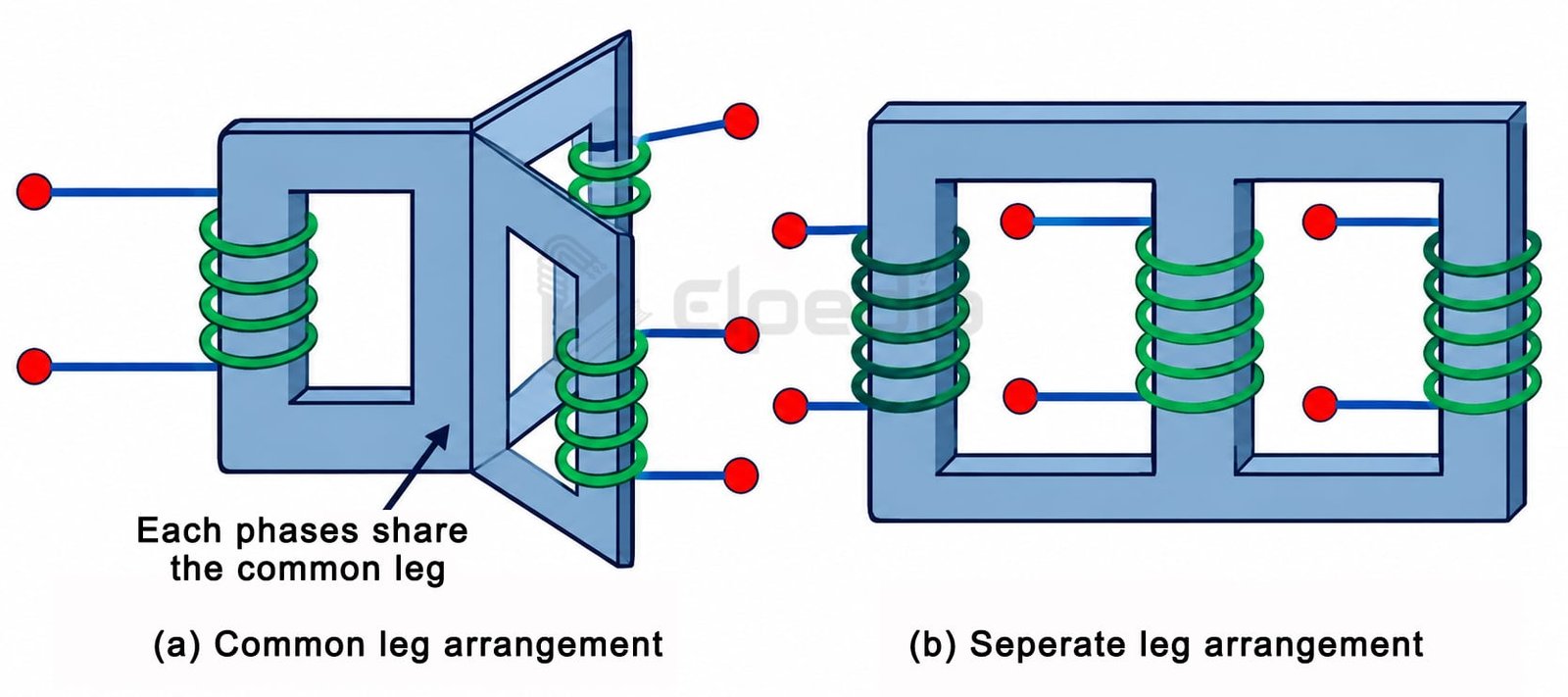
In both arrangements, the primary and secondary windings are placed around the respective core limbs.
Generally, the low-voltage (LV) winding is placed closer to the core, while the high-voltage (HV) winding is placed outside it. This arrangement reduces the insulation requirements between the core and the windings.
Core-type transformers are widely used in power generation, transmission and distribution systems, including high-voltage applications.
Their construction provides easy access to the windings and allows effective cooling because a larger portion of the winding surface is exposed to the cooling medium.
Shell-Type Transformer
In a shell-type transformer, the core surrounds a major portion of the windings.
In a typical three-phase shell-type design, the core has multiple limbs, and the central limbs carry the windings, while the outer limbs provide parallel return paths for the magnetic flux.
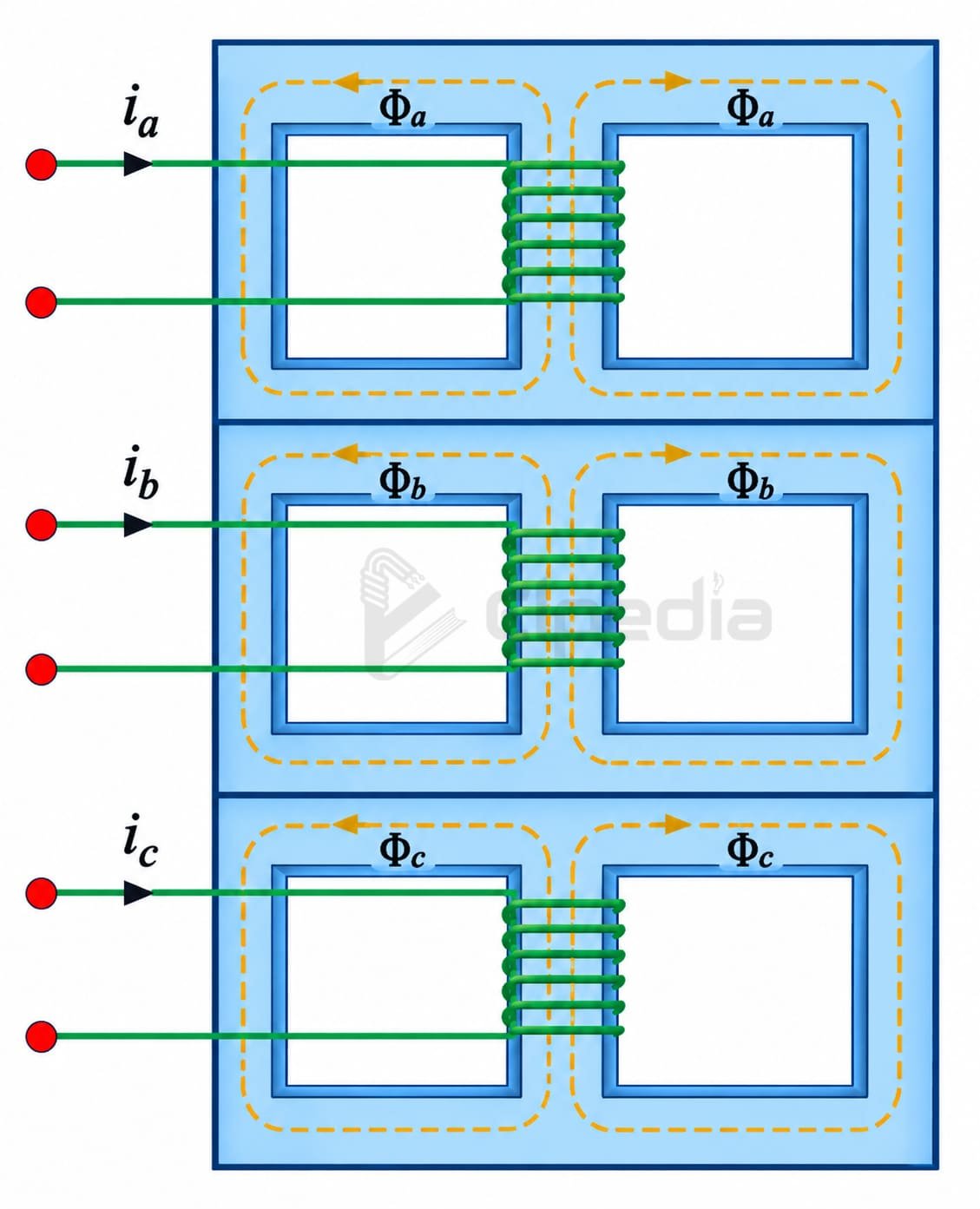
The primary and secondary windings are commonly arranged in interleaved sections, such as sandwich or disc windings, to improve magnetic coupling and reduce leakage flux.
Shell-type transformers offer good mechanical support for the windings and can withstand short-circuit forces effectively.
They are used in applications such as furnace transformers, rectifier transformers, and other industrial systems requiring high current or specialized electrical performance.
Three phase transformer windings
A three-phase transformer consists of two sets of windings: primary windings and secondary windings. Each set has three individual windings, one for each phase (R, Y and B). These windings are wound around the limbs of the magnetic core.
The primary winding is connected to the three-phase AC supply, and it produces alternating magnetic flux in the core.
While the secondary winding receives the magnetic flux from the core and develops an induced emf to supply the load.
Generally, the low-voltage (LV) winding is placed closer to the core, while the high-voltage (HV) winding is placed outside the LV winding. This arrangement reduces the insulation requirement between the core and the windings.
The three primary windings and three secondary windings can be connected in different configurations, such as Star-Star (Y-Y), Delta-Delta (Δ-Δ), Star-Delta (Y-Δ) and Delta-Star (Δ-Y) connections., depending on the application.
The choice of winding connection depends on the required voltage level, neutral availability, phase displacement and operating requirements of the electrical system.
Three-phase transformer windings are generally made of copper or aluminium conductors. The conductors are insulated to withstand the operating voltage and prevent short circuits between turns and windings.
The phase relationship between the primary and secondary voltages depends on the winding connections. Depending on the connection arrangement, the secondary voltage may be in phase with the primary voltage or displaced by 30°, 150° or another specified angle.
Working Principle of Three-Phase Transformer
The working of three phase transformer is similar to that of the single phase transformer. A three-phase transformer works on the principle of mutual electromagnetic induction, based on Faraday’s law of electromagnetic induction.
When a three-phase AC supply, consisting of three sinusoidal voltages of equal magnitude and frequency, displaced from one another by 120 electrical degrees is connected to the primary windings, three alternating currents flow through them.
These currents produce three alternating magnetic fluxes in the core, displaced from each other by 120 electrical degrees. These magnetic fluxes link with the corresponding secondary windings and induce three EMFs in them.
When a three-phase load is connected to the secondary side, current flows through the secondary windings, transferring electrical power from the primary to the secondary circuit through electromagnetic induction without changing the supply frequency.
Applications of Three-Phase Transformer
Three-phase transformers are widely used in electrical power generation, transmission, distribution and industrial applications. They are mainly used to step up or step down three-phase AC voltage levels according to the requirements of the electrical system.
The important applications of three-phase transformers are as follows:
1. Power Generation Stations: Three-phase transformers are used in power plants to step up the generated voltage to higher levels for efficient power transmission.
2. Electrical Power Transmission: They are used in transmission substations to increase or decrease voltage levels for the efficient transfer of electrical power over long distances.
3. Power Distribution Systems: Distribution transformers are used to step down high transmission and sub-transmission voltages to suitable levels for supplying electricity to residential, commercial and industrial consumers.
4. Industrial Applications: Three-phase transformers supply power to industrial equipment such as induction motors, pumps, compressors, welding machines and other heavy electrical machinery.
5. Renewable Energy Systems: They are used in solar and wind power plants to connect renewable energy generation systems to the electrical grid by matching the required voltage levels.
6. Electrical Substations: Three-phase transformers are installed in substations to interconnect power systems operating at different voltage levels.
7. Electric Traction Systems: They are used in railway electrification systems and traction substations to provide the required voltage for electric locomotives and other traction equipment.
8. Commercial Buildings: Three-phase transformers are used in shopping malls, hospitals, educational institutions and large commercial buildings to provide power for lighting, air-conditioning systems, lifts and other electrical loads.
9. Rectifier and Converter Systems: Three-phase transformers are used in industrial rectifier units, battery charging systems and power electronic converters to provide the required AC voltage for conversion into DC.
10. Large Data Centres: They are used in data centres to step down incoming electrical supply voltages to suitable levels for UPS systems, power distribution units and other electrical equipment.