Two point starter – Construction and Working
A two point starter is a starting device used to safely start a DC series motor by limiting the high starting current. Since a DC series motor draws a large current when it starts, connecting it directly to the supply can damage the motor windings and other components. The two point starter introduces external resistance into the motor circuit during starting and gradually removes it as the motor gains speed.
In this article, we will discuss the construction, working principle, operation, and protective features of a two point starter, along with its advantages and disadvantages.
Construction of two point starter
A two point starter is a series motor starter performs the same basic function as the three point and four point starters used with shunt and compound motors. However, its internal arrangement and external connections are different.
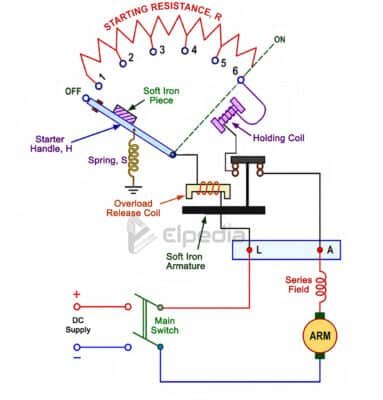
A series motor starter also has a holding coil and overload release. The holding coil protects the motor when the supply is lost and also prevents the motor from running under no-load conditions. The overload release protects the motor from excessive current.
Working
When the DC supply is switched on, the starter arm is moved gradually towards the right. When the arm touches first stud, the series motor is connected to the supply through the complete starting resistance. This resistance limits the starting current.
As the starter arm is moved further towards the ON position, the starting resistance is gradually removed from the circuit. When the arm reaches the ON position, the entire starting resistance is cut out, and the motor operates directly from the supply.
The holding coil keeps the starter arm in the ON position. If the supply fails while the motor is running, the current through the holding coil becomes zero. Similarly, if the motor current becomes too low, the magnetic pull of the holding coil decreases. In either case, the holding coil can no longer keep the starter arm in the ON position. The spring attached to the arm then pulls it back to the OFF position, automatically disconnecting the motor from the supply.
The overload release is connected in series with the motor, so it carries the complete motor current. If the motor current increases beyond the safe value, the overload release coil becomes strongly magnetised.
This magnetic force lifts the soft iron armature and opens the holding coil circuit. The holding coil is then demagnetised, causing the starter arm to return to the OFF position under the action of the spring. Thus, the motor is automatically disconnected from the supply and protected from excessive current.
To switch off a DC series motor, the line switch should be opened instead of moving the starter arm back to the OFF position.
If the starter arm is moved back directly, the field circuit may be interrupted at the first stud. Since the field winding carries the same current as the armature, a large amount of energy is stored in its magnetic field. When the field circuit is suddenly opened, this stored energy produces a heavy spark at the contact. Therefore, the line switch should always be used to switch off the series motor.
There is an important difference between a series motor starter and a shunt motor starter. In a DC series motor, the field current, armature current, and line current are the same. Therefore, the flux changes with the motor current.
The back EMF of the series motor is proportional to the flux produced. Since the flux changes with current, the back EMF also changes when the current changes.
When the motor current increases, the flux and back EMF also increase. The increase in back EMF opposes the supply voltage and naturally limits the increase in current. This gives the series motor a self regulating effect during starting.
Because of this self regulating action, a series motor starter requires fewer resistance steps than a shunt motor starter of the same rating and operating between the same current limits. Consequently, each section of the starting resistance has a higher resistance value.
The exact determination of the number of resistance sections is more complicated for a series motor starter. This is because the flux changes during starting and the relationship between flux and field current is nonlinear.
Although the number of sections is smaller than that of a shunt motor starter, the difference between the resistance values of the individual sections is proportionally smaller.
In practical applications, the resistance values do not need to be very precise. It is often possible to use approximately equal resistance values for all sections. This is mainly because of the self regulating effect of the DC series motor during starting.
Advantages of two point starter
- It limits the starting current by adding external resistance
- It provides protection to the motor from excessive current and abnormal operating conditions.
- The construction is simple compared with more complex starter arrangements.
- The starting resistances are gradually removed, allowing the motor to accelerate smoothly.
- The holding coil and overload release can disconnect the motor from the supply during supply failure or an overload condition.
- It is specifically designed for starting DC series motors, where the field winding and armature are connected in series.
Disadvantages of two point starter
- It is not suitable for shunt motors.
- Some electrical energy is dissipated as heat in the starting resistance during the starting process.
- Its main purpose is to limit starting current rather it does not provide detailed control of motor speed.
- Repeated movement of the starter handle can cause wear and sparking at the starter contacts.
- The starter generally requires the operator to move the handle gradually through the starting positions.
- Moving the starter handle directly to the OFF position while the motor is running can interrupt the series field circuit and cause heavy sparking. Therefore, the line switch should normally be used to switch off the motor.