Electric Charge: Definition, Types, and Everyday Effects
Electric charge shapes nearly every interaction in the physical world, from the spark you feel touching a doorknob to the circuits powering the device you are reading this on.
Yet many learners find the concept abstract until they see how it connects atoms, everyday materials, and entire power grids.
This guide breaks down what electric charge actually is, how it behaves, how it is measured, and why it matters in both physics and practical engineering.
Key Takeaways
Electric charge is a fundamental property of matter that causes particles and objects to experience electric force whenever they sit in an electromagnetic field.
It is the root cause of all electrical phenomena, from lightning bolts to smartphone screens. Here are the essentials before diving deeper:
- Electric charges come in two types, positive charge and negative charge, carried mainly by protons and electrons respectively. Like charges repel each other while opposite charges attract.
- Static electricity is caused by an imbalance of electric charges on objects, while electric current is the continuous flow of charge through a conductor.
- Electrical charge is measured in coulombs (C). One coulomb is the charge transported by a current of one ampere in one second.
- Charge is quantized in integral multiples of 1.6 × 10⁻¹⁹ C, meaning nature only deals in whole-number packets of the elementary charge.
- Understanding electric charge helps explain subatomic particles, everyday shocks from doorknobs, and the operation of circuits and electronic devices.
What Is Electric Charge?
Electric charge is a fundamental property of matter that causes charged particles and objects to experience electric forces and interact through the electromagnetic field.
The terms “electric charge” and “electrical charge” refer to the same physical quantity. Charge is usually represented by the symbol Q or q, and its SI unit is the coulomb (C).
Electric charge is an intrinsic property of certain elementary particles, such as electrons and quarks.
It is not something that is simply added to a particle; rather, it is a fundamental property of the particle itself. Protons have positive charge, while electrons have negative charge.
Electric charge is responsible for several important electrical phenomena:
- Creates an electric field: A charged particle or object produces an electric field around it.
- Produces electric force: Charged objects exert forces on one another, even when they are not in direct physical contact.
- Causes attraction and repulsion: Unlike charges attract each other, while like charges repel each other.
- Follows Coulomb’s Law: The electric force between two charged objects depends on the magnitude of their charges and the distance between them.
A simple example can be observed by rubbing a plastic comb on dry hair. The rubbing transfers some electrons between the hair and the comb, giving the comb a net electric charge.
When the charged comb is brought close to small pieces of paper, the paper pieces are attracted to it and may jump toward the comb. This happens because of the electric force produced by the charged comb.
Thus, electric charge is a fundamental property of matter that is responsible for many everyday electrical phenomena.
Electric Charges in the Atom
Understanding how electric charges are distributed inside atoms is the key to understanding almost every electrical phenomenon in nature and technology.
Every atom contains three types of subatomic particles:
- Protons sit in the nucleus and carry a positive charge of +1.6 × 10⁻¹⁹ coulombs each. Positive charges are associated with protons.
- Neutrons also reside in the nucleus but carry zero charge and they are electrically neutral.
- Electrons orbit the nucleus in an electron cloud and carry a negative charge of −1.6 × 10⁻¹⁹ coulombs each. Negative charges are associated with electrons.
Neutral atoms have an equal number of protons and electrons, making their net electric charge zero.
When an atom loses one or more electrons, it has more protons than electrons and becomes a positively charged ion, called a cation.
When an atom gains electrons, it has more electrons than protons and becomes a negatively charged ion, called an anion.
Consider a sodium (Na) atom. It normally has 11 protons and 11 electrons, so its total charge is zero. If the sodium atom loses one electron, it then has 11 protons and 10 electrons. Therefore, its net charge becomes +1e, and it forms a sodium ion (Na⁺).
Modern scattering experiments and spectroscopy confirm these charge assignments to extraordinarily high precision, reinforcing the picture that the elementary charge value is exact at 1.602 176 634 × 10⁻¹⁹ C under the 2019 SI redefinition.
Positive and Negative Charge
In the 1740s, Benjamin Franklin introduced the terms positive and negative to distinguish the two types of electric charge.
Before Franklin, scientists such as Charles du Fay described electricity using the idea of two different types of electrical “fluids.”
Franklin proposed a simpler way of describing electric charge based on an excess or deficiency of electrical charge.
Here is how the sign convention works in practice:
- A positively charged body has more protons than electrons.
- A negatively charged body has more electrons than protons.
- Two objects with the same sign-both positive or both negative-repel each other. Charges repel when signs match.
- Unlike charges attract: a positive and a negative body pull toward each other.
Think of a balloon rubbed on your hair. The balloon gains electrons from the hair, becoming negatively charged, while the hair becomes positively charged. Press the balloon against a wall and it sticks.
Why? Even though the wall is neutral overall, the balloon’s negative charge pushes electrons in the wall’s surface away and pulls the wall’s positive charges closer, a process called polarization.
Electric charges interact through polarization even in neutral objects, creating enough attraction to hold the balloon in place.
Units of Electric Charge and “One Coulomb”
Precise measurement matters in physics and engineering, and electric charge measured in standardized units is what makes circuit analysis, electronics design, and laboratory work reproducible.
The SI unit of electric charge is the coulomb (C), named after the French physicist Charles-Augustin de Coulomb (1736–1806). Here is what defines it:
- One coulomb is the charge transferred in one second at one ampere of steady current: Q = I × t.
- One coulomb equals approximately 6.24 × 10¹⁸ elementary charges – an enormous number of individual electrons or protons.
- Other units of electric charge include microcoulombs (μC = 10⁻⁶ C), nanocoulombs (nC = 10⁻⁹ C), and picocoulombs (pC = 10⁻¹² C).
- In battery technology, the ampere-hour (Ah) is a practical unit. In electrochemistry, one faraday (approximately 96 485 C) represents the total charge carried by one mole of electrons, serving as an electrochemical unit that links electric charge to chemical reactions.
Quick example: if a 2 A electric current flows through a wire for 10 seconds, the total charge transferred is Q = 2 × 10 = 20 C.
For a deeper glossary of related terms, check out the article on 150+ Basic Electrical Engineering Definitions.
Microscopic View: Subatomic Particles and Elementary Charge
Electric charge is quantised, meaning it appears only in discrete packets equal to the elementary charge e.
You will never measure half an electron’s worth of charge on a free particle.
- The elementary charge is defined exactly as e = 1.602 176 634 × 10⁻¹⁹ C under the modern SI.
- A proton has a charge of +1.6 × 10⁻¹⁹ coulombs, while an electron has a charge of approximately −1.6 × 10⁻¹⁹ coulombs and a neutron carries zero charge.
- The total charge on any object follows Q = n · e, where n is the integer count of excess or deficit elementary charges.
Numerical example: Suppose a plastic rod has 1.0 × 10¹³ extra electrons. Since each electron has a charge of −1.602 × 10⁻¹⁹ C.
Q = −(1.0 × 10¹³)(1.602 × 10⁻¹⁹) = −1.6 × 10⁻⁶ C
Thus, the plastic rod has a net charge of approximately −1.6 μC.
Deeper in the Standard Model, quarks carry fractional charges (±⅓ e, ±⅔ e), but quarks are permanently confined inside protons and neutrons.
Every observable macroscopic charge is therefore an integer multiple of e, and the charge carried by elementary particles always sums to whole units in any hadron.
Forces Between Charges: Electric Force
Electric charge gives rise to the electric force, which is a push or pull between charged particles or objects.
This force can act even when the objects are not in direct physical contact. The interaction is described in terms of the electric field surrounding a charged object.
The qualitative form of Coulomb’s Law states that,
- The electrostatic force between two point charges is directly proportional to the product of their charge magnitudes.
- The force is inversely proportional to the square of the distance between the two objects. Double the distance, and the force drops to one quarter.
- Like charges (both positive or both negative) repel; unlike charges attract.
The Coulomb constant k ≈ 8.99 × 10⁹ N·m²/C² quantifies how strong the electric force is.
Even relatively small amounts of electric charge can produce measurable forces, particularly when the charges are close together. For example, a charged comb can attract small pieces of paper, and a charged comb can even deflect a thin stream of water.
Electric forces are fundamental to the behavior of matter. At the atomic and molecular level, electromagnetic interactions play a major role in chemical bonding and the structure of atoms and molecules. They also underlie the operation of countless electrical and electronic devices.
Static Electricity and Charging Methods
Static electricity refers to electric charges at rest-charges that have built up on insulators or isolated conductors and remain stationary until they discharge, sometimes as a visible spark.
Static electricity happens when charges build up on the surface of an object, typically through one of three methods:
- Friction (triboelectric charging): Rubbing two objects made of different materials transfers electrons from one material to the other. A balloon rubbed on hair gains electrons and becomes negatively charged; the hair loses electrons and becomes positively charged. The triboelectric series ranks materials by their tendency to donate or accept electrons.
- Conduction (contact): A charged object touches a neutral conductor and charge transferred between them distributes across both surfaces. Both objects end up with the same sign of charge.
- Induction: A charged object is brought near a neutral conductor without touching it. The conductor’s internal charges rearrange-opposite charges migrate toward the external object, same-sign charges move away. If you ground the conductor during this rearrangement, net electric charge remains on it after the grounding is removed.
Walking across a carpet on a dry day is a classic friction-charging scenario: your shoes strip electrons from carpet fibers, and the built-up charge discharges with a small shock when you touch a metal doorknob.
Role of Charge in Electric Current and Circuits
Electric current is the rate at which electric charge flows past a point in a conductor: I = Q / t. Where static electricity involves charge at rest, current involves charge flowing steadily through a closed path.
It is important to separate the concepts clearly: current is not a type of charge. It is the motion of charged particles through a material.
In metallic conductors, the charge carried through the circuit is transported primarily by negatively charged electrons drifting through a lattice of positively charged atomic cores.
By historical convention, conventional current is defined as flowing from the positive terminal to the negative terminal – the opposite direction from actual electron flow in metals.
In electrolytes and plasmas, both positively charged and negatively charged ions move simultaneously, so both contribute to current flows.
Consider a simple circuit: a battery, copper wires, and a lamp. The battery’s voltage creates a potential difference that pushes electrons around the loop.
The total charge in the circuit is conserved-no charge is created or lost; it cycles continuously. For more on how current distributes in real circuits, see Elpedia’s guide on the Current Divider Rule.
Crucially, moving electric charges create magnetic fields. This connection between electric and magnetic fields is why magnetism is a force produced by the motion of electric charges, and why changing magnetic fields can induce electric currents-a principle that powers generators and transformers.
For a hands-on example of this interplay, explore the Working Principle of DC Motor.
Fundamental Properties of Electric Charge
Several fundamental principles govern how electric charge behaves across all physical systems, from subatomic particles to industrial power grids.
- Scalar nature: Electric charge is a scalar quantity. It has magnitude and sign (positive or negative) but no spatial direction. The algebraic sum of charges gives the total: for instance, +3 μC and −2 μC together yield +1 μC.
- Additivity: Electric charge additivity means total charge equals the sum of individual charges in a system: Q_total = q₁ + q₂ + … + qₙ. The electric charge contained in any region is simply the sum of every charge present.
- Conservation: Total charge in a closed system is conserved. The total electric charge of an isolated system remains constant over time. Charges are neither created nor destroyed in an isolated system-they can only move between objects. Electric charge is conserved in isolated systems, whether the process is a chemical reaction, a nuclear decay, or a particle collision. The charge-current continuity equation expresses charge conservation mathematically, linking the rate of charge change inside a volume to the current flowing through its boundary.
- Quantisation: Every observable charge is an integer multiple of the elementary charge e. No smaller free-charge unit has been detected.
- Relativistic invariance: The charge of a particle does not change with speed. Fast-moving nuclei in accelerators carry the same magnitude of charge as stationary ones.
Finally, electromagnetism unifies electricity and magnetism into a single force, a framework established by Maxwell in the 19th century and fundamental to all modern physics.
Conductors, Insulators, and Everyday Static Electricity
Materials differ in how tightly their electrons are bound, and this determines whether electric charges move freely or stay put.
Material Type | Electron Behavior | Examples | Static Charge Effect |
|---|---|---|---|
Conductor | Electrons move freely | Metals, salt water | Charge spreads quickly, dissipates easily |
Insulator | Electrons tightly bound | Rubber, glass, dry air | Charge accumulates, persists on surface |
Everyday static electricity effects you have probably noticed:
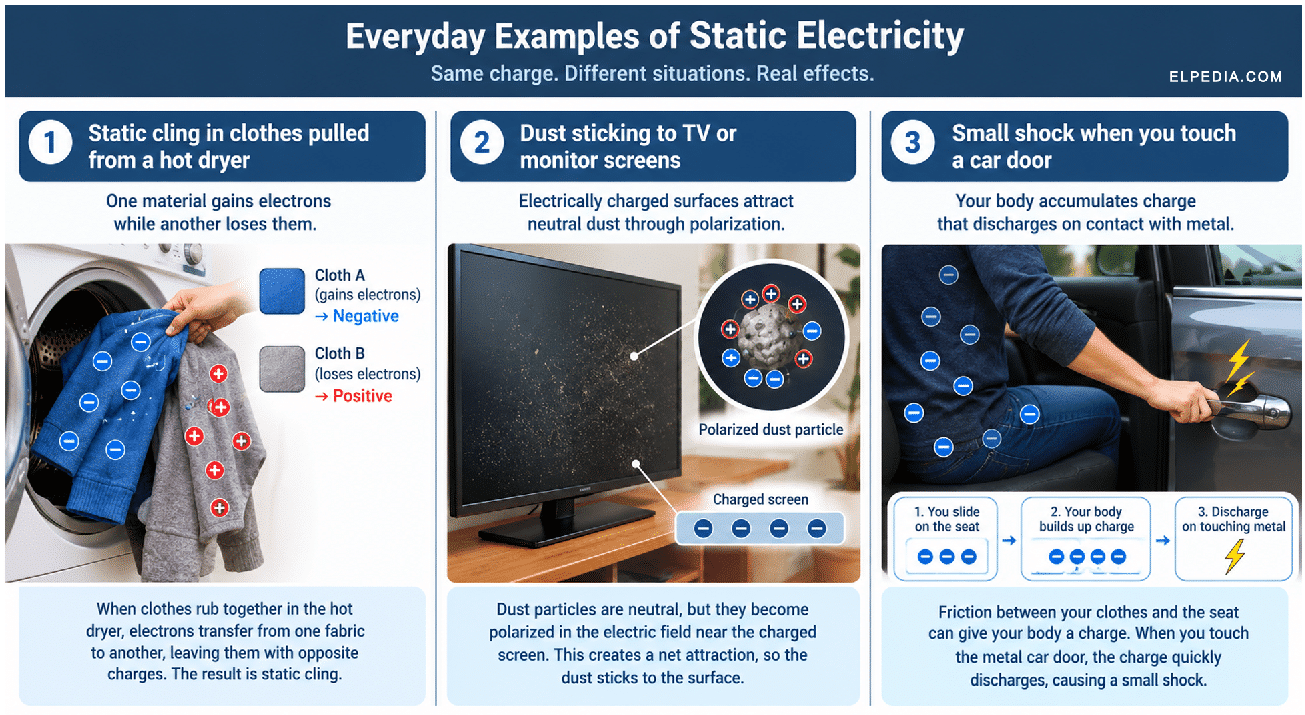
- Static cling in clothes pulled from a hot dryer-one material gains electrons while another loses them.
- Dust sticking stubbornly to plastic TV or monitor screens-electrically charged surfaces attract neutral dust through polarization.
- A small shock when you touch a car door after sliding across the seat-your body accumulates charge that discharges on contact with metal.
Grounding-connecting an object electrically to Earth-allows excess electric charge to flow away into Earth’s vast reservoir, reducing static buildup and shock risk.
Humidity also plays a role: moist air provides tiny conductive paths that let charges leak away, which is why static shocks are more common in dry winter months.
Mathematical Relations and How Electric Charge Is Measured
Precise equations let scientists and engineers calculate electric charge using measurable quantities like current and time.
The two core formulas are:
- Q = I · t – total charge equals electric current multiplied by time. This is how electric charge measured in lab circuits is typically determined.
- Q = n · e – total charge equals the count of excess or missing electrons (n) times the elementary charge. This connects macroscopic measurements to microscopic subatomic particles.
Standard instruments for measuring charge include:
- An ammeter (measures current) paired with a stopwatch to compute Q = I · t.
- An electrometer, a high-sensitivity device that compares an unknown charge against a known reference, capable of detecting picocoulombs.
The dimensional formula of electric charge in SI base units is [T¹ I¹], relating it to time (second) and electric current (ampere)-useful context for readers studying dimensional analysis.
Worked example: A small electronic device draws 0.5 A steadily for 60 seconds. The charge transferred is Q = I × t = 0.5 × 60 = 30 C.
That is roughly 1.87 × 10²⁰ individual electrons passing through the circuit. For related calculations involving resistors in these circuits, Elpedia covers series and parallel configurations in detail.
Historical and Scientific Context
Our modern understanding of electric charge developed gradually over roughly three centuries.
These milestones explain why we still use terms like “coulomb,” “positive charge,” and “field lines” today-they reflect a lineage of increasingly precise experimentation.