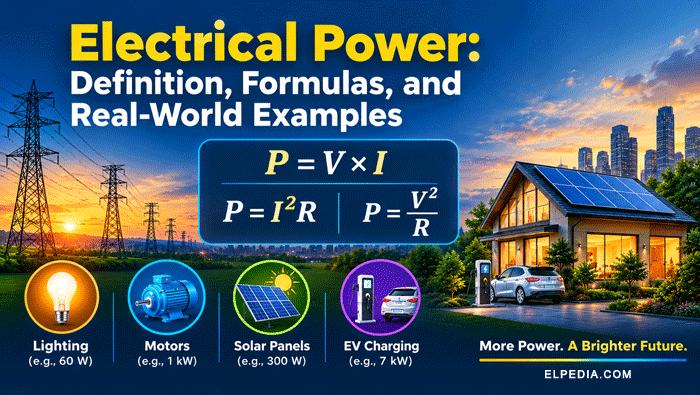
Electrical Power: Definition, Formulas, and Real-World Examples
Electric power is the rate at which electrical energy is converted into other forms of energy; heat, light, or motion. Electrical power shapes daily routines, from charging a phone to running an industrial assembly line.
This article walks through the physical definition, core formulas, and practical examples of electrical power so you can apply these concepts in circuits, energy calculations, and real engineering problems.
Key Takeaways
- Electric power is the rate of converting electrical energy into other forms (heat, light, motion), defined by P = dW/dt and calculated in circuits as P = V × I. The SI unit is the watt (W), where one watt equals one joule per second.
- Combining the power formula with Ohm’s law produces P = I²R and P = V²/R, which are essential for analysing resistive circuits, sizing wire, and selecting safe electrical equipment.
- Electrical energy (measured in joules or kilowatt-hours) and electric power (watts) are distinct: power is the instantaneous rate, energy is the accumulated total. Your electricity bill charges for energy consumption in kWh, not instantaneous power.
- Electrical power can be produced from fossil fuels (coal, natural gas, oil) and from renewable energy sources (solar, wind, hydro). Power generation methods include wind, solar, fossil fuels, and nuclear energy.
- Elpedia covers these concepts to bridge fundamental physics with practical electrical engineering and energy knowledge for students and working professionals.
Introduction: Why Electrical Power Matters
Electrical power can be transformed into light, heat, or motion, making it the backbone of modern infrastructure.
For example,
- A 1000 W electric iron converts electrical energy to heat for pressing clothes.
- A 5 W LED light bulb produces visible light at a fraction of the energy an incandescent lamp requires.
- A 3 kW domestic electric shower heats water on demand.
Everyday applications of electrical power include lighting, heating, and powering devices across homes, offices, and factories.
Electricity is an energy carrier produced by converting other energy sources. Electric power is essential for telecommunications and broadcasting, for data centres that process billions of requests per day, and for electric vehicles replacing internal combustion engines.
Electric power consumption correlates with a country’s industrial development; nations with higher per-capita electricity use tend to have larger manufacturing and service sectors.
Physical Definition of Electrical Power
Electric power (P) is defined as the rate of doing work or transferring electrical energy, expressed as,
![\[P = \frac{dW}{dt} \]](https://elpedia.com/wp-content/ql-cache/quicklatex.com-72e2dd2b1c8894d4704b541a768df1e9_l3.png "Rendered by QuickLaTeX.com")
Here W is work or electrical energy in joules (J) and t is time in seconds (s).
Electrical energy is produced by moving electrons through a conductor, and the rate at which that energy is transferred or converted is what we call power. Electrical power is measured in watts (W), and 1 watt equals 1 joule per second (J/s).
In a circuit, instantaneous power at any moment is the product of instantaneous voltage and current.
![\[P(t) = v(t) \, .\, i(t) \]](https://elpedia.com/wp-content/ql-cache/quicklatex.com-7fcc50bc1bc09e814e9e6ff5b8f2e32a_l3.png "Rendered by QuickLaTeX.com")
This expression works for both DC power (constant values) and alternating current (time-varying values). In a DC circuit, voltage and current may remain constant, whereas in an AC circuit, they vary with time.
Electrical power can range from very small values to extremely large values depending on the application: milliwatts in temperature sensors, watts in consumer electronics, kilowatts in household appliances like a 2 kW kettle, and megawatts in power stations.
For example, if a lamp converts 60 joules of electrical energy into other forms of energy every second, its power consumption is:
![\[P = \frac{60}{1} = 60\text{ W} \]](https://elpedia.com/wp-content/ql-cache/quicklatex.com-e02069145187336484d67491c0491601_l3.png "Rendered by QuickLaTeX.com")
The concept of power is not limited to electrical systems. In mechanical systems, power is expressed as:
![\[P=\text{Force x Velocity}\]](https://elpedia.com/wp-content/ql-cache/quicklatex.com-bc661a88e4228e02625ab9b1e4eb1ae8_l3.png "Rendered by QuickLaTeX.com")
Similarly, in an electrical system:
![\[P=\text{Voltage x Current} \]](https://elpedia.com/wp-content/ql-cache/quicklatex.com-a4c0047bb3fd9bcbc89133f69129df4d_l3.png "Rendered by QuickLaTeX.com")
Thus, in both cases, power represents the rate of energy transfer or work done. The physical quantities involved are different, but the fundamental concept of power remains the same.
Relationship Between Electrical Energy and Electric Power
Electrical energy is the capacity to do electrical work, whereas electrical power is the rate at which electrical energy is transferred, converted, or consumed. The core relationship linking them is:
![\[E = P \times t \]](https://elpedia.com/wp-content/ql-cache/quicklatex.com-3867da620f0775d9b620351dab2e733e_l3.png "Rendered by QuickLaTeX.com")
where E is electrical energy, P is power, and t is time. Rearranging gives
![\[P = \frac{E}{ t}\]](https://elpedia.com/wp-content/ql-cache/quicklatex.com-2bbfccca6f4b68c5fea03cdd83b7a089_l3.png "Rendered by QuickLaTeX.com")
This shows that electrical power is the amount of electrical energy transferred or consumed per unit time.
Electrical energy is commonly measured in joules (J). For larger quantities, especially in domestic and commercial electricity consumption, it is usually measured in kilowatt-hours (kWh).
For example, 1 kWh = 3.6 MJ. This is because 1 kWh = 1000 w × 3600 s = 3,600,000 J = 3.6 MJ.
The kilowatt-hour is commonly used for electricity billing because household energy consumption would result in very large numbers if expressed in joules.
A concrete example: a 2 kW electric heater running for 3 hours uses E = 2 kW × 3 h = 6 kWh. At a rate of USD 0.18/kWh, that session costs USD 1.08 and appears as part of the monthly energy consumption on your electricity bill.
Electrical energy can be stored in batteries and capacitors. Batteries hold energy as chemical potential; capacitors store it in electric fields; inductors store it in magnetic fields.
Power, by contrast, describes how fast that stored energy is delivered or absorbed at any given instant.
The Electric Circuit Perspective: Voltage, Current, and Power
An electric circuit is a closed conducting path through which electric current can flow. A basic electrical circuit generally consists of a source, such as a battery or generator, a load, such as a lamp, motor, or heater, and connecting conductors.
Voltage is the electrical potential difference between two points in a circuit. It represents the work done or energy transferred per unit charge.
Voltage is defined as V = W/Q, so 1 volt means one joule of work required to move one coulomb of electric charge between two points.
Current is the flow of electric charge measured in amperes. One ampere equals one coulomb of charge per second (I = Q/t). Conventional current flow runs from the positive terminal to the negative terminal of a source.
Combining the above definitions yields the basic power formula in circuits:
![\[\boxed{P = \frac{W}{t} }\]](https://elpedia.com/wp-content/ql-cache/quicklatex.com-0764cefec8dbe73ba3936d4670d1bd68_l3.png "Rendered by QuickLaTeX.com")
Power can also be calculated as
![\[\boxed{P = V \times I}\]](https://elpedia.com/wp-content/ql-cache/quicklatex.com-bbac6cc52265e4158edd571eea245c7c_l3.png "Rendered by QuickLaTeX.com")
Therefore, electrical power is equal to the product of voltage and current and is measured in watts (W).
Consider a simple DC circuit in which a 12 V battery supplies a current of 2 A to a load. The electrical power delivered to the load is,
![\[P=V \times I = 12 \times 2 = 24 { W} \]](https://elpedia.com/wp-content/ql-cache/quicklatex.com-84630c9c59fbf72fbaf9cd9c236f6d32_l3.png "Rendered by QuickLaTeX.com")
A battery converts its stored chemical energy into electrical energy, which is then transferred through the circuit and converted into other forms of energy by the load, such as light, mechanical energy, or heat.
Electric Power Formula and Ohm’s Law
Ohm’s law states that the voltage across a resistive element is proportional to the current flowing through it: V = I × R, where R is resistance in ohms (Ω).
This relationship holds well for most metallic conductors at constant temperature. Combining the power equation (P = V × I) with ohm’s law equation (V = I × R), produces the first alternative power formula,
![\[\boxed{P = I^2R}\]](https://elpedia.com/wp-content/ql-cache/quicklatex.com-98f2af9fafabbeafe090c77f7787ae86_l3.png "Rendered by QuickLaTeX.com")
It also shows that the power dissipated by a resistor is proportional to the square of the current. For a constant resistance, if the current is doubled, the power increases by a factor of four.
Substituting the current formula derived from ohm’s law (I = V/R) into the power equation (P = V × I) gives the second alternative.
![\[\boxed{P=\frac{V^2}{R} }\]](https://elpedia.com/wp-content/ql-cache/quicklatex.com-c88e07ba9c1cf950741489e71f31284f_l3.png "Rendered by QuickLaTeX.com")
This form is useful when voltage and resistance are known but current is not.
Worked example: Consider a 9 V battery connected across a 10 Ω resistor.
Using Ohm’s law,
![\[I = \frac{V}{R} = \frac{9}{10} = 0.9 A \]](https://elpedia.com/wp-content/ql-cache/quicklatex.com-88413ce4f6bc33cb618f89cc6d22b149_l3.png "Rendered by QuickLaTeX.com")
Then, power can be calculated as,
![\[P = V \times I = 9 \times 0.9 = 8.1 W \]](https://elpedia.com/wp-content/ql-cache/quicklatex.com-a01e962494f7d5e0edc24b60ed15800b_l3.png "Rendered by QuickLaTeX.com")
The same result can be verified using:
![\[P = \frac{V^2}{R} = \frac{81}{10} = 8.1 W \]](https://elpedia.com/wp-content/ql-cache/quicklatex.com-08d63d277302a6830f46fdd10e28ce55_l3.png "Rendered by QuickLaTeX.com")
In a purely resistive load, such as an electric heater, incandescent lamp, or electric kettle, electrical energy is predominantly converted into thermal energy (heat) according to Joule’s law.
These power equations are therefore important in electrical engineering for calculating power dissipation, selecting appropriate component ratings, estimating heat generation, and analyzing the thermal performance of electrical circuits.
Passive Sign Convention and Direction of Power Flow
The passive sign convention is a standard convention used in electrical circuit analysis to determine whether a component is absorbing or delivering electrical power.
According to this convention, a reference polarity is assigned across the two terminals of a component. When the current enters the terminal marked positive (+), the calculated power is positive.
A positive power value means that the component is absorbing electrical power. The absorbed electrical energy may be converted into other forms of energy.
For example, a resistor absorbs power and releases heat, a motor winding absorbs electric energy and produces mechanical energy on its shaft and an electric heater absorbs electrical power and converts it into thermal energy.
When current leaves the positive terminal, the calculated power is negative. This indicates the component is delivering power to the rest of the circuit. A battery or generator operates this way.
For example, Consider a 12 V battery supplying a current of 2 A to a load.
Since the current leaves the positive terminal of the battery, its power is P = -24 W. The negative sign indicates that the battery is delivering 24 W of power to the circuit.
The connected load absorbs this power, P = +24 W.
This confirms the conservation of energy: the power delivered by the source is equal to the power absorbed by the load.
This convention provides a consistent method for analyzing power flow in electrical circuits. It is particularly useful in source transformation, network analysis, and checking the power balance of complex electrical systems.
Electric Power in DC and AC Circuits
Electrical power can be supplied as either direct current (DC) or alternating current (AC). Although both types transfer electrical energy, they differ in the direction and variation of current.
Direct current (DC) is electric current that flows continuously in one direction. DC is commonly used in electronic circuits, battery-powered devices, and the output of solar photovoltaic (PV) panels.
In a purely resistive DC circuit, power is calculated as, P = V × I = I²R = V²/R. Electrical energy is transferred continuously from the source to the load.
Alternating current (AC) periodically changes both its magnitude and direction. AC is widely used in electrical power generation, transmission, distribution, and domestic power systems.
The frequency of mains electricity is commonly 50 Hz or 60 Hz, depending on the country or region.
During the late 19th century, Nikola Tesla and George Westinghouse promoted the use of AC systems, while Thomas Edison supported DC systems.
AC became dominant for large-scale power distribution largely because transformers can efficiently increase or decrease AC voltage.
High transmission voltages allow the same amount of power to be transmitted with lower current, thereby reducing (I²R) losses in transmission lines.
In an AC circuit, instantaneous power at any particular moment is still given by,
p(t) = v(t) · i(t)
However, because voltage and current vary with time, the instantaneous power also varies. For energy consumption and power-system analysis, the average power over a complete cycle, known as real power, is particularly important.
For a purely resistive AC load, voltage and current are in phase, and real power equals
![\[P=V_{\text{rms}}I_{\text{rms}} \]](https://elpedia.com/wp-content/ql-cache/quicklatex.com-b15578e2c978f92c836c5e6ca44c1418_l3.png "Rendered by QuickLaTeX.com")
For a sinusoidal waveform, the RMS value can be calculated from its peak value as:
![\[V_{\text{rms}}=\frac{V_{\text{peak}}}{\sqrt{2}}\]](https://elpedia.com/wp-content/ql-cache/quicklatex.com-1d095856703d3f66d2d128d6adb13e2c_l3.png "Rendered by QuickLaTeX.com")
When inductors or capacitors are present in an AC circuit, voltage and current may not be in phase, producing reactive power (measured in vars) and apparent power (measured in VA). Real power, reactive power, and apparent power form the power triangle.
For practical electricity consumption, real power, measured in watts, is the quantity associated with net energy consumption.
Reactive power does not result in net energy consumption over a complete AC cycle, although it affects current flow, equipment loading, and the capacity required in an electrical power system. Learn more about the electrical power in ac circuits.
Power in Resistive Circuits and Heating Effects
A resistive circuit is a circuit in which resistance is the primary opposition to current flow, and electrical energy is mainly converted into heat. Common examples include electric heaters, toaster elements, and incandescent filament lamps.
The power dissipated by a resistor can be calculated using,
![\[P=I^2R \]](https://elpedia.com/wp-content/ql-cache/quicklatex.com-fc122f4f827939da143253570449f301_l3.png "Rendered by QuickLaTeX.com")
This equation shows that the power dissipated is proportional to the square of the current. Therefore, if the current through a resistor is doubled, the power dissipation increases by a factor of four.
A 5 Ω resistor carrying 3 A dissipates P = 9 × 5 = 45 W. Using a resistor rated at 0.25 W in that position would cause overheating and failure within seconds.
Every resistor has a specified power rating, which indicates the maximum amount of power it can safely dissipate under specified conditions. Common power ratings include: 0.25 W, 0.5 W, 1 W, 5 W, and higher for wire-wound types.
When selecting a resistor, its power rating should be higher than the expected power dissipation. Designers normally provide an appropriate safety margin rather than operating a resistor continuously at its maximum rated power.
The same principle applies to electrical wiring and household appliances. Every cable, socket, extension cord, fuse, and circuit breaker has a specified current-carrying capacity.
For example, an extension cord rated for 13 A at 230 V can handle about 3 kW, plugging in a 2.5 kW kettle and a 1 kW iron simultaneously pushes the cord to 3.5 kW, exceeding its rating. The excess current causes power lost as heat in the cord’s wire, raising its temperature toward ignition point.
Fuses and circuit breakers provide protection by interrupting the circuit when the current exceeds a safe level for a sufficient period. They help prevent excessive heating of wiring and electrical equipment.
Electrical Machines and Conversion of Electrical Energy
Electrical machines are devices that convert energy from one form to another. Depending on their function, they can convert:
- Electrical energy into mechanical energy — as in motors
- Mechanical energy into electrical energy — as in generators
- Electrical energy from one voltage level to another — as in transformers
Electromagnetic induction is also the fundamental principle used for generating most of the electrical power in large-scale power plants.
An electric motor converts electrical power into mechanical power. Small induction motors used in household appliances, such as washing machines, may typically operate in the range of a few hundred watts, depending on the appliance and operating condition.
Industrial motors used to drive compressors, pumps, fans, and conveyors can have ratings ranging from several kilowatts to several megawatts.
Not all the electrical power supplied to a motor is converted into useful mechanical output. Some of it is lost as heat and through mechanical effects. In DC machines, common losses include winding resistance losses, core losses, friction, and windage losses. These losses are discussed in detail in Losses in DC Machine.
A generator converts mechanical power into electrical power. The mechanical input is usually provided by a prime mover, such as a steam turbine, gas turbine, hydro turbine, or wind turbine.
The power flow in a DC machine illustrates how mechanical power supplied through the shaft is converted into electrical power, with various losses occurring within the machine.
Large generators used in power stations can have ratings of hundreds of megawatts and they feed the grid at high voltage for transmission.
A transformer is a static electrical machine that transfers electrical energy between circuits and changes the AC voltage level. It can either increase the voltage using a step-up transformer or decrease it using a step-down transformer.
Increasing the transmission voltage allows the same power to be transmitted at a lower current.
Transformers are purely electrical machines that change AC voltage levels. By stepping voltage up for transmission, transformers reduce current. Since power loss in conductors is given by I²R, halving the current cuts losses by a factor of four.
This is why electrical power is transmitted over long distances at high voltage and relatively low current. Transformers make it possible to step the voltage up for efficient transmission and step it down again to suitable levels for distribution and end users.
Sources of Electric Power: Fossil Fuels and Renewable Energy
Electrical power supplied to homes, industries, commercial buildings, and other consumers is generated by power plants and delivered through the electrical grid.
Electricity can be generated from a variety of energy sources, including fossil fuels, nuclear energy, hydropower, solar energy, wind energy, and other renewable sources.
Fossil fuels such as coal and natural gas have historically played a major role in global electricity generation.
In a conventional thermal power plant, the fuel is burned to produce heat. This heat is used to produce steam, which drives a turbine connected to an electrical generator.
Coal- and gas-fired power plants remain important sources of electricity, although their share of global generation has been changing as renewable and nuclear generation increase.
Renewable electricity generation has expanded significantly in recent years. According to the IEA’s Global Energy Review 2026, renewable sources accounted for about 34% of global electricity generation in 2025, while coal accounted for about 34%.
When nuclear power is included, low-emission sources—renewables plus nuclear—accounted for 43% of global electricity generation in 2025.
The IEA also reports that global renewable capacity additions reached a record 800 GW in 2025, with solar PV accounting for about three-quarters of these additions.
Solar PV generation increased by approximately 600 TWh during the year, making it the largest contributor to the growth in global electricity generation.
These developments represent a significant change from earlier decades, when fossil fuels accounted for a much larger share of global electricity generation.
The increasing use of renewable energy has also encouraged the development of hybrid renewable energy systems.
These systems combine two or more energy sources, which can improve the reliability and availability of electricity, particularly when individual renewable sources are intermittent.
For example, solar power is available primarily during daylight hours, while wind generation can vary throughout the day.
Hybrid renewable energy systems are particularly useful for remote communities, isolated loads, and areas with limited or weak grid connections.
Battery energy storage can further improve system flexibility by storing surplus electricity and supplying it when renewable generation is insufficient.
The global electricity sector is increasingly characterized by the expansion of solar PV, wind power, battery storage, and other low-emission technologies.
At the same time, conventional generation sources continue to provide a substantial portion of electricity in many regions.
According to the IEA, low-emission sources are expected to continue expanding, with their combined share of global electricity generation projected to reach 50% by 2030 under its current outlook.
The future electrical power system is therefore expected to involve a combination of centralized power plants, distributed renewable generation, energy storage, smart grids, and increasingly flexible electricity networks.
Electric Power, Energy Consumption, and Practical Examples
Every electrical device has a power rating, which indicates the rate at which it consumes electrical energy. Different devices have widely different power requirements.
Typical power ratings include:
- LED light bulb: 5 to 15 W
- Laptop: 45 to 90 W
- Microwave oven: 800 to 1,200 W
- Domestic EV charger: 3.6 to 7.4 kW
- Public DC fast charger: 50 kW and above
Worked Example: Energy Consumption of a Ceiling Fan
Consider a 100 W ceiling fan that operates for 8 hours per day.
The electrical energy consumed is:
![\[E = 100 \times 8 = 0.8\text{ kWh} \]](https://elpedia.com/wp-content/ql-cache/quicklatex.com-80ef45cf349f8e36958ab32eab954733_l3.png "Rendered by QuickLaTeX.com")
For 30 days, the total energy consumed is,
![\[E = 0.8 \times 30 = 24\text{ kWh} \]](https://elpedia.com/wp-content/ql-cache/quicklatex.com-888be11c0ace4583af3ba8254c83d10f_l3.png "Rendered by QuickLaTeX.com")
If electricity costs USD 0.18 per kWh, the monthly cost of operating the fan is:
![\[\text{Cost} = 24 \times 0.18 = \text{USD }4.32 \]](https://elpedia.com/wp-content/ql-cache/quicklatex.com-24b9216ca0e1c48128c960361430e920_l3.png "Rendered by QuickLaTeX.com")
Thus, the fan adds approximately USD 4.32 to the monthly electricity bill.
Worked Example: Energy Savings with LED Lighting
Suppose a 60 W incandescent bulb is replaced with a 9 W LED bulb that provides the same light output of approximately 800 lumens.
The reduction in power consumption is:
![\[P_{\text{saved}} = \frac{60-9}{60}\times100 = 85\% \]](https://elpedia.com/wp-content/ql-cache/quicklatex.com-cc0bbfb09d46668f94101c3196fdeac4_l3.png "Rendered by QuickLaTeX.com")
It means the LED bulb uses 85% less electrical power while providing similar useful light output.
If 10 such bulbs operate for 5 hours per day, the monthly energy saving is:
![\[E_{\text{saved}} = (60-9)\times10\times5\times30 \]](https://elpedia.com/wp-content/ql-cache/quicklatex.com-81cce4f5c45e2e651d4fbe117369f531_l3.png "Rendered by QuickLaTeX.com")
![\[E_{\text{saved}} = 76,500\text{ Wh} = 76.5\text{ kWh} \]](https://elpedia.com/wp-content/ql-cache/quicklatex.com-4e4df5e259e907c3e517c574b304ba26_l3.png "Rendered by QuickLaTeX.com")
At an electricity rate of USD 0.18/kWh, the monthly saving is:
![\[\text{Saving} = 76.5\times0.18 = \text{USD }13.77 \]](https://elpedia.com/wp-content/ql-cache/quicklatex.com-1083ed255ebf2815e87957cc7ce22839_l3.png "Rendered by QuickLaTeX.com")
Thus, replacing ten 60 W incandescent bulbs with 9 W LED bulbs can save approximately 76.5 kWh of electricity and USD 13.77 per month, assuming the bulbs operate for 5 hours per day.
Understanding the power formula helps users and engineers design circuits, choose appropriate electrical equipment, and manage energy consumption.
Whether you are selecting a generator for a construction site or estimating solar panel output for a rooftop, the relationship P = V × I and its Ohm’s law variants are the starting point.
Safety Considerations with Electric Power
Higher electrical power generally means higher current, higher voltage, or both. If electrical components are not properly rated, excessive power can lead to electric shock, overheating, insulation damage, and fire.
Never handle electrical equipment with wet hands. Water containing dissolved salts can significantly reduce the resistance of the human body.
For example, skin resistance may decrease from around 100 kΩ when dry to as low as 1 kΩ when wet, which can increase the current by up to 100 times.
Circuit breakers and fuses are selected according to the maximum safe current of the circuit, considering the wire size, insulation, connected equipment, and installation conditions.
A 15 A breaker on a 120 V circuit protects up to about 1,800 W of continuous load. Plugging in appliances that exceed this rating trips the breaker, preventing dangerous heat buildup in the wire.
Practical tips:
- Check the power rating on extension cords before daisy-chaining appliances.
- Ensure adequate ventilation around high-power devices such as space heaters and server racks.
- Engineers use both power formulas and thermal calculations to confirm that all components in an electric circuit operate within specified temperature and power ratings.